Get Full Government Meeting Transcripts, Videos, & Alerts Forever!
Get email alerts on the Zoning Procedure topic
No spam. Unsubscribe anytime.
Lancaster County attorney reviews ex parte rules, executive sessions and appeal timelines for BZA
Summary
County Attorney Jenny Merritt DuPont told the Lancaster County Board of Zoning Appeals the board must avoid ex parte contacts, hold deliberations in public, and follow statutory timelines for appeals and mediation; she also explained when executive session is permitted and urged strong recordkeeping.
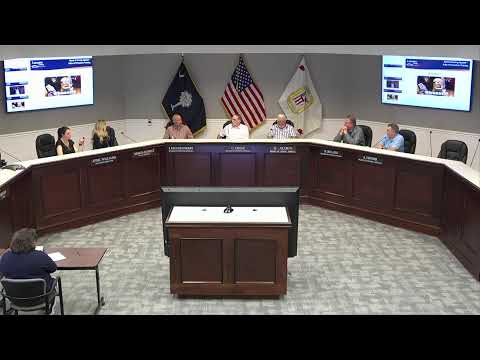
Jenny Merritt DuPont, Lancaster County attorney, told the Lancaster County Board of Zoning Appeals on a regularly scheduled meeting that board members must avoid private communications about pending cases, keep deliberations public, and follow state law when appeals or pre‑litigation mediation arise.
DuPont told the five‑member board that because the BZA is a quasi‑judicial body the county attorney ‘‘cannot simultaneously represent the fact finder’’ on a particular case and provide substantive advice that would favor one party. She said the county attorney can advise the board on procedure but not on how to apply law or criteria to a case before the board.
That distinction is central to how members may interact with staff and applicants. DuPont said board members ‘‘shall not discuss any case pending before the board with parties of record or other interested persons except as part of a public hearing concerning that case,’’ citing an opinion from the state attorney general. When asked whether a member may call staff for additional information about a specific hearing, she responded plainly: "You cannot do that. No, sir." She and staff clarified that members may discuss rules and general procedures with staff outside a hearing but may not seek or receive case‑specific information outside the public forum.
DuPont also reviewed when the board may use executive session under South Carolina law. She said the Freedom of Information Act permits a closed session to receive legal advice about a pending or threatened claim, but that no final action, vote, polling of members or substantive deliberation about how to apply law to a pending case may take place in executive session. "Legal advice can be provided to the board regarding a specific legal issue or concept related to the matter before the board, but cannot be provided as to how that legal issue ... should be applied to the matter before the board," she said.
On appeals and mediation, DuPont summarized statutory timelines and steps. She said an aggrieved person must file an appeal to circuit court within 30 days after the board’s written decision is mailed. If a property owner requests pre‑litigation mediation, the court grants the request and any written mediation agreement must be filed within five working days; a mediation settlement must be approved by the local governing body in public session and by the circuit court before it takes effect. DuPont stressed the importance of thorough minutes and posted orders, because a judge reviews the certified record of board proceedings and generally will not receive new evidence.
She also described membership, meeting and procedural provisions that currently govern the BZA: the South Carolina Comprehensive Planning Act (which sets a 3–9 membership range and other organizational requirements), the Lancaster County Unified Development Ordinance and the Lancaster County Code of Ordinances (which set the county’s five‑member size, four‑year terms, residency and other rules), and the board’s existing rules of procedure (adopted in 2017 and now under amendment). DuPont noted Lancaster County’s recently adopted General Provisions Ordinance (fall 2024) that fills gaps where other rules are silent.
DuPont said she and staff have prepared condensed materials on parliamentary procedure and Robert’s Rules to help members run meetings more efficiently and that staff will distribute those cheat sheets. She also said the county requested budget funds this year to retain separate legal counsel specifically for the BZA so the board will have access to an attorney who is not also providing legal advice to planning staff.
Board members asked several clarifying questions about ex‑parte contacts, intervention in appeals and remote participation. Staff and DuPont said the BZA’s current rules name Robert’s Rules to fill procedural gaps and do not adopt Lancaster County Council’s electronic participation rules, so the BZA need not apply council’s electronic‑voting provisions unless the board amends its rules to do so.
Votes at a glance: The board approved the meeting agenda (vote announced as 4–0) and approved minutes from the March 4, 2025 meeting (vote announced as 3–0 with 1 abstention due to absence).
The BZA staff announced one contested case filed for the June meeting and staff said it intends to hold monthly meetings with training opportunities when no cases are active so members can meet continuing education requirements.
The board’s next procedural changes will be the subject of the ongoing rules‑of‑procedure amendments under review by staff and counsel.