Get Full Government Meeting Transcripts, Videos, & Alerts Forever!
Get email alerts on the Utility Scale Solar Battery Valuation topic
No spam. Unsubscribe anytime.
Oregon Department of Revenue details how Morrow County should value utility‑scale solar and battery systems
Summary
Rob Motley of the Oregon Department of Revenue told the Morrow County Board of Commissioners that his central assessment team uses cost, income and—when available—market approaches to value utility‑scale solar and battery storage systems.
Rob Motley of the Oregon Department of Revenue told the Morrow County Board of Commissioners that his central assessment team uses cost, income and—when available—market approaches to value utility‑scale solar and battery storage systems.
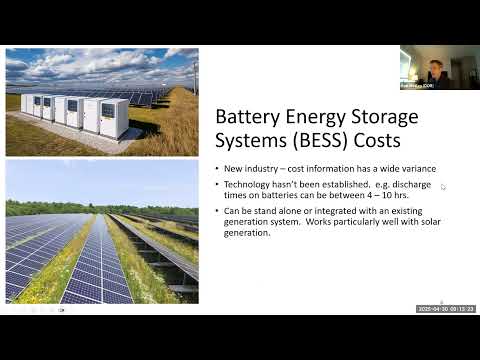
Motley, the central assessment team manager, said the department is still building experience with combined photovoltaic (PV) and battery energy storage systems in Oregon. “Battery energy storage systems, they are brand new to the state of Oregon,” he said, and the Department currently sees “one installed solar with battery energy storage in Oregon” in Morrow County and a standalone battery storage project completed late last year in Multnomah County.
The presentation focused on cost trends and valuation implications. Motley showed National Renewable Energy Laboratory data showing a large decline in utility‑scale PV cost per watt from roughly $6.50/W (DC) in 2010 to about $1.20/W (DC) in 2023 and said that falling costs of new technology reduce the replacement cost and increase depreciation on older systems. He also showed earlier‑stage data indicating battery costs (measured in $/Wh) are projected to fall but have less historical depth than PV data.
Why this matters: County assessors set property values that drive tax revenue and negotiations over payment‑in‑lieu (PILOT) agreements. Motley emphasized ORS 307.175—the statute that established the state PILOT pilot for solar—uses an AC nameplate capacity and a flat per‑megawatt fee and “was written at a different time for a different cost structure.” Because the statute did not anticipate battery storage, the flat fee calculation may not capture the additional investment represented by battery systems.
How the department values projects: Motley described three approaches the Department uses: - Cost approach: replacement cost minus depreciation, which is sensitive to rapidly changing component prices. - Income approach: the Department requires project owners to file income and expense information; assessors perform a discounted cash flow (DCF) analysis using contracted revenues (most projects have long‑term offtake contracts, commonly 20 years or more). - Market approach: used only when credible sales exist; utility projects often are owner‑operated and do not trade frequently, limiting comparable sales data.
On the PILOT question, Motley said batteries can be included in a negotiated PILOT under ORS 307.175 if they are part of the system, but the statute’s flat fee is based on AC inverter nameplate and may not capture the DC rating or the battery portion. “We value the system—all the components of the system as a unit,” Motley said, and counties should recognize that the statute’s per‑megawatt calculation was not written to account for modern battery investment.
Board members asked practical questions about splitting abatements or negotiating separate tax treatments for solar and battery components, and about whether projects have split payment arrangements between PILOT and other incentive programs. The Department staff said they have not seen common practice of splitting a single project into separate PILOT and SIP agreements, but that such negotiation would be done up front and could be modeled in advance.
Useful life and replacement costs were flagged as major valuation drivers. Department staff gave a wide lifespan range for battery systems—“somewhere between 5 and 40 [years],” Michael Gomez said—depending on cycle life and usage. That variability matters because a shorter battery life increases replacement costs embedded in a DCF and reduces long‑term value.
The presentation also covered federal tax incentives. Michael Gomez explained that the federal investment tax credit (ITC) is generally realized in year one and can reduce taxable income by roughly 30% of project cost; assessors treat that as a one‑time cash flow that causes an early‑project spike in value under the income approach and then a noticeable drop after year one once the credit has been applied.
Commissioners asked for and were offered follow‑up modeling. County staff and Commissioners discussed next steps, including asking the Department of Revenue for a multi‑year cash‑flow analysis of hypothetical combined solar/battery projects and using that analysis to inform any negotiations about PILOTs or other incentives.
Department staff said they are available for follow up and to provide data specific to any proposed project.
Ending: Commissioners thanked the presenters and asked staff to coordinate any follow‑up analyses that would help the county evaluate the fiscal impacts of prospective projects and any PILOT negotiations.