
Deschutes County officials raise concerns about bill to centralize CJC grant applications
Get AI-powered insights, summaries, and transcripts
Subscribe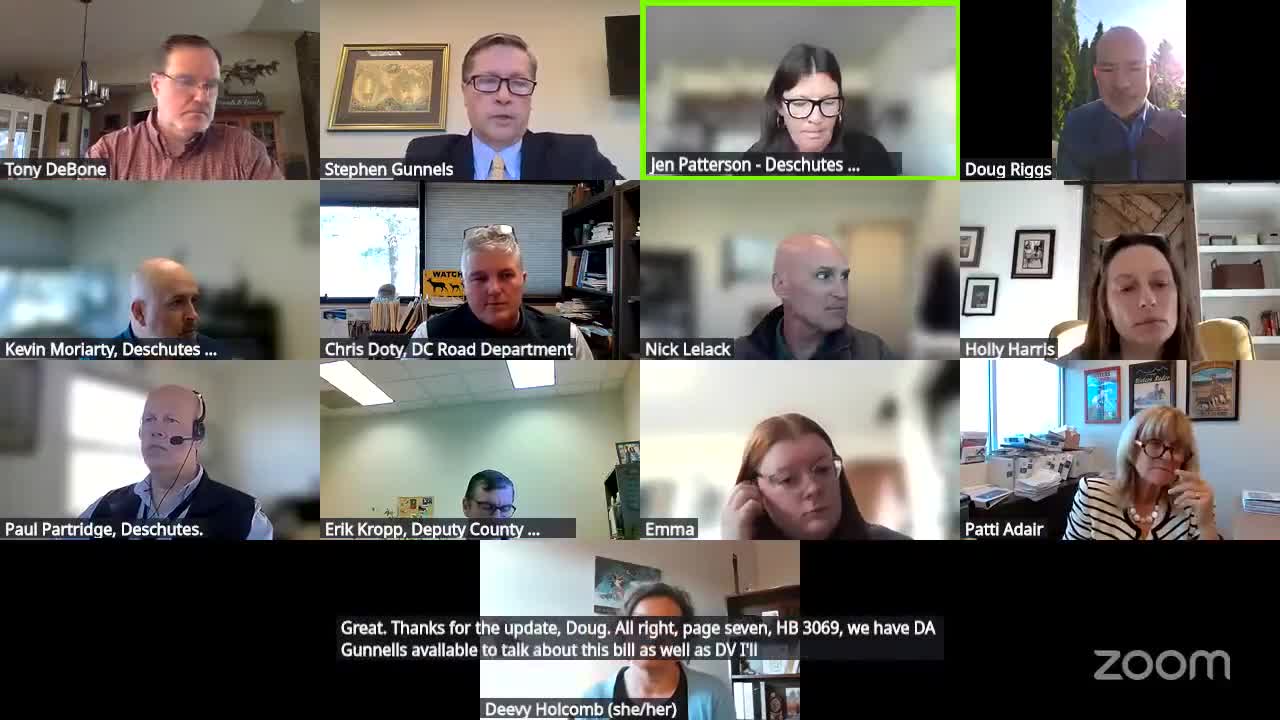
Summary
County prosecutors and staff told commissioners House Bill 3069 would simplify Criminal Justice Commission grants but could cut allowable administrative costs and shift burdens to counties. Officials proposed a joint letter and meeting with the bill sponsor.
Deschutes County officials told the Board of Commissioners on May 2 that House Bill 3069, which would consolidate Criminal Justice Commission (CJC) grant applications into a single biennial county request, needs careful review before the county endorses it.
District Attorney Steve Gunnels said the bill’s sponsor, Rep. Krepp, “wants to streamline the CJC grant application process and put counties kind of at the center of the application process,” but added that one feature “is potentially concerning for counties” — a proposed cap on administrative costs at 3 percent. “I think that’s more in the 8 to 9% range typically for counties,” Gunnels said.
Why it matters: CJC grants fund programs aimed at reducing prison utilization and recidivism. County officials said a one‑size approach could reduce local flexibility and understate the administrative work required to manage multiple program areas across different local providers.
County staff and stakeholders outlined several practical concerns. A county staff member (DV) said the bill, as written, “doesn’t do a sufficient enough job as written, to respect or to lean on the role of the local public safety coordinating councils,” and warned that consolidating timelines and metrics into a single grant could increase coordination burdens across several agencies. County legislative representative Doug Riggs added that the dash‑1 and dash‑2 amendments had only recently appeared and urged caution about implementing a major administrative shift in the middle of a biennium.
Officials also flagged other provisions discussed in hearings: the proposal to eliminate existing grant review committees, an 11‑member commission proposed to oversee awards (with questions about whether that membership would include enough subject‑matter expertise), and absence of an explicit city representative on the commission — a point the League of Oregon Cities raised in testimony.
Next steps: Commissioners agreed to prepare a short, constructive letter outlining county concerns and suggested amendments and to invite Rep. Krepp to a follow‑up Zoom discussion. County staff (DA’s office and DV) and commissioners offered to draft bullet points and meet with the sponsor to discuss timing and administrative rate concerns.
Ending: County officials framed the approach as engaged but cautious: streamlining application processes may have value, but local staff and the county’s public safety coordinating council would need clarity on administrative rates, reporting requirements and transition timing before the board takes a formal support position.