Get Full Government Meeting Transcripts, Videos, & Alerts Forever!
Get email alerts on the Encampment Response Code Compliance topic
No spam. Unsubscribe anytime.
Code Compliance details private‑property encampment process: 72‑hour outreach, 7–10 day abatement window, criminal trespass option
Summary
Code Compliance Administrator Stormy Gonzalez told the Citizen Homelessness Commission that after outreach Code Compliance addresses litter and land‑use violations on private property, issuing a 7–10‑day notice and pursuing abatement warrants if owners do not remove debris; property owners can also file criminal trespass affidavits with DPD.
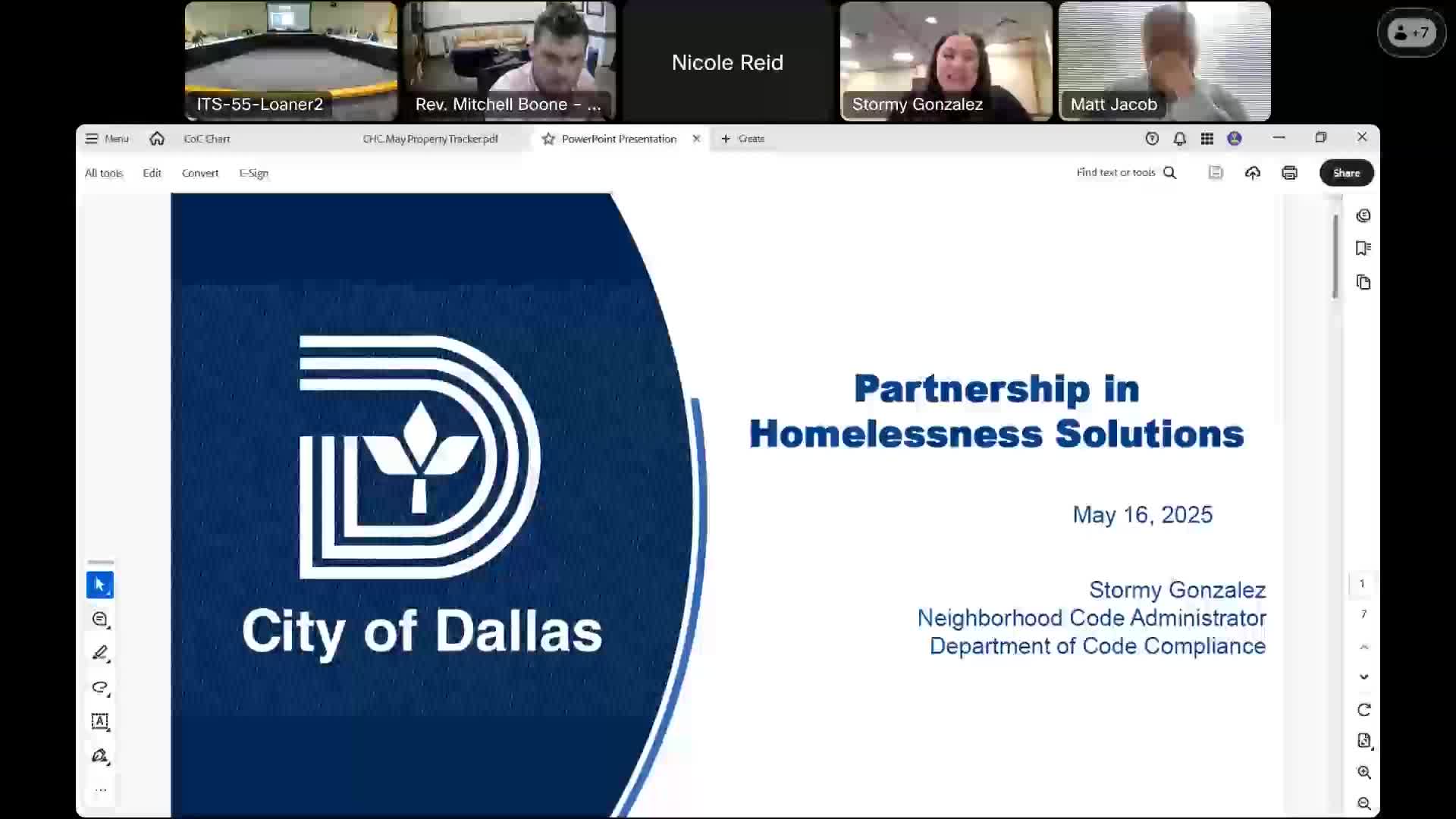
At the May meeting, Stormy Gonzalez, Code Enforcement Administrator for the Code Compliance Department, described how the city addresses encampments found on private property and emphasized a partnership approach with outreach teams.
Gonzalez said the department’s role is to address litter and illegal land‑use violations on private property after outreach. She said OHS leads outreach and engagement to offer sheltered services and that outreach teams issue a 72‑hour notice to allow unsheltered individuals time to voluntarily relocate and remove personal belongings. Gonzalez described Code Compliance’s follow‑up: if litter or encampment violations remain, Code Compliance issues a notice of violation that gives the property owner seven to 10 days for voluntary abatement; if no progress is made, staff will obtain a warrant to remove remaining items and may seek nuisance abatement service.
Gonzalez said code staff make “every effort to contact property owners” and provide guidance, including information about obtaining a criminal trespass affidavit (CTA) from the Dallas Police Department, which property owners can use to have DPD enforce trespass if a person returns. Gonzalez described the overall approach as empathetic and collaborative: “We recognize the complexities of homelessness and the need for an empathetic collaborative approach.”
Commissioners asked for typical timelines; Gonzalez said cases vary and that abatement via nuisance teams may take up to 28–30 days depending on workload, though some removals happen within a week if circumstances permit. Commissioners raised related operational questions: what the city’s process is on public property, how to report encampments via 311 (the city’s service‑request portal), and whether educational materials for property owners are available; Gonzalez said staff provide neighborhood outreach, speak at meetings and can publish guidance and contact information and that she would follow up on where guidance is posted online.
A speaker noted that, after a recent reorganization, 72‑hour notices are issued by EMCR (Emergency Management/Community Response) for outreach activity; Code Compliance emphasized it follows outreach and due process before enforcement steps are taken. Gonzalez and other staff said field response prioritizes safety, empathy and preserving personal property where possible.
Commissioners asked about how the system handles encampments on freeway right‑of‑way and other non‑street‑address locations; staff recommended photographing sites, using 311’s map/pin tool when submitting requests, and following up with Code Compliance where needed. No enforcement action was taken during the meeting; staff said they will continue outreach and coordination with DPD, OHS/EMCR and nuisance teams.