Get Full Government Meeting Transcripts, Videos, & Alerts Forever!
Get email alerts on the Homelessness Continuum Of Care topic
No spam. Unsubscribe anytime.
Office of Homeless Solutions outlines how Housing Forward and All Neighbors Coalition coordinate HUD funding
Summary
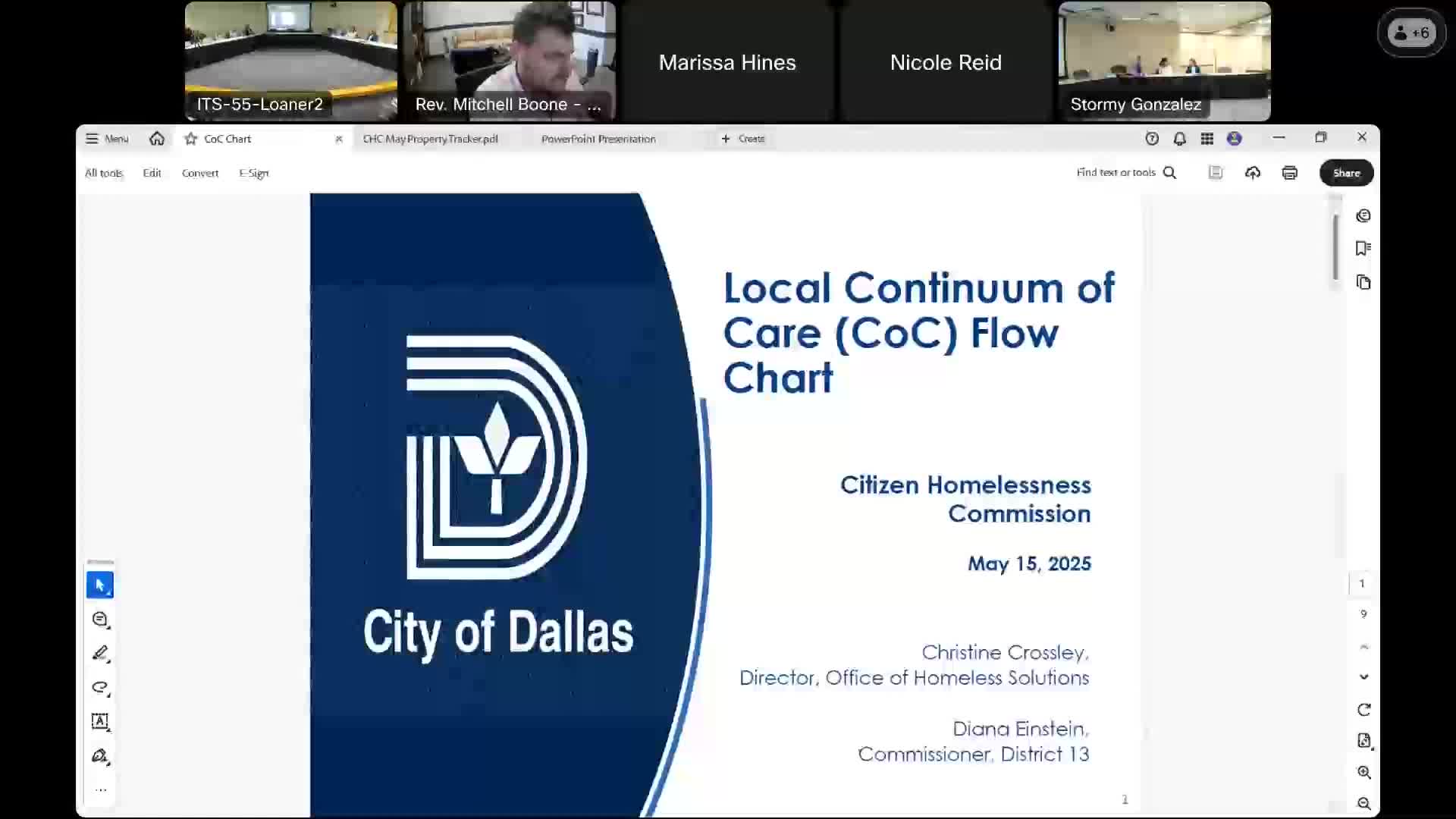
At a May meeting of the City of Dallas Citizen Homelessness Commission, Office of Homeless Solutions Director Christine Crosley and Commissioner Diana Einstein explained how the local Continuum of Care (All Neighbors Coalition) and lead agency Housing Forward organize HUD funding, application scoring and collaborative priorities.
At a May meeting of the Citizen Homelessness Commission, Office of Homeless Solutions Director Christine Crosley and Commissioner Diana Einstein gave commissioners an overview of the local Continuum of Care and how federal homelessness funding is coordinated.
The presentation explained that the local Continuum of Care (CoC), called the All Neighbors Coalition, spans Dallas and Collin counties and uses Housing Forward as the collaborative applicant and lead agency to assemble and submit HUD funding applications. Crosley told commissioners: “Housing Ford is responsible for assembling the annual community wide application for funding, which we'll get to in a bit, coordinating our Continuum of Care and Board, data management, reporting, performance evaluation, and promoting system performance improvement under a unified strategy to end homelessness.”
Why it matters: HUD funding and program priorities are awarded through a formal application process that increasingly evaluates communitywide coordination. Crosley said HUD now expects a collaborative application—rather than disconnected, project‑level submissions—so communities must demonstrate a shared strategy and performance measurement in order to receive funding.
The CoC structure presented includes an open General Assembly of member organizations, implementation work groups that design and test policies and services, an executive council of agency leaders, an independent review committee that scores applications, and a decision‑making CoC board that sets funding priorities. Crosley said the implementation work groups supply proposals and lived‑experience input that then inform the collaborative application and the CoC board’s priorities.
Crosley described the HUD Notice of Funding Opportunity (NOFO) process: HUD issues a NOFO and expects a collaborative application showing how local projects and providers connect to the community’s goals. She said recent federal practice has shifted from annual, separate project renewals to a communitywide, coordinated application that may fund a community’s package of projects together. Crosley noted the city’s prior work on a large local initiative—the Dallas Realtime Rapid Rehousing Initiative—and said that alignment helped make the local application competitive.
Commissioners asked how the CoC’s geography is set and who can be the collaborative applicant. Crosley said HUD establishes CoC geographic designations and that the lead agency model varies by community; some jurisdictions locate the CoC lead inside a municipal agency when the city/county boundary allows, while others use an independent nonprofit lead to represent a regional CoC.
Commissioners were also told how commissioners can engage: attend the CoC general assembly, participate in implementation work groups, and bring district concerns back to the COC process. Commissioner Diana Einstein said her goal was “not only to educate the commission but our citizens as well,” and the Office of Homeless Solutions plans to post the presentation materials on the commission’s website.
The presentation listed technical resources and links for commissioners, including meeting schedules, past funding awards, and HUD guidance documents. Crosley encouraged commissioners to use work groups as a way to influence policy and program design.
Looking ahead: Crosley urged commissioners to use the CoC’s governance and work‑group structure to stay informed about funding cycles and to bring local priorities into the collaborative application process.