Get Full Government Meeting Transcripts, Videos, & Alerts Forever!
Get email alerts on the Infrastructure Water Sewer topic
No spam. Unsubscribe anytime.
Kearney staff brief planning commission on updated water and sewer master plans; city tracking major projects and funding
Summary
A consultant and utilities director briefed the Kearney City Planning Commission on updated sewer and water capacity, major trunk-main projects tracked at roughly $58 million for sewer and $39 million for water, state revolving fund planning, and a recent $2 million EDA grant for a 30-inch trunk main.
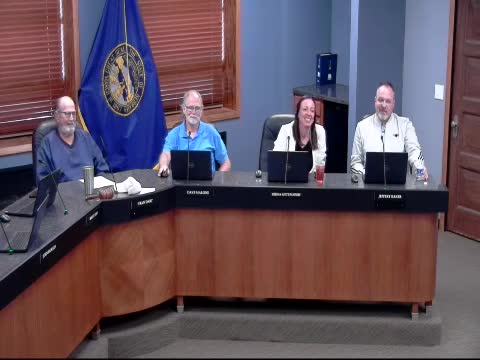
The Kearney City Planning Commission received an updated briefing on the city's water and sanitary-sewer infrastructure and capital needs, including capacity figures, high-priority trunk-main projects and funding sources such as the State Revolving Fund (SRF) and an Economic Development Administration (EDA) grant.
Craig Bennett, presenting an updated set of planning studies to the commission, described how trunk mains and lift stations built over the past three decades enabled growth and explained the city's current capacity. “We have 3.8 MGD, million gallons per day, average daily use of waste stream that goes to our treatment plant,” Bennett said, adding that the plant’s permitted capacity is 5.9 MGD and that hydraulically the plant can handle up to 18 MGD. He told commissioners that operating at about 64% of permitted capacity means the city can accommodate additional development without immediate plant expansion.
Bennett and staff outlined several tracked projects and rough planning costs. He said the total of green-highlighted sewer items in the presentation summed to about $58,000,000 if built together. He noted two trunk-main projects the city has been tracking at approximately $10,000,000 and $7,000,000 respectively and that the city has secured a $2,000,000 EDA grant for a 30-inch trunk main tied to development near the Kearney Expressway Bypass.
For drinking water, Bennett said the combined well fields and towers provide substantial capacity (he cited roughly 29 MGD total water capacity and an average peak of 14.6 MGD) and that the city is tracking about $39,000,000 in water projects, including a new water tower and redundant feed lines. He emphasized the value of advance planning and oversizing mains where appropriate, and said SRF — the state revolving fund for clean water/drinking water projects — is the main financing mechanism the city uses to stage and fund projects.
Sarah (director of utilities) confirmed the city tracks infrastructure life-cycle costs and replacement materials; in response to a commissioner question she said lead service-line replacement work is progressing in phases across the city and that crews are checking and replacing identified lead lines.
Commissioners asked about timing. Staff said one project tied to an EDA grant (the 30-inch trunk main) is scheduled for construction this summer; other projects will proceed as grant or funding opportunities arise. Bennett summarized that the trunk-main investments and lift-station work have historically unlocked adjacent land for development and that sewer projects generally need to precede development in outlying areas.
The presentation was informational; no formal commission action was required.