Get Full Government Meeting Transcripts, Videos, & Alerts Forever!
Get email alerts on the Public Drug Use 4 Pillars topic
No spam. Unsubscribe anytime.
Supervisors hear BLA and health experts on adopting Zurich-style "4 pillars" approach; departments outline coordinated street teams and treatment expansion
Summary
The Government Audit and Oversight Committee held a multi‑hour hearing May 15 on the “4 pillars” approach (prevention, harm reduction, treatment, enforcement) and heard the Budget and Legislative Analyst, clinicians and city departments outline evidence and new operational steps — including neighborhood street teams and expanded treatment starts — while noting legal and capacity constraints for supervised consumption sites in the United States.
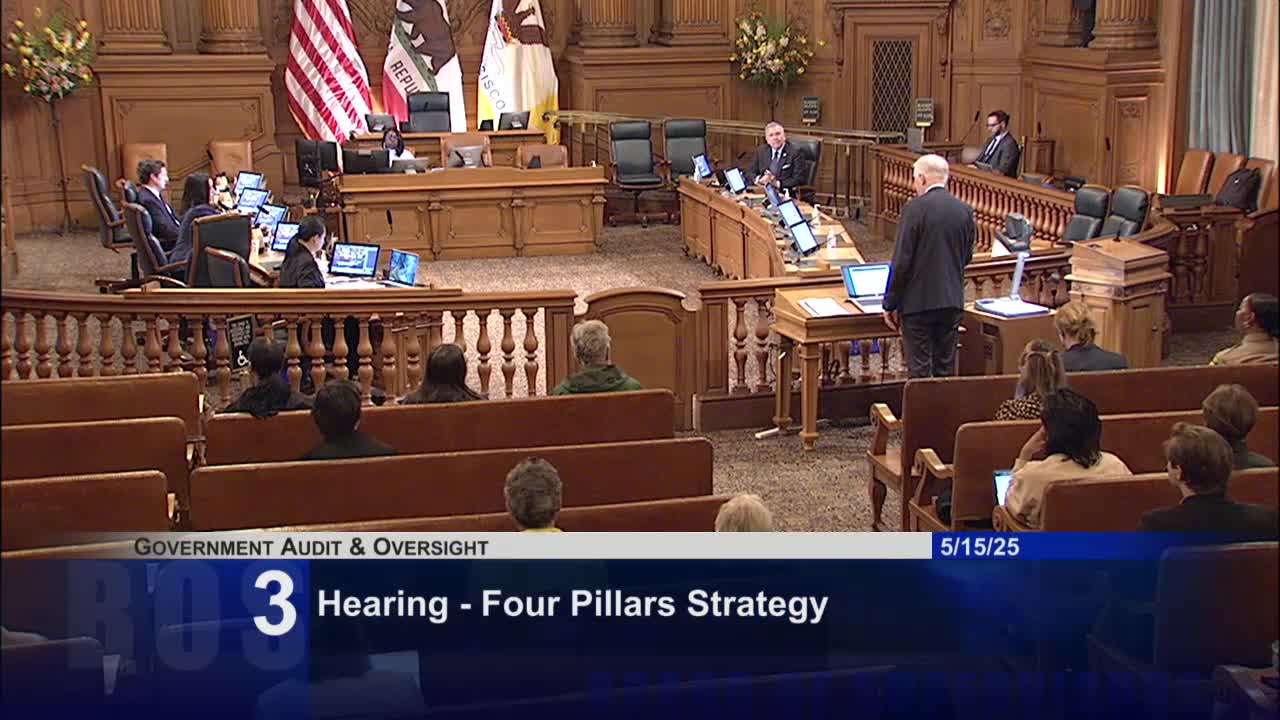
The Government Audit and Oversight Committee held an extended hearing May 15 on a proposed “4 pillars” framework to address public drug use and open‑air markets. The four pillars (prevention, harm reduction, treatment and enforcement) are the organizing framework the Budget and Legislative Analyst (BLA) studied in comparison with Zurich’s long-running program, and the committee heard BLA staff, addiction medicine physicians, public health leadership, emergency management and police representatives.
BLA findings and safe‑consumption modeling Fred Brusseau and Terry Feeley of the city’s Budget and Legislative Analyst office summarized a report comparing Zurich’s experience with San Francisco and presented a cost–benefit model for a supervised consumption site in San Francisco. Brusseau said Zurich adopted an integrated 4‑pillars approach beginning in the 1980s–1990s and credited cross‑agency collaboration for reducing visible open‑air drug use in public parks.
Key BLA data presented to the committee: - Zurich’s model emphasizes coordinated action among police, health and social services and includes safe consumption sites; San Francisco currently has none in operation. - The BLA’s baseline cost model for a single supervised consumption site showed estimated annual benefits of about $3.5 million versus costs of about $3.7 million; a larger facility yielded greater net benefits in the BLA scenarios (benefits ≈ $6.3 million). The report excluded the statistical “value of a life” calculation in headline figures but estimated a prevented 15–27 fatal overdoses per year attributable to a site. - The federal “crack house” statute (Anti‑Drug Abuse Act) creates unresolved legal risk for supervised consumption sites; recent court rulings have not settled the matter nationally.
Public health and clinical perspectives Two addiction medicine physicians — Dr. Ayesha Appa (addiction medicine and infectious diseases) and Dr. Dan Ciccaroni (UCSF, addiction medicine) — emphasized addiction as a chronic disease that requires long‑term engagement, trust building and multimodal treatment, including medication for opioid use disorder (MOUD) such as methadone and buprenorphine and behavioral interventions like contingency management. Appa noted recovery often requires multiple treatment attempts; Ciccaroni highlighted engagement, warm handoffs, and integrated services at supervised‑consumption venues as enablers for linkage to care.
Departmental response and operations Department of Public Health Director Tsai described a city “reset” emphasizing cross‑agency coordination and named priorities: expand treatment beds and low‑barrier options; accelerate and simplify entry to care; increase retention/persistence in care; and pair harm reduction supplies with proactive linkages to treatment. DPH said it has increased MOUD starts but faces capacity and persistency gaps.
Mary Ellen Carroll, Executive Director of the Department of Emergency Management, described the new neighborhood street teams — multidisciplinary teams (DPH street health, HSH outreach, DEM, fire medic captains and others) now deployed across city neighborhoods to coordinate daytime huddles, real‑time communications and shared priority lists of individuals needing consistent outreach and linkage.
Commander Derek Lieu explained DMACC (Drug Market Agency Coordination Center) operations and noted the unit’s focus areas: disrupting supply (seller interdiction), addressing public drug use and demand, targeting unpermitted vending, and neighborhood recovery/activation. DMACC reported large fentanyl seizures and an increase in user arrests in recent years; the presentation included 2024 DMACC fentanyl totals of 66,708 grams (reported seizure figure) equating to millions of lethal‑dose equivalents per the BLA's conversion assumptions.
Corrections and treatment in custody The Sheriff’s Department and jail health staff described medication provision and withdrawal management available in custody and the roll‑out of CalAIM‑related pre‑release supports, including 30‑day post‑release medication supplies for people leaving custody.
Areas of agreement and outstanding issues Committee members and presenters repeatedly emphasized cross‑agency coordination, improved data and the need to expand treatment capacity. The BLA and clinicians stressed that supervised consumption sites have public‑health benefits in jurisdictions where they operate but flagged legal uncertainty and implementation complexity in the U.S. Several supervisors and speakers also raised concerns about displacement: enforcement pressure in one area can move open‑air drug use into other neighborhoods absent sufficient capacity citywide. The department leaders described neighborhood teams and “Restore” non‑congregate housing beds that pair immediate housing with initiation of MOUD as tools to reduce that displacement and to engage people at the moment they are willing to accept services.
Public comment and community input During public comment many speakers urged a stronger harm‑reduction emphasis and some urged adoption of supervised consumption sites; others described the importance of maintaining long‑term supportive housing and community‑based services (several speakers focused on preserving residential programs and the ARF/RCFE beds at the Behavioral Health Center). Speakers with lived experience described trust, continuity of care and compassionate engagement as essential.
Committee action After presentations and Q&A, the committee voted to file the hearing record. Roll call: Vice Chair Sauter — Aye; Member Sherrill — Aye; Chair Jackie Fielder — Aye; motion passed.
Why it matters: The hearing framed policy choices facing San Francisco as it confronts high overdose mortality and visible public drug use. The BLA presented evidence and a cost model for supervised consumption sites that city staff said are not on the immediate table because of federal legal risk; departments described new operational coordination (neighborhood street teams, Restore program, expanded MOUD starts) intended to provide a more integrated local response.
Next steps: The BLA and departments remain available for follow‑up. The committee’s filing preserves the record for future Board actions; several supervisors signaled interest in continued review of coordinated implementation options and data collection to track outcomes such as MOUD uptake, overdose fatalities, and neighborhood public‑safety metrics.