Get Full Government Meeting Transcripts, Videos, & Alerts Forever!
Get email alerts on the Housing Displacement topic
No spam. Unsubscribe anytime.
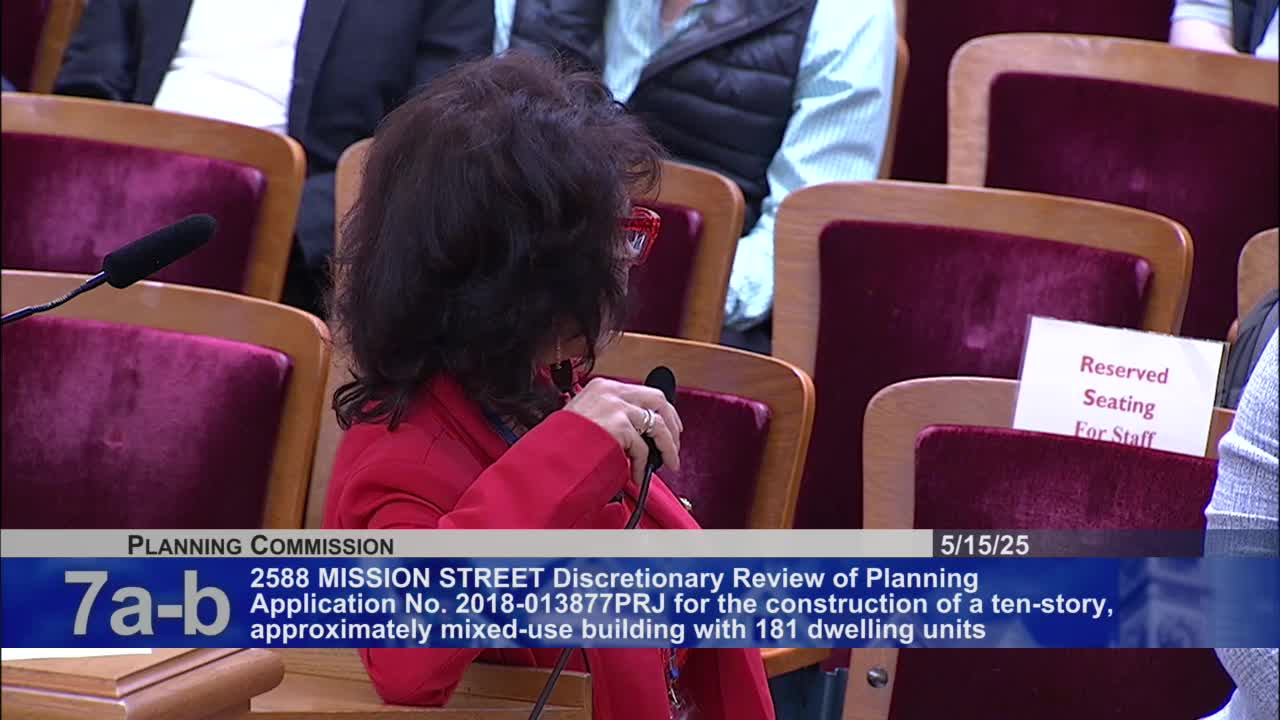
Planning Commission approves 2588 Mission project over community objections
Summary
The San Francisco Planning Commission voted 4–3 on May 15 to decline discretionary review and adopt findings allowing a 10‑story, density‑bonus housing project at 2588 Mission Street to proceed, drawing sustained public testimony citing displacement, the 2015 fire, and calls for 100% affordable housing or city acquisition.
The San Francisco Planning Commission on May 15 voted 4 to 3 to decline discretionary review and adopt findings that allow the project proposed for 2588 Mission Street to proceed under state density bonus rules.
The project sponsor seeks a new 10‑story over‑basement residential mixed‑use building roughly 100 feet tall with about 173,000 square feet, 181 dwelling units, roughly 4,000 square feet of retail, about 500 square feet of community facility space, 32 Class 1 bicycle parking spaces, and roughly 6,000 square feet of private and common open space. Staff reported the project would provide 17% of the base density through the state density bonus and requested five code waivers and three concessions.
The commission’s vote came after more than two hours of public testimony, much of it urging the commission to uphold a request for discretionary review. Speakers described the site’s history, including a 2015 fire that displaced dozens of residents and killed one person, and argued the project would accelerate gentrification and displacement in the Mission, a priority equity geography in the city’s housing element. Staff recommended approval, saying the project complies with the planning code and with state density bonus provisions; the project sponsor’s attorney argued that state law and the Housing Accountability Act limit the commission’s authority to deny the project.
Why it matters: The decision pits the city’s statutory streamlining and density bonus framework against local equity goals enshrined in the housing element and the planning code’s priority equity geography designation. Community groups and many public commenters urged the commission and the mayor’s office to pursue acquisition for community‑led or permanently affordable development; staff and the project sponsor said no feasible acquisition had been finalized.
Key facts and votes: Commissioners Campbell, McGarry, Braun and Commission President (Soh/Tsao in the record) voted to not take discretionary review and to adopt the findings (yes). Commissioners Williams, Imperial and Moore voted no. The motion passed 4–3.
Discussion highlights - Community testimony: Dozens of callers and in‑room speakers — including United to Save the Mission, the Latino Parity and Equity Coalition, Coalition on Homelessness, Mission‑area residents and small business owners — argued the project would exacerbate displacement of Latinx and other vulnerable populations. Speakers urged acquisition by the city or use of Prop I funds for deeply affordable housing and for prioritizing return rights for residents displaced in 2015. - Legal standard cited by sponsor: David Blackwell, attorney for the project sponsor, and other speakers for the sponsor emphasized the state density bonus law and the Housing Accountability Act as the controlling legal standards and said the commission must find a specific adverse public health or safety impact supported by a preponderance of the evidence to deny the project. - Planning staff position: Ella Simonsky summarized the project program and said the department finds the project consistent with the code and state density bonus law, recommending approval while noting shared concerns about displacement and gentrification but asserting the department lacks legal authority to require a greater share of permanently affordable units than the project proposes. - Data gaps and tenant counts: Commissioners and public commenters noted conflicting counts of displaced or previously housed residents on the parcel — public commenters and community organizers cited roughly 60 displaced residents and referenced a 47‑unit count from the Rent Board; planning staff said DBI records showed a certificate of final occupancy for 17 dwelling units but that building plans and tenant lists were not conclusive. Commissioner Imperial and others pressed staff about outreach with the mayor’s office and MOHCD and whether acquisition talks had been pursued; staff said the city facilitated meetings but that funding priorities and existing commitments limited purchase options.
Decision and next steps The commission’s adoption of findings to allow the project to proceed does not itself conclude CEQA review or other legislative steps; staff noted further entitlements and conditions (including any required waivers or concessions) will be processed through the city’s permit and environmental review timelines. Community groups said they would challenge the outcome and continue advocacy for acquisition and deeper affordability.
Ending The vote underscored the tension between state housing streamlining laws and local equity goals. The project sponsor and the city will next move forward with detailed entitlement steps; opponents signaled plans to continue legal, political and public campaigning.