Get Full Government Meeting Transcripts, Videos, & Alerts Forever!
Get email alerts on the City Budget Fy26 topic
No spam. Unsubscribe anytime.
Mayor submits $561 million FY26 budget; council refers appropriation orders to committee
Summary
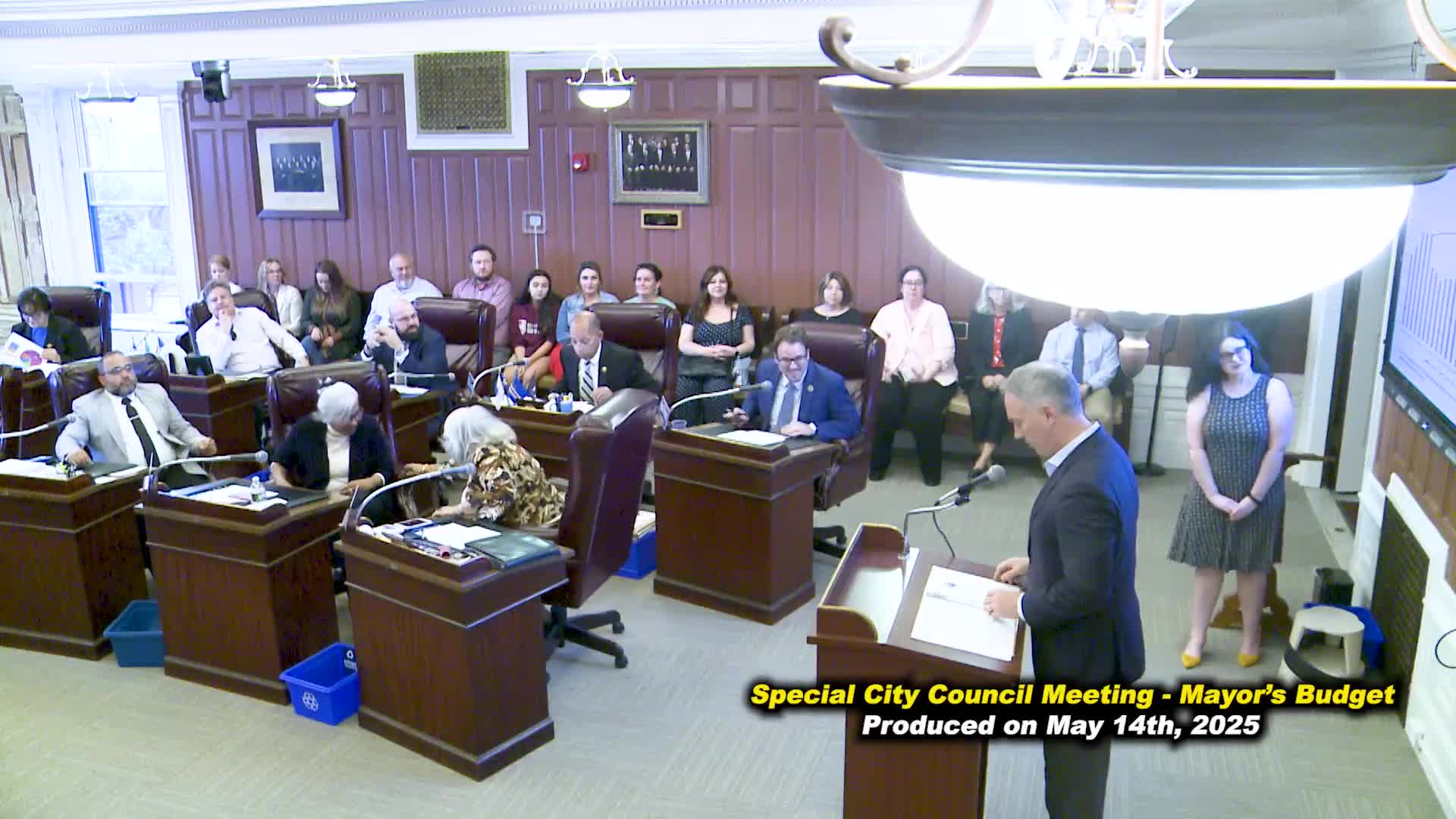
Mayor John Renee Pritchett presented a $561 million proposed fiscal year 2026 budget for the city of New Bedford, highlighting rising pension and health-care costs and a shortfall in state aid; the City Council referred several appropriation orders to the quasi committee of the whole.
Mayor John Renee Pritchett on Wednesday submitted the city of New Bedford’s proposed fiscal year 2026 budget, a $561,000,000 spending plan that he told the City Council “sustains services at levels our residents expect and deserve and avoids unduly burdening taxpayers.”
Pritchett framed the proposal against long-term fiscal pressures, including a persistent shortfall in state local aid and escalating pension and health-insurance costs that he said constrain the city’s ability to maintain services. He told the council that, after adjusting for inflation, New Bedford receives less non-school local aid now than it did in 2008 and that the gap amounts to roughly $14,000,000 in the current year and $187,000,000 cumulatively since that year.
The proposed total budget is $561,000,000, with a general fund of $500,400,000. The administration’s projection reduces net general-fund staffing by two full-time equivalents in FY26 (proposed 983 FTEs). Pritchett said employee health insurance is forecast to rise to $50,400,000 in FY26, about 10.1% of the general fund, and he warned that state-imposed retirement funding schedules require escalating pension payments that peak in the next decade.
“Sections 21 to 23 of the Municipal Health Care Reform Act afford municipalities the opportunity to control these costs,” Pritchett said, urging the council to consider the law used by other nearby towns. He said the measure “levels the playing field between the unions and taxpayers” when health-plan design is contested and that other municipalities in the region have adopted it with measurable savings.
Pritchett also outlined major capital and economic projects that factor into the city’s fiscal picture, including a $300,000,000 reconstruction of the Route 195 viaduct, airport tower and terminal work, waterfront industrial expansion (more than 70 acres added in recent years), resumption of passenger rail service to Boston, and ongoing offshore-wind-related activity such as Vineyard Wind. He noted that wastewater enterprise budgets reflect federally mandated sewer-separation projects under an Environmental Protection Agency administrative order.
The mayor stressed limits on local control: the school budget is driven by the state Chapter 70 foundation formula and represents roughly two-thirds of the overall budget; county and vocational-technical assessments and certain legally required payments (debt service, pensions) are not discretionary. “You cannot reduce that portion,” he said of the education funding required by state law, adding later, “Can’t touch this. Hands off,” in an aside about protections on mandated items.
After the mayor’s presentation, the City Council heard and read items 2 through 9—several appropriation orders tied to the municipal general fund, airport, hotel-and-lodging tax, cable access, downtown parking, wastewater and water enterprise budgets—and voted to refer those measures to the quasi committee of the whole for further review. The referral motion was seconded by Councilor Ian Abreu and carried on an aye vote.
Votes at a glance: - Item 1 (communication from Council President Shane Burgo requesting a special committee meeting for the submittal of the FY26 budget): Motion to receive and place on file — moved by Councilor Brian Gomes; seconded by Councilor Ian Abreu; outcome: approved. - Items 2–9 (appropriation orders for FY26: municipal ordinary revenue $460,838,400; airport $1,374,461; arts/culture/tourism from hotel/lodging tax $129,600; cable access $1,488,882; CCDA handicap parking $66,500; downtown parking $1,113,112; wastewater $35,596,711; water $20,904,506): Motion to refer to the quasi committee of the whole — mover not specified in the record; seconded by Councilor Ian Abreu; outcome: approved. - Motion to adjourn — moved by Councilor Sean Oliver; seconded by Councilor Ian Abreu; outcome: approved.
The mayor invited council members and department heads to probe department-line budgets in coming weeks and thanked the city CFO, Bob Ekstrom, and finance staff for preparing the proposal. Council members noted the budget books arrived during the meeting and will use forthcoming committee sessions to examine departmental requests, revenue assumptions and potential policy options such as adoption of Sections 21–23 of the Municipal Health Care Reform Act.
The council’s next steps are formal committee review of the appropriation orders and department budgets; no formal votes to adopt the FY26 budget were recorded at Wednesday’s session.