Get Full Government Meeting Transcripts, Videos, & Alerts Forever!
Get email alerts on the Consolidated Plan topic
No spam. Unsubscribe anytime.
Erie holds public hearing on 2025–29 consolidated plan; city outlines housing, shelter and rehab priorities
Summary
City of Erie Department of Economic and Community Development held a public hearing on its HUD-required 2025–29 consolidated plan and the FY2025 annual action plan, presenting draft findings on local homelessness and housing need, proposed 2025 allocations, and seeking public comment during a 30-day display period.
The City of Erie Department of Economic and Community Development on the evening held a public hearing on its proposed 2025–29 consolidated plan and the fiscal year 2025 annual action plan, presentations officials said are required by the U.S. Department of Housing and Urban Development for entitlement communities.
The consolidated plan, a five-year strategy that sets the city’s priority needs and the categories eligible for federal Community Development Block Grant (CDBG), HOME Investment Partnerships (HOME) and Emergency Solutions Grant (ESG) funds, was presented to the public by Deborah Smith, director for the Department of Economic and Community Development, and consultant Bill Wasilewski of M and L Consulting.
Bill Wasilewski, who led the presentation, told attendees that “the consolidated plan is a 5 year plan document … required by HUD as part of its status as an entitlement community under the community development block grant program the HOME program in the ESG program.” He said the plan draws on census data, a housing and homeless needs assessment, stakeholder consultations and a targeted survey of people with lived experience of homelessness to identify priorities.
City staff summarized the plan’s main findings: the 2024 point-in-time count showed 378 people in emergency shelters and 76 people unsheltered; roughly 30% of households are cost-burdened, paying more than 30% of income for housing; and inventory of affordable and accessible housing is insufficient. Staff said length of stay in shelters has increased and that shelter capacity is a recurring need. Staff also identified barriers to housing access including criminal- and rental-history issues, application and security costs, utility and arrear payments, and limited inventory. Subpopulations with growing needs since the previous planning cycle include elderly residents, youth, people experiencing chronic homelessness and large families.
The consolidated-plan strategic priorities that staff presented for 2025–29 include homeowner rehabilitation assistance, rental rehabilitation, creation of new affordable rental housing, increased homeownership, homelessness housing services, public facilities and infrastructure improvements, public services, code enforcement and demolition of dilapidated structures, economic development, and downtown revitalization.
On proposed uses of FY2025 funds, Deborah Smith said the city is using FY2024 allocation levels as placeholders because HUD has not yet provided official FY2025 allocations. Smith said the city’s draft “total” allocation figure on the handout was discussed during the meeting and that a previously required repayment for an Inspector General audit reduces available HUD funding by $115,446; she said the city chose to repay that amount in one lump sum. Smith also referenced $23,417.06 in program income identified in the draft numbers.
Dave Dieter, assistant director in the Department of Economic and Community Development, provided a more detailed breakdown of proposed spending in the draft annual plan. For CDBG he identified a public-service housing category proposal of $1,558,000 (including city housing rehab and Erie Redevelopment Authority housing rehab, with $221,000 earmarked for those rehab activities); $1,201,964.82 for public facilities and improvements; $114,918 for special economic development; and $571,063 for general administration. For HOME, staff proposed $500,000 to the Boston Store rental rehabilitation project, $200,000 to the Eastside Renaissance rental rehabilitation proposal and $64,318 for HOME administration, totaling $764,318; Dieter noted HUD requires 15% of HOME funds be reserved for CHDO-qualified activities and said the Hands Boston Soar project qualifies. For ESG, the draft line is $267,205, with staff noting ESG allocations are typically partitioned by formula into emergency/transitional shelter (60%), rapid re‑housing (32.5%) and administration (7.5%).
No formal votes were taken at the hearing. Staff said the plan was placed on the 30-day public display beginning April 11 and that the comment period runs through May 10; staff said a city council adoption hearing is targeted for about May 20 and that the city will submit the plan to HUD after it receives its official FY2025 allocation (expected from HUD in mid‑May but subject to change).
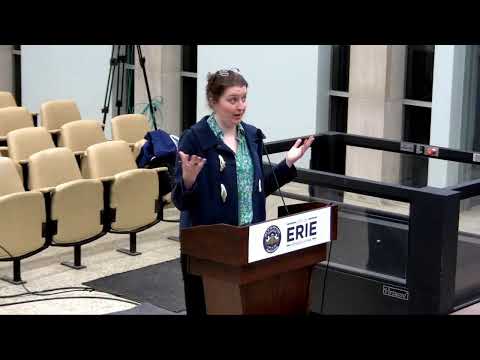
Public commenters spoke in support of CDBG‑funded small-business and neighborhood programs and raised questions about outreach and federal funding risk. Floyd Ho, mentor and instructor at the Achievers Entrepreneur Hub, praised CDBG support for small businesses, saying, “I wanted to thank y'all because y'all went the extra mile,” and described several local entrepreneurs and business launches his program supported. Liz Reyes, neighborhood resource team leader for the Love Your Block program through the City of Erie, described that program’s small home‑repair and cleanup work and told the hearing, “In the past 3 years, Love Your Block has completed 94 small home repair projects, saved residents over a hundred and $83,000 in labor costs, engaged 483 resident volunteers, collected over 17 tons of trash and and completed 677 new repairs and features.”
A member of the public, Susanna Faulkner, asked for clarification about the public comment deadline and expressed concern about outreach and future federal funding. Faulkner noted a May 2 Office of Management and Budget memo she had read, saying it “proposes a 44% cut to HUD funding across the board,” and asked how the city would respond if federal HUD funding were significantly reduced. City staff replied that the May 2 memo reflected an administration “skinny budget” proposal for FY2026 and that no congressional priorities had been set.
Staff repeated how to submit comments during the display period: by email to Deborah Smith or by hard copy at designated public locations; they said hard copies of the consolidated plan and annual plan are available at three public centers including the Glasgow Library.
The hearing closed with staff asking attendees to sign the meeting sheet and encouraging written comments during the display period. The draft consolidated plan and annual action plan remain on public display until the stated comment deadline, and the city will update the plan as needed after receiving the official HUD FY2025 allocation.