Get Full Government Meeting Transcripts, Videos, & Alerts Forever!
Get email alerts on the Transit Procurement topic
No spam. Unsubscribe anytime.
Committee approves one‑year $30 million mobility sourcing pool, with annual review and reporting
Summary
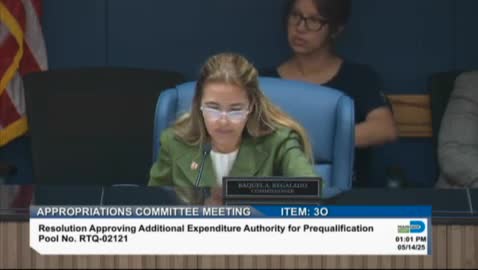
After discussion and an amendment, the committee approved a one‑year, up‑to $30 million mobility sourcing pool for transit parts and proprietary services (item 3Q) and required annual reporting and contract ratification to guard transparency and allow a future review of longer‑term procurement options.
The Appropriations Committee approved a mobility sourcing program (item 3Q) to create a procurement pool for single‑source or proprietary parts and services needed to maintain bus and rail fleets, but restricted the program to a one‑year, not‑to‑exceed $30,000,000 allocation and directed enhanced oversight and reporting.
DTPW staff told commissioners the department maintains more than 100 miles of rail and a bus fleet of about 750 vehicles and regularly needs proprietary parts and maintenance services that are available from a limited group of manufacturers. Phil Edwards (Chief, Intergovernmental Affairs, DTPW) said the pool is intended to accelerate procurement for parts and services that would otherwise take months to acquire through standard competitive processes.
Concerns and amendment Several commissioners raised oversight concerns after the OIG recently reported a procurement‑related corruption incident within the transportation system. Commissioners asked who would manage and sign decisions for the pool and sought safeguards against misuse. Committee members also debated the MetroMover’s future; one commissioner urged study of replacement options rather than continued high‑cost maintenance.
To address the concerns, the committee amended the proposal: rather than authorize up to $130,000,000 over five years as originally drafted, it approved a one‑year, up to $30,000,000 pool with the following conditions: each contract executed from the pool must be posted publicly, contracts will come to the commission for ratification, DTPW must report annually on pool use and procurement decisions, and staff responsible for approvals must be identified for oversight.
Committee action: motion to adopt with the one‑year, $30,000,000 amendment passed by voice vote; staff agreed to return with data and to work with the OIG as needed for oversight.
Why it matters: transit reliability depends on timely access to parts and proprietary services. Commissioners required tighter, time‑limited authorization and strengthened transparency to balance operational needs with procurement safeguards.
Next steps: DTPW staff will run the one‑year program, provide quarterly updates, and report back at the committee after 12 months with performance data and recommendations on whether to extend or redesign the pool.