Get Full Government Meeting Transcripts, Videos, & Alerts Forever!
Get email alerts on the Solid Waste Budget topic
No spam. Unsubscribe anytime.
Houston council hears Solid Waste Department plan to shrink response times, shore up recycling and staffing in FY26 budget
Summary
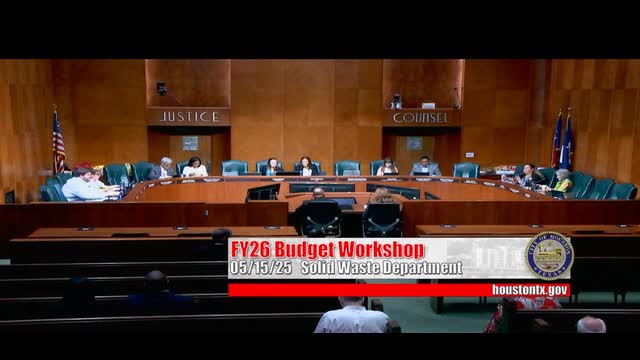
Interim Solid Waste Director Larry Hasson presented the Solid Waste Department's proposed fiscal 2026 budget to the Houston City Council, saying the plan would reduce overall expenditures while raising service targets for on‑time collections, illegal‑dumping response and neighborhood drop‑off wait times.
Interim Solid Waste Director Larry Hasson presented the Solid Waste Department's proposed fiscal 2026 budget to the Houston City Council, saying the plan would reduce overall expenditures while raising service targets for on‑time collections, illegal‑dumping response and neighborhood drop‑off wait times.
Hasson said the department expects a 9% reduction in expenditures across its three funds, with the general fund down about 5%, the recycling revenue fund down about 14% and the container lease fund down about 18%. He told council members the budget assumes savings tied to a voluntary retirement payout option that reduced payroll by about $2.4 million so far and that additional late takers will increase savings further.
The presentation laid out specific operational targets: boosting heavy trash on‑time collection from roughly 75% to 90%; improving illegal‑dumping response from about 21 days to a 10‑day target; cutting residential drop‑off wait times from about 30 minutes to 15 minutes; and raising yard‑waste on‑time collection from roughly 26% to a 75% target in FY26. "Our goal is to respond to all those calls in 45 minutes," Hasson said about vehicle‑spill responses.
Why it matters
Council members and public commenters flagged recycling and landfill capacity as budget priorities with long‑term cost implications. Several council members pressed for concrete staffing, contractor and revenue details they said are needed to judge whether the targets are feasible. Public speakers and an environmental group urged the council to consider a municipal trash fee to provide sustainable funding for service improvements and diversion programs.
Key details from the presentation
- Staffing and restructure: Hasson said department leadership has restructured administrative operations and plans to increase span of control. The presentation noted 31% of eligible employees took the retirement payout; the department identified nine frontline roles among those vacancies to fill and said it will convert some upper and midlevel vacancies into frontline positions.
- Service consolidation and routing: The department plans to consolidate four service quadrants into two halves to concentrate staff and reduce overtime, and to use routing software already purchased (Routeware, Samsara and related tools) across the whole department after partial prior adoption. "By combining quadrants, you allow yourself to put more people in seats of trucks to deploy to finish routes in a faster time," Hasson said.
- Heavy trash and on‑demand pilot: Hasson described a shift toward a more work‑order or demand‑driven approach for heavy trash to reduce routine routing and speed response; he said a pilot has been running in District K and centralizing heavy trash could shrink route size.
- Illegal dumping and enforcement: The department expects to increase investigated illegal‑dumping cases (presentation projected a jump from about 9,000 to 19,000 investigated cases) and to cut average resolution time, citing an increase in code enforcement staffing.
- Container lease fund and sponsorships: The container lease fund (about $4 million) pays for deliveries, repairs and new containers. Hasson confirmed eight FTEs on that fund are paid from the special revenue fund. The HOA sponsorship subsidy program (a $6 subsidy per household) is expected to grow from about 56 HOAs to roughly 180 in FY26.
- Revenues and recycling: The budget projects recycling fund revenue increasing from about $15.8 million to $17.3 million, driven in part by CPI, dumpster and tire permits and extra container fees. Hasson said curbside recycling revenue reported elsewhere is modest and that much of recyclable material sales revenue is handled by the city's MRF contractor; council members asked for detailed breakdowns of recycling revenues and program costs.
Council questions and follow‑ups
Several council members sought numbers and timelines: Vice Mayor Pro Tem Amy Peck asked about contractor spending and pre‑positioning contractors for peak seasons; Hasson said finance is still finalizing contractor projections. Council Member Martinez pressed for analysis of a developer or move‑in fee to pay for new homes' container costs and asked for results from the on‑demand heavy trash pilot and details on reducing quadrants from four to two. Council Member Kamen and others asked about average employee work hours and landfill life expectancy; Hasson said active landfill life estimates range roughly from 10 to 20 years depending on the site and said he would provide more precise cost and timeline figures.
Hurricane preparedness and disaster reimbursement
Council members raised storm response and debris‑removal costs. Hasson said the department is coordinating weekly hurricane‑preparedness planning with Public Works and has staged contracts and staff for rapid response. He confirmed the city seeks federal reimbursement for declared disasters but said the FY26 departmental budget does not include contingency funding for unreimbursed disaster costs; the department typically requests funds from the finance office'rainy day/emergency funds when needed.
Public comment
Bill Kelly of Environment Texas urged the council to provide the Solid Waste Department resources comparable to other major Texas cities and noted the national average recycling diversion rate is about 34.7% while the city's FY26 target in the presentation was around 18%. "If we run out of space in [the landfill], it is a ticking time bomb," Kelly said.
Longtime commenter Jack Volinsky told the council, "Houston, we got a problem," and urged a city fee to fund services, estimating (from his experience) that private pickup historically cost about "$50 per household per month." Doug Smith requested a full, fully burdened cost accounting of the city's recycling program, noting that apparent revenue from recyclable material sales is small relative to program costs.
What the department will provide next
Council members requested follow‑up information: contractor budget estimates and pre‑positioning plans; exact drivers and vehicle staffing once the new trucks arrive; a line‑item explanation for the 54% increase in residential waste expenditures and the 56% increase in curbside recycling expenditures; a breakdown of sponsorships that represent newly enrolled HOAs versus those switching from private service; landfill procurement timelines and cost estimates; and precise recycling revenue and miscellaneous revenue line items. Hasson and staff agreed to provide the requested details in writing.
Outlook
Hasson said the department expects to see measurable changes within five to six months after implementing quadrant consolidations, updated routes and full deployment of purchased routing technology. Several council members and public speakers signaled they will press for additional revenue options, including a municipal solid waste fee, to fund long‑term diversion and service reliability improvements.