Get Full Government Meeting Transcripts, Videos, & Alerts Forever!
Get email alerts on the County Budget topic
No spam. Unsubscribe anytime.
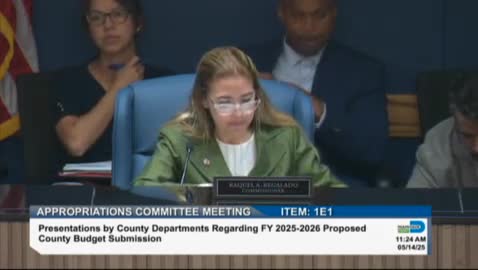
Miami-Dade officials present budget outlook showing roughly $387 million shortfall for FY 2026
Summary
Miami‑Dade County officials warned of a multi‑hundred million dollar gap for fiscal year 2026, driven by new constitutional office costs, revenue uncertainty and market inflation; constitutional officers’ separate budget requests could widen the gap to about $473 million.
Carla Denise Edwards, Miami‑Dade County chief administrative officer, told the Appropriations Committee on the morning of the meeting that the county is facing a “perfect storm of economic challenges” and currently projects a general‑fund shortfall for fiscal year 2026 of about $387,000,000.
The county’s budget presentation, prepared by the Office of Management and Budget, shows Miami‑Dade as a $12.7 billion organization with roughly 63% of that earmarked for operating expenses. OMB’s forecast projects countywide revenues and carryover for FY 2026 of about $3.2 billion against projected expenses of roughly $3.6 billion, leaving the $387 million gap. Edwards said that if constitutional officers receive additional funding beyond the administration’s 6% growth assumption, the deficit would grow to an estimated $473,000,000.
Why it matters: a gap of this size would force the county and the commission to choose among cutting services, raising fees, using one‑time reserves or changing planned spending. Edwards listed three principal cost drivers: the added expense of newly established constitutional offices, real and anticipated revenue pressures, and market‑driven cost increases for goods, services and labor.
Key numbers and drivers - County total budget (all funds): $12,700,000,000 (Edwards) - Projected FY26 general‑fund revenues and carryover: ~$3,200,000,000 - Projected FY26 general‑fund expenses: ~$3,600,000,000 - Projected shortfall based on current assumptions: $387,000,000 - Shortfall if constitutional office requests are fully met: ~$473,000,000
Edwards told commissioners the administration assumed a baseline 6–7% growth in county tax rolls when producing the forecast, and that negotiated collective‑bargaining increases (3% this year and 4% next year) and other contractual costs are significant expense drivers. She recommended a mix of expense management, fee reviews (solid waste, water/sewer, transit and others) and operational savings rather than a mayor‑driven millage increase.
Constitutional officers’ budgets - Elena Garcia, the supervisor of elections, presented a tentative FY25–26 operating budget request of about $52,000,000, of which $47,500,000 is requested from the general fund. Garcia said capital requests include $4,100,000 already approved for tabulation scanners and an additional $1,700,000 for voter check‑in stations and facility improvements. - Barbara Galvez, chief administrative officer for the Clerk of the Courts and Comptroller, said her office’s general‑fund request reflects roughly 4.5% growth and that internal revenue swaps and cost allocation changes made part of the request revenue‑neutral. Galvez told commissioners her office did not tap midyear supplemental reserves this year.
Housing and HUD funding risks Nathan Cogan of Housing and Community Development said Miami‑Dade administers about 19,000 housing choice vouchers and that the program is fully funded by HUD. He warned of an “unprecedented” national shortfall this fiscal year — some $3.7 billion nationally — and said the county is coordinating with the mayor’s office on federal advocacy and contingency planning.
What commissioners said Several commissioners pressed administration staff for more specificity, including a district‑level breakdown of where services and programs would be affected and clearer documentation of the funds the county set aside for constitutional office implementation. David Clodfelter of OMB said last year’s five‑year forecast showed a much smaller gap — roughly $53,000,000 — and attributed most of the deterioration to timing and decisions by newly formed constitutional offices, including the tax collector’s decision to operate as a fee officer, which OMB said increased county‑wide costs by about $107,000,000.
Next steps Edwards said OMB will continue updates and work with commissioners on fee reviews, operational savings and potential program reductions to produce a balanced FY26 budget for commission consideration.
Ending: Commissioners scheduled further budget presentations and indicated follow‑up work with constitutional officers and agencies to identify possible mitigations and preserve core services.