Comal County weighs recycling overhaul, tightens mulch drop-off rules after cost analysis
Loading...
Summary
Comal County staff presented a detailed cost analysis on May 15 on options to run the county recycling and mulch programs, and the Commissioners Court adopted a new brush policy that will stop accepting green-waste bags and tie residents’ ability to drop off brush to the county’s on-site mulch inventory.
Comal County staff presented a detailed cost analysis on May 15 on options to run the county recycling and mulch programs, and the Commissioners Court adopted a new brush policy that will stop accepting green-waste bags and tie residents’ ability to drop off brush to the county’s on-site mulch inventory.
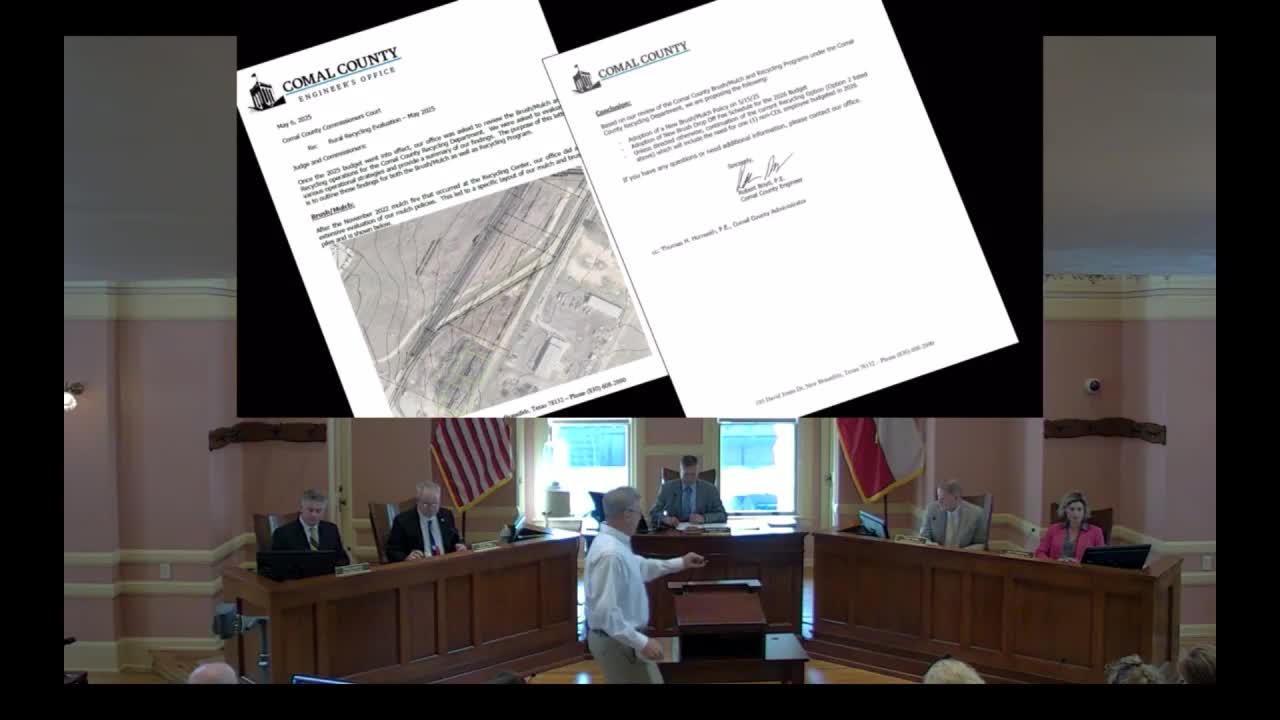
The report, delivered by Robert Boyd, a county staff member, examined nine options ranging from continuing single-stream collection at the Rural Recycling Center to reopening remote recycling sites with separated streams for cardboard and aluminum. Boyd said audits at a local materials-recovery facility (MRF) showed high contamination for single-stream loads and drove much of the analysis. "The first audit was all single stream and we had a 35% contamination rate," Boyd said during the workshop presentation. He told commissioners the county could instead focus on baling cardboard and aluminum or place compactors at selected sites.
Why it matters: the county must weigh operating costs, likely revenues and community access. Single-stream recycling requires large trucks and staff; commodity prices have fallen, making single-stream processing more expensive. The county’s mulch operation also has fire-safety and inventory constraints that affect whether residents can drop off brush and take mulch.
Key decisions and context Boyd told the court that the county’s mulching site is organized into six pile locations with a maximum inventory of about 26,667 cubic yards (six piles) produced from roughly 20,000 cubic yards of ground brush. The county will stop accepting brush if inventory exceeds six piles or 20,000 cubic yards of brush and will reopen drop-offs when inventory falls. "We're not accepting green waste bags anymore," Boyd told the court, citing contamination concerns that reduce product quality. The court approved the new brush policy (action agenda item 8) and directed staff to include proposed fee changes for brush drop-offs in the 2026 budget.
Costs, revenue and operational trade-offs The presentation broke down nine scenarios. Highlights included: - Single-stream at the Rural Recycling Center (option 1): no new labor required but an annual net operating cost estimated at about $130,000 after mulch/brush revenue. Disposal cost estimates were based on MRF audits and staff tonnage projections. - Single-stream with separated cardboard/aluminum at the Rural Center (option 2): adds one non-CDL staff member and reduced disposal costs; estimated net operating cost rose to about $148,000 annually. - Cardboard compactor options (option 3) and an approach that collects only cardboard and aluminum (option 4) were modeled; the latter produced the lowest net operating cost in the one-site scenarios because it eliminates single-stream disposal charges. - Reopening remote sites (options 5–9) added costs for additional CDL drivers and new trucks or trailers but improved local access and increased revenue projections from baled cardboard and aluminum. One modeled option that used dump trailers and separated streams across sites lowered operating cost compared with full single-stream collection countywide.
Revenue figures cited by staff included a purchasing estimate of about $45 per ton for baled cardboard and roughly $940 per ton for baled aluminum. Boyd said the county currently generates roughly one ton of cardboard per day and about one ton of aluminum every six weeks, based on recent volumes. He also said replacement cost for each recycling truck today is about $265,000 and the county spends about $70,000 annually on maintenance and fuel for three recycle trucks.
Public comment and local impacts West Leah Miller, executive director of the nonprofit food pantry Provisions, told the court that her organization relies on the county recycling program to dispose of large volumes of cardboard. "As the executive director for the food pantry, I'm appealing to you ... that the remote recycling locations be reinstated," Miller said. She told commissioners many low-income residents in unincorporated areas lack municipal collection options and depend on county sites.
Commissioner responses and next steps Commissioners asked whether county trucks could be repurposed if the court moved away from single-stream; Boyd answered the county could liquidate older trucks or retain them if market conditions for recyclables improved. Commissioners also discussed compactors and noted compactor service costs sometimes exceed expected revenue, effectively meaning the county would pay both hauling and disposal costs.
The court approved the new brush/mulch policy banning green-waste bags and linking brush drop-off to mulch inventory (action agenda item 8). Boyd said proposed fee increases for brush drop-offs (to be included in the 2026 budget) would raise commercial dump-truck drop-off fees from $40 to $150 and increase pickup/trailer fees by roughly 50% to better reflect processing costs and to produce a cleaner mulch product.
What remains undecided The commissioners did not select one of the nine model options to change the recycling footprint immediately. Boyd left the nine-option comparison table with costs, one-time equipment purchases and staffing impacts for the court’s follow-up. Commissioners indicated they will consider the fee schedule in the 2026 budget cycle and may take additional direction on whether to reopen remote sites, buy trucks/trailers, or pursue a limited cardboard-and-aluminum-only program.
Clarifying details - Mulch inventory: county staff described a six-pile system with a 26,667-cubic-yard threshold (six piles). When piles exceed internal temperature thresholds (about 60°C) or remain more than six months, staff may move material. - Contamination: Waste Management/MRF audits cited 35% contamination on a full single-stream audit and slightly lower contamination after cardboard/aluminum were removed. - Revenue assumptions: purchasing estimates cited ~$45/ton for baled cardboard and ~$940/ton for baled aluminum; county staff cautioned commodity markets fluctuate.
Ending Staff will include the proposed brush/mulch fee adjustments in the 2026 budget and return with implementation details. Commissioners signaled continued public interest in restoring local convenience sites but emphasized the county must balance service access, operating costs and market realities for recyclable commodities.