Get Full Government Meeting Transcripts, Videos, & Alerts Forever!
Get email alerts on the Cap And Invest topic
No spam. Unsubscribe anytime.
May Revision would extend 'cap-and-invest' to 2045 and shift $1.5 billion to Cal Fire; lawmakers and stakeholders warn of downstream cuts
Summary
The governor's May Revision proposes extending California's cap-and-trade program to 2045 and shifting $1.5 billion from the general fund to the Greenhouse Gas Reduction Fund for Cal Fire operations, drawing warnings from lawmakers and stakeholders about cuts to transit, housing, and community air programs.
The governor's May Revision proposes extending California's cap-and-trade program to 2045, relabeling it the "cap and invest" program, and shifting $1.5 billion from the general fund to the Greenhouse Gas Reduction Fund (GGRF) to support Cal Fire operations in 2025–26, rising to $1.9 billion by 2029–30.
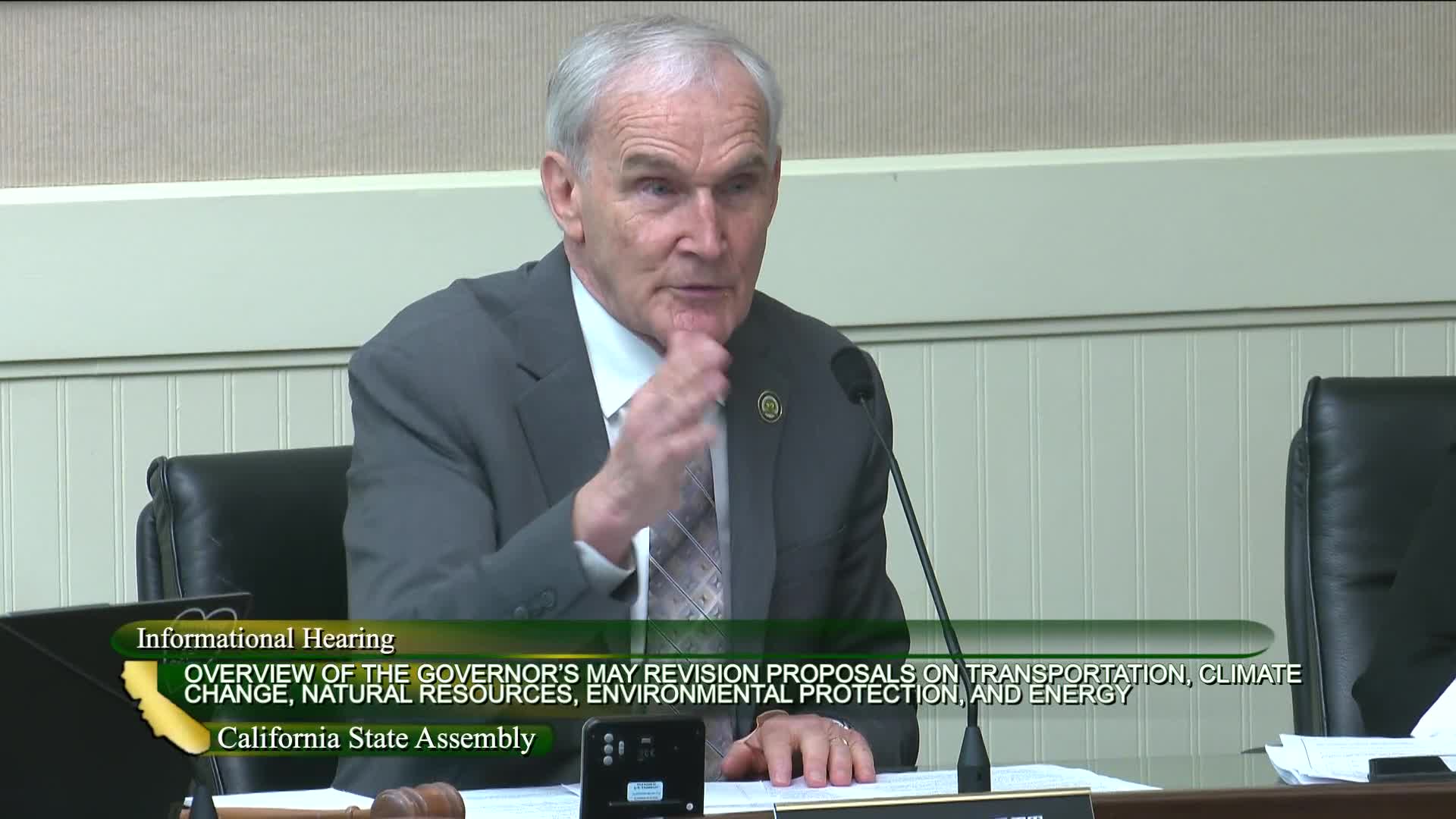
The measure, presented to Assembly Budget Subcommittee No. 4 by Department of Finance staff, frames the extension as a way to provide market certainty and align the program with the state's carbon neutrality goal. "The May revision, solves for a general fund budget problem," said Andrew Arch of the Department of Finance during the hearing.
Lawmakers expressed skepticism about the budget design and warned the shift could force cuts to programs that have already received awards or rely on continuous appropriations from GGRF. "I'm concerned that you're proposing to cut over a billion dollars from transit agencies that are struggling from money that was already committed to them," the subcommittee chair said, noting transit agencies had planned on previously announced funding. The chair asked the administration to identify which projects, if any, had already been awarded and would lose funding.
Department of Finance representatives told the panel the May Revision itself shows the Cal Fire shift but does not include a full discretionary spending plan for GGRF; the administration said remaining priorities would be negotiated with the Legislature. Stephen Benson, Department of Finance, confirmed the $1.5 billion figure and its growth trajectory: "The May revision includes 1.5 in 25–26, and it grows to 1.9 in 29–30." The administration also provided provisional language allowing Finance to replace a reduced GGRF appropriation with a matching general fund appropriation if auction proceeds come in lower than projected.
Stakeholders said the proposal risked substantial disruption. Michael Quintel of the California Transit Association said the May Revision threatened "a reduction of up to $3,000,000,000 between now and fiscal year 28–29," and warned that about $2 billion of that had already been committed to capital projects. Multiple housing and environmental organizations urged the Legislature to protect continuous appropriations used for programs such as the Affordable Housing and Sustainable Communities program and community air pollution reductions; speakers said those programs generate co-benefits for disadvantaged communities.
Several committee members also expressed concern that using a revenue stream tied to emissions auctions to fund an essential emergency service could be structurally unsound. "We should really think carefully about taking an essential government service like Cal Fire... and fund[ing] it from what is everybody recognizes is a temporary funding stream," the chair said.
Administration witnesses said no changes to statutory continuous appropriations were included in the May Revision document itself, and that the administration intended to negotiate an overall GGRF expenditure framework with the Legislature. The Legislative Analyst's Office told the committee it would provide written comments and a fuller analysis at the next hearing.
Next steps: Subcommittee members asked the administration to return with a detailed GGRF expenditure plan, an itemization of projects with prior commitments, and clarification on the general fund backstop mechanics. The committee scheduled further review and public comment for the next hearing.