Get Full Government Meeting Transcripts, Videos, & Alerts Forever!
Get email alerts on the Community Corrections Updates topic
No spam. Unsubscribe anytime.
Marion County officials outline staff-led CIT team, warn of $7 million state cuts and seek zoning records before AIC expansion
Summary
Community Corrections leaders described a staff-driven crisis intervention team proposal, said state Community Corrections grants face a $7 million reduction that could fully hit local programs in 2027, and said zoning records are needed before expanding treatment services at the Assessment and Intervention Center.
Marion County Community Corrections officials on May 15 told the Marion County Communications Advisory Board and Local Justice Reinvestment Advisory Council that they are developing a staff-led crisis intervention team, warned of a $7,000,000 reduction in state Community Corrections funding that could materially affect local grants by 2027, and said they need zoning and code records before moving forward on proposed treatment expansions at the county’s Assessment and Intervention Center.
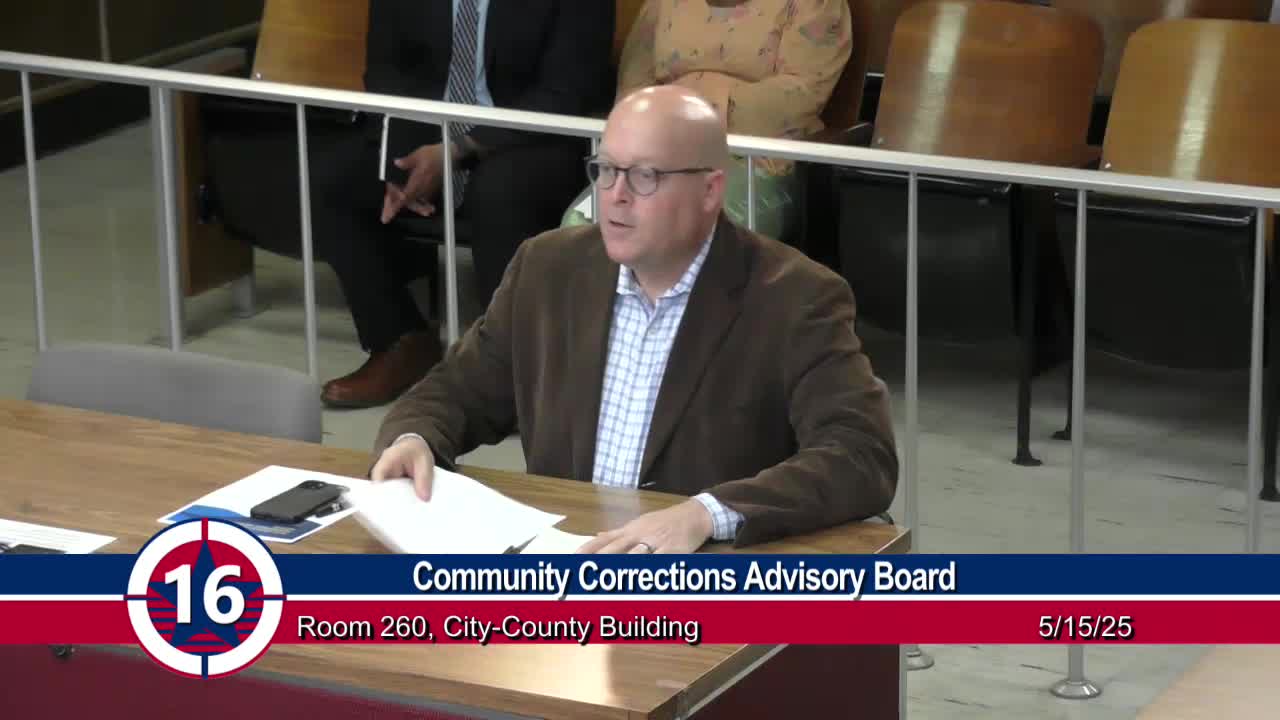
“1 of our team leaders, Alyssa Smith, recently attended crisis intervention training. And she has put together a proposal for, leadership within MCCC to basically create a CIT team, of our staff,” said Scott Holes, executive director of the Community Corrections Agency. Holes said the proposed team would allow case-management staff on the first floor to de-escalate lower-level incidents in office space without requesting uniformed deputies, and that staff are coordinating training and resources with the Indianapolis Metropolitan Police Department and other local trainers.
Holes credited Alyssa Smith for preparing the proposal: “It’s a very, very well done proposal. She put a lot of thought and effort into this.” He said most detention staff have had some CIT training but the proposal is for a dedicated, staff-based CIT team focused on case-management interactions rather than the response role already filled by deputies.
Holes also briefed the board on state budget changes. “We found out that the Indiana Department of Corrections Community Corrections Division is being cut by $7,000,000,” he said, adding that about $6.9 million of that will affect the grant portion of the division’s budget. He told the board state officials intend to use 2025 underspend in a non-reverting Community Corrections account to blunt the immediate impact and that the county will likely understand the local effect by July. “2026 will probably not be a huge impact,” he said; “2027, however, we will probably very likely feel, almost a total $7,000,000 cut impact, in that year.”
Holes said the Department of Corrections plans a review of programs statewide to identify compliance issues that may affect future grant eligibility. He said the state indicated decisions about cuts to county-level grant allocations would be implemented locally—each county board would decide how to prioritize reductions among programs—though he said the agency advocated for clearer state guidance rather than leaving prioritization solely to local boards.
Separately, Holes described ongoing work with the Indy Chamber to align job-placement efforts for justice-involved clients with local employer needs. He said the agency’s experience shows placement is generally successful but retention is the larger challenge; the Chamber has pointed the agency toward software tools intended to better match client interests and skills with in-demand local jobs, which Holes said could improve job fit and long-term employment.
On facility planning, Holes said the local Justice Reinvestment Advisory Council has concluded internal discussions about potential uses of the Assessment and Intervention Center but that the board needs the building’s code and zoning records before final recommendations. He listed possible options under consideration, including expanding a first-floor “monitoring center” model similar to one used at Eskenazi Health and using part of the second floor for group and individual therapy and medication-assisted bridge scripts, but said those options depend on what the building’s code and zoning allow.
Because the meeting lacked a quorum, Holes requested the board consider conducting a virtual vote on a PACE contract in the next day or two, with staff distributing documents for an electronic vote. “I would ask for the board’s consideration to be able to conduct that as a virtual vote, over the in the next day or 2,” he said. Chair Carla Duffy said she would check whether the procedure is allowed and follow up with counsel and staff.
No formal board votes occurred at the meeting. Holes said staff will distribute any new information on state grant impacts and zoning documents and will present recommended next steps once those records and budget numbers are available.