Get Full Government Meeting Transcripts, Videos, & Alerts Forever!
Get email alerts on the Municipal Budgeting topic
No spam. Unsubscribe anytime.
Queen Creek finance staff outlines $682.7 million tentative budget, infrastructure and staffing plans
Summary
Deputy Finance Director Dan Olson reviewed the town's tentative $682.7 million budget, growth assumptions, infrastructure spending and staffing increases, and described financing approaches for continued build-out.
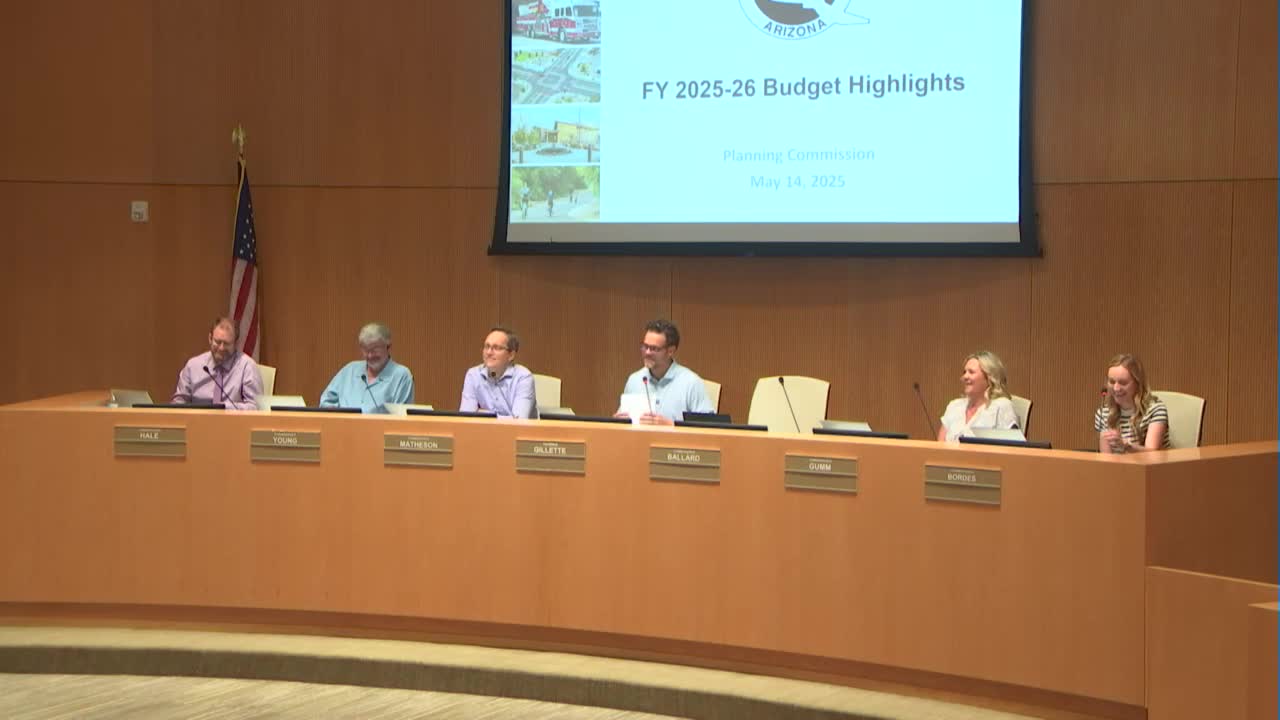
Deputy Director Dan Olson of Queen Creek's finance department reviewed the town's tentative budget, projections and financing approach during the commission's work study session.
Olson said the tentative budget the town council adopted as a tentative figure last week is $682.7 million and that the town expects revenue growth to remain positive though to taper from past double-digit rates. He said the town is budgeting 37 new positions, 21 of which are public safety-related, and that more than half of the proposed capital program funds will be used for infrastructure such as roads, utilities and vertical construction.
Olson described population and revenue forecasting methods used by staff: projections driven by current zoning, known developments and annual "dot maps" that locate current and expected housing growth. Using those methods, staff projects the town will exceed 89,000 residents in the near term and uses a 2050 horizon for long-range build-out assumptions.
On revenue sources, Olson noted sales tax is the single largest component of operating revenue and pointed out that construction-related sales tax and state-shared revenues tied to population growth also contribute. He said the council has directed a 15% increase in water and wastewater rates, and that the town will communicate more details to residents in the near term.
To fund large infrastructure items, Olson said the town relies on a mix of debt issuances and restricted cash sources such as impact fees and construction-related sales tax. He explained that the town matches the timing of infrastructure costs to who benefits, often spreading costs over multiple years through debt so future users also contribute. Olson said the budget employs five-year projections to identify timing risks and one-time capital items that can be funded from savings (fund balance).
Olson highlighted key financial-management practices: budgeting from the town's strategic plan and master plans, running multi-year projections to assess sustainability, and maintaining operating reserves. He stated the town has an operating-reserve policy set at 25% of the next year's revenues.
Commissioners asked questions about the timing and sources of funding for long-term build-out; Olson replied the town will primarily use debt over the next decade and also rely on impact fees and construction sales tax. He said multi-family development has become a larger factor in recent years compared with the prior focus on single-family housing, and that the finance team and development services staff collaborate closely on population and revenue projections.
Olson encouraged commissioners to review budget materials posted on the town website and invited follow-up questions.