Get Full Government Meeting Transcripts, Videos, & Alerts Forever!
Get email alerts on the Free Speech Upipa topic
No spam. Unsubscribe anytime.
Utah Supreme Court weighs whether anti‑SLAPP law shields parent who complained about teacher
Summary
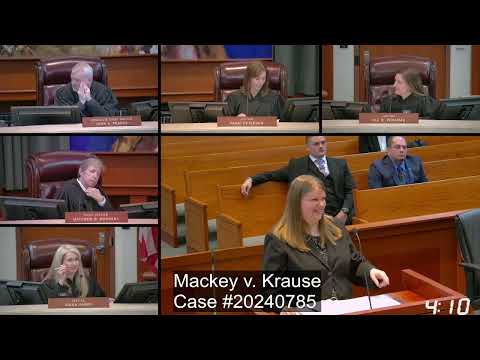
At oral argument in Mackie v. Krauss, justices pressed lawyers on when Utah’s Uniform Public Expression Protection Act (UPIPA) protects parents who speak to school officials and at school board meetings from defamation suits, and on how courts should treat evidence and privileges under the statute’s expedited procedures.
The Utah Supreme Court heard oral argument in Mackie v. Krauss over whether Utah’s Uniform Public Expression Protection Act, known as UPIPA, protects a parent who complained about a teacher at a school board meeting and in follow‑up communications from a subsequent defamation lawsuit.
At issue is whether the parent’s statements were “on a matter of public concern” under UPIPA and therefore subject to the statute’s expedited procedure for dismissing suits the law aims to deter as meritless or chilling to public speech.
Why it matters: UPIPA (the state’s anti‑SLAPP framework) creates a faster path to dismiss claims that arise from protected petitioning, press, speech, assembly or association on matters of public concern. The court’s construction of “matter of public concern,” how the three UPIPA procedural phases interact, and what evidence a responding party may rely on at each phase could affect defamation litigation arising from school complaints statewide.
During argument the court focused on three recurring questions: (1) what a workable definition of “matter of public concern” is under UPIPA; (2) whether the statements at the public school board meeting, a private follow‑up call with the superintendent, and a later email with attached notes are covered by the statute; and (3) how UPIPA’s phased burdens (the statute’s so‑called phase 1/2/3 structure) reconcile pleadings, summary evidence and defenses such as conditional or absolute privileges.
Counsel for the appellant argued the statute was meant to be broadly protective of petitioning and speech on public matters and that the parent’s communications fit one of UPIPA’s buckets (governmental proceedings or communications about issues under consideration in governmental proceedings). Counsel for the plaintiff, Ryan Bell, said the Act is aimed at stopping “meritless claims” brought to chill speech but argued the record in this case shows facts supporting the complaint and that UPIPA should not be applied to bar a meritorious defamation action. “This is a statute that is intended to stop meritless claims,” Bell told the court.
Justices pressing both sides sought limiting principles for “public concern.” One justice cited the U.S. Supreme Court’s test in Snyder v. Phelps — speech is of public concern if it can be fairly considered as relating to political, social or other community matters — and asked whether that community‑focused formulation would be workable in Utah. Appellate counsel agreed the Snyder formulation was a useful starting point but emphasized UPIPA’s statutory language restricts coverage to particular contexts (governmental proceedings, communications under consideration in those proceedings, and a catch‑all for matters of public concern).
The lawyers also disputed which communications underlie the teacher’s complaint. The record, as counsel described it at argument, includes: a school board meeting on Dec. 6; a follow‑up call with the superintendent on Dec. 9; and a set of notes the parent provided to the superintendent on Dec. 13. A youth‑reporting form and a police report dated Dec. 14 also appear in the record. Counsel for the plaintiff said the complaint rests on statements at the board meeting, the private call and, he argued, the notes and related reporting; defense counsel countered that the complaint does not specifically plead the notes and that UPIPA motion practice asks courts to focus on the pleadings and the admissible evidence presented at the expedited stage.
A separate line of questioning addressed how much weight a court may give to evidence that was not pleaded in the complaint but was submitted in opposition or reply papers supporting or opposing a UPIPA motion. The statute’s proof provision (section 106 in the record) permits the court to consider pleadings and evidence similar to a motion for summary judgment; justices asked whether that allows the court to draw inferences for the non‑moving party at the prima facie stage or whether courts must limit themselves to whether, if the opposing party’s evidence were believed, it would establish each element of the claim without drawing additional inferences.
Privilege disputes were central to argument. Counsel debated whether absolute or conditional privileges that protect certain communications in governmental proceedings should be litigated in the UPIPA process or deferred to later stages. Plaintiff’s counsel argued the record contains evidence sufficient to show abuse of any conditional privilege — citing evidence of alleged ill will, alleged reckless disregard for the truth, and witness statements that the underlying incidents were not reported the same way to investigators — and said those matters are appropriate for the court to consider in determining whether the motion should be dismissed. The defense argued privileges are affirmative defenses and that allowing broad fact‑intensive privilege challenges at the UPIPA stage would undercut the statute’s aim and force plaintiffs to plead and prove extensive factual detail at filing.
Several justices asked about the role of the uniform act’s commentary and whether the court may consult the drafters’ comments or other states’ interpretations for guidance. Counsel agreed the comments are not binding but said they can be persuasive when construing a recently enacted uniform statute.
On factual chronology, counsel and the court discussed that the notes were provided to the superintendent on Dec. 13 and a police report appears dated Dec. 14; the parties told the court they were uncertain who actually made the police report and that the record includes a school youth‑reporting form indicating reports were made to both DCFS and police. Counsel acknowledged the parent was not deposed in the district court, and the justices asked whether evidence produced during expedited briefing or discovery properly can be used to supplement or amend the complaint for UPIPA purposes.
The court took the case under advisement and said it will issue an opinion. No ruling was announced at the argument session.
The arguments center on whether UPIPA’s protections will broadly cover parents who bring school‑related complaints or whether the statute should be limited where communications are private, directed to a superintendent, or arise from allegations that a plaintiff says were not only public in scope. The court’s decision will guide lower courts on applying UPIPA’s scope, the treatment of pleadings versus submitted evidence during the expedited process, and how privileges and the “public concern” inquiry interact in school‑related defamation disputes.