Get Full Government Meeting Transcripts, Videos, & Alerts Forever!
Get email alerts on the Governmental Immunity topic
No spam. Unsubscribe anytime.
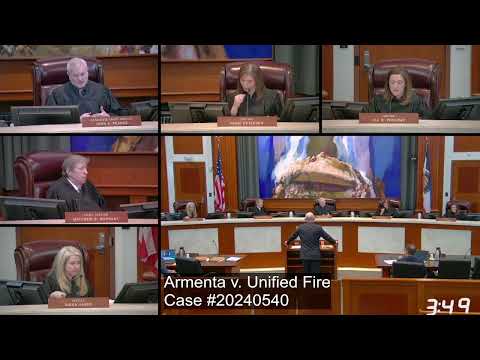
Utah Supreme Court hears challenge to immunity for municipal 911 medical responders in Armenta v. United Fire Authority
Summary
The Utah Supreme Court heard argument over whether the Governmental Immunity Act's exception for "emergency medical assistance" shields United Fire Authority from a negligence suit by George Armenta, who alleges paramedics failed to diagnose a heart attack during a 911 response.
The Utah Supreme Court on Tuesday heard argument in Armenta v. United Fire Authority over whether the Governmental Immunity Act protects municipal 911 medical responders from negligence suits when they evaluate and treat people at the scene of an emergency.
Terrence Rooney, counsel for petitioner George Armenta, told the court that on the day at issue Armenta "experienced the most terrifying experience he's had in his life" when he became nauseous, dizzy and lost consciousness; Rooney said family members called 911 and a United Fire Authority ambulance crew responded and that Armenta alleges the crew "denied him a recourse" after failing to diagnose a heart attack.
The case turns on the act's use of the phrase "emergency medical assistance" and whether that term covers ambulance and paramedic care provided in response to 911 calls or instead was intended to reach only certain on‑scene, event‑driven aid (for example, firefighters pulling people from burning buildings or responders at a hazardous‑materials incident). Rooney argued that the statute's language and structure show the legislature distinguished "assistance" from ambulance "services," and that the immunity provision instead protects responders who act while addressing a broader emergency rather than routine 911 medical responses.
Andrew Roth, counsel for Unified Fire Authority (UFA), urged a broader plain‑text reading, saying "emergency medical assistance" is a wide term that can include "any kind of aid provided that is medical in nature, that is provided in the context of an emergency." Roth told the court the statute's text and ordinary meaning counsel in favor of coverage for government actors who respond to 911 calls and render on‑scene medical care.
Justices pressed both sides on distinguishing (1) the act of transporting an injured person to a place where medical care can be provided and (2) the on‑scene, diagnostic and therapeutic acts performed by EMTs and paramedics. Several justices noted that the statute lists a number of activities (fighting fire, evacuations, handling hazardous materials) that appear to contemplate event‑driven emergencies. Rooney argued that reading the provision to protect ambulance or hospital emergency‑room care would sweep in entities the legislature did not intend to immunize — a point Justice Pierce and others pressed when asking whether the statute, if read broadly, might raise Open Courts Clause concerns.
Roth responded that if the statutory text is read as written, constitutional challenges (including Open Courts Clause claims) are the proper remedy for parties who claim the statute eliminates a pre‑existing right of action. He also urged the court to treat the immunity question with the standard tests used in prior decisions (the so‑called Stanford/open‑courts inquiries) and noted practical facts in the record: UFA historically contracted ambulance transport with Gold Cross (UFA's website referenced a Gold Cross arrangement from February 2004 through July 2008), and UFA's billing figures were discussed in briefing (Roth said UFA billed roughly $20 million and collected about $9 million in 2021).
The justices asked detailed questions about whether the emergency determination should be measured from the caller's perspective (someone believing they need emergency care) or from the responding governmental actor's perspective (the responder's assessment and actions on scene). Counsel for Armenta said the "event" framing — that the statute protects responders in the course of addressing discrete events like fires or chemical spills — was central to his reading and that ambulance transport historically was a private, contractable function in Utah. Counsel for UFA countered that the statutory phrase "assistance" is broader than other code uses of "services," and that textual analysis supports inclusion of 911 medical responses.
No decision was reached at argument. The court took the case under advisement to consider whether the Governmental Immunity Act's emergency medical assistance exception covers UFA's conduct on the facts alleged and whether any application would run afoul of the Utah Constitution's Open Courts provision.