Get Full Government Meeting Transcripts, Videos, & Alerts Forever!
Get email alerts on the County Budget topic
No spam. Unsubscribe anytime.
Lancaster County council outlines no-millage first-reading budget, adds half-year staffing and public-safety investments
Summary
Council members agreed on a no-millage first-reading budget for presentation May 27, directing staff to include several half‑year positions, a reallocated EMS equipment post, and use of fund balance for additional surveillance cameras while keeping options for other adjustments.
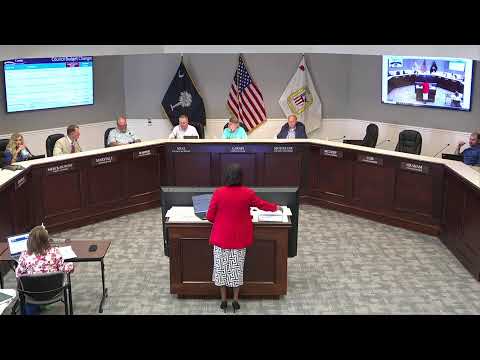
Lancaster County Council on a budget workshop agreed to present a balanced budget for first reading on May 27 that, as discussed, will not propose a millage increase but will include targeted adjustments and limited use of fund balance.
The council’s discussion centered on how to allocate roughly $8 million in projected new revenue and about $1.64 million of proposed additions requested by council members since the last meeting. Miss Harris, a county finance staff member, told the council the projection reflects top-line new revenue of “just over $8,000,000” and a total general fund near “just over $104,000,000.” She also walked the council through multiple position and policy options raised since the prior meeting.
Why this matters: Council members said they want to preserve fiscal health while responding to public-safety needs, staff pay compression, and service expansions. The council identified roughly $1,000,000 in available programming from new revenue and agreed to use fund balance for specific one-time items so the overall 2026 budget can be presented at first reading without a millage increase.
Most of the substantive changes the council agreed to were compromises intended to keep the budget balanced without raising property tax rates. The council decided to: - Present a no-millage first-reading budget on May 27 while retaining roughly $303,000 (after some reinsertions) in additional programming capacity from the available revenue projection. - Restore the coroner’s career-ladder increase (6 positions at $7,500 each as previously proposed) into the package. - Convert one proposed “accreditation officer” position into an equipment manager role and fund it at a half-year level for the coming fiscal year. - Add EMS staffing (the 3 EMTs and 3 paramedics previously proposed) at half‑year funding; council members discussed but did not approve full-year funding at this meeting. - Approve adding 30 additional networked enforcement cameras (to be procured with fund balance), on top of five already budgeted, for a total of 35 cameras programmed in the fund-balance appropriation.
Public-safety investments and EMS staffing: Council member Harper (council member) urged technology investments after recent crimes were solved using camera footage, saying he would “like to see us commit additional funds to our camera system, possibly adding an additional 30 cameras that would cost about a hundred and $25,000 a year.” Sheriff Hale confirmed the cameras have been helpful in investigations and told the council, “they come at $3,500 a piece,” noting an additional one-time installation figure discussed in the meeting. County staff said five cameras were already included in the fund-balance use and that adding 30 more could be accommodated by moving roughly $125,000 from fund balance into the camera line.
EMS leaders and equipment support: Mister Cato, an EMS official, confirmed the six positions discussed would staff the Indian Land station and “would give us 4 trucks in Indian Land plus a Q RV.” EMS leadership and council members negotiated prioritizing an equipment manager over an accreditation officer this year; the equipment manager would handle maintenance of stretchers, AEDs and other county medical devices and reduce the burden on IT staff who have been doing some equipment work informally. Council also discussed compaction and pay compression across county staff tied to a proposed $5% across-the-board increase and a separate $15 minimum wage proposal. Miss Harris presented a model to address compression, estimating approximately $180,000 to implement a two-tier adjustment for hourly staff above the new $15 minimum.
Other programming changes: The council removed several lower-priority items and converted some proposed new positions to half-year starts (for example, the adaptive sports coordinator and convenience-site part-time staff). Council members also asked staff to add a line for increased EMS medical-supply and postage costs (staff reported EMS is about $13,000 over this year’s medical-supply allotment and that postage costs are also higher), which staff said they will finalize for first reading.
Process and next steps: Miss Harris and county finance staff will prepare a first-reading budget ordinance for May 27 that reflects the council’s directions (no millage increase, half-year funding for specified positions, fund-balance purchases for cameras and other one-time items). The council will have opportunity to amend the ordinance at first reading and will hold a public hearing before third reading. Council member Mosteller moved to adjourn at the end of the session; the motion was seconded by Mister Neal and the meeting closed.
The discussion was primarily directive rather than a set of final policy votes, and several items (full-year EMS staffing levels, the sheriff’s proposed medical contract funding and longer-term compaction remedies) remain subject to further council action or contract discussions.