Get Full Government Meeting Transcripts, Videos, & Alerts Forever!
Get email alerts on the Vision Zero topic
No spam. Unsubscribe anytime.
Santa Clara outlines Vision Zero plan, cites survey showing safety hot spots on southern corridors
Summary
City staff and consultants presented a draft Vision Zero implementation approach after two prior workshops and a city survey; the plan prioritizes a high-injury network, a countermeasure toolbox and a phased implementation tied to grant opportunities such as Safe Streets for All.
City of Santa Clara staff and their consultants presented a draft Vision Zero implementation plan at a community webinar, describing a data-driven program to reduce traffic fatalities and severe injuries and identifying priority corridors and near-, mid- and long-term countermeasures.
The city’s traffic engineering lead, Nicole He, said the project aims to produce a draft Vision Zero plan “later in the summer” and complete the planning effort by the end of the year. She said the plan couples collision analysis with public feedback to prioritize projects and programs across engineering, enforcement, education and emergency response.
The plan uses an eight-year collision dataset and a high-injury network to focus resources. Robert Paderno of consultant Kimley Horn said the analysis covered collisions from 2016–2023 and showed “approximately 60% of all collisions occurred on 16% of the road network.” Paderno and other presenters described a countermeasure toolbox that includes lane reallocation (road diets), high‑visibility crosswalks, refuge islands, curb extensions, roundabouts, signal timing changes and rapid‑flashing beacons.
Why it matters: staff and consultants said concentrating interventions on a high-injury network allows Santa Clara to target finite funding and to increase the likelihood that changes will reduce severe outcomes. The plan also establishes programmatic elements — a continuing Vision Zero working group, an implementation funding program and annual public progress reports — intended to sustain and track work after adoption.
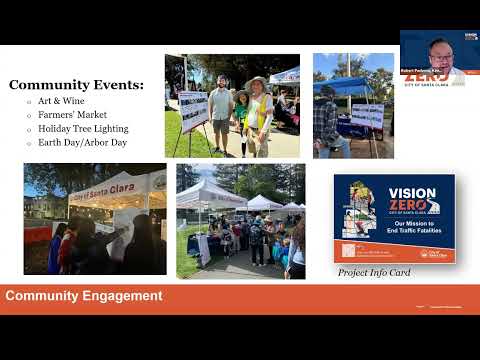
Survey and public engagement: staff reported an online community survey that launched in mid‑February and closed April 7. Nicole He and Paderno said the survey received 729 responses from 621 unique contributors and that most comments focused on the southern portion of the high‑injury network. Respondents ranked enforcement against red‑light running and speeding, traffic calming measures (speed humps, roundabouts) and improved signage and striping among the top interventions.
Implementation approach and funding: presenters described a phased approach. Near‑term work is expected to emphasize low‑cost, quick actions that can be bundled with existing capital programs (striping, speed feedback signs); midterm work includes moderate construction or design projects; and long‑term items could require right‑of‑way acquisition or utility relocation (for example, some roundabouts). Nicole He told attendees staff would pursue federal grant opportunities including the Safe Streets for All program and would also seek state and local funding.
Engineering and program details: the team described potential engineering changes such as curb neckdowns, dedicated turn lanes, conversion of signals to roundabouts, bike detection at signals and reallocation of lane space for separated bicycle facilities. Mike Colte, Kimley Horn, said Vision Zero strategies will also address people, speeds, vehicles and post‑crash care — including education campaigns, targeted enforcement and emergency response improvements such as “Stop the Bleed” training and equipment.
Next steps: the city will host a third community workshop to present priority project improvements (tentatively June 30), and staff said a third online survey will launch at the end of the month. The project website and mailing list will carry the draft and final plan and annual progress materials once adopted.
Quotes from the meeting include: “We plan on delivering the draft Vision 0 plan later in the summer,” Nicole He said. Robert Paderno summarized the data approach: “We used collision data collected and analyzed between the years of 2016 to 2023.” Mike Colte added that “engineering is just one part of the puzzle” and that enforcement, education and emergency response are integral to reducing harm.
Ending: The city asked residents to continue participating in outreach events, take the next survey and attend the June workshop so staff can refine the priority projects and the implementation schedule.