Get Full Government Meeting Transcripts, Videos, & Alerts Forever!
Get email alerts on the Operations topic
No spam. Unsubscribe anytime.
Houston Airport System to add incident command center, return to general manager model and reshape operations
Summary
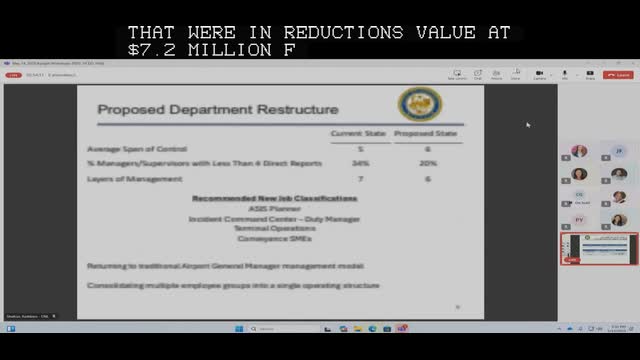
Director Jim Sechniak outlined an organizational restructure that includes an incident command center to consolidate dispatch, TSA operations and gate control, a return to a general manager model at both airports, reduced management layers and a proposed specialized airport/aviation planner job classification.
Director Jim Sechniak told the council the Houston Airport System will restructure front-line operations to improve day-to-day oversight and emergency response. The plan includes opening an Incident Command Center (ICC) to bring call taking, TSA operations, maintenance dispatch, gate control and airfield operations into a single operations hub.
Sechniak said the airport will return to a general manager model at both George Bush Intercontinental Airport (IAH) and William P. Hobby Airport (Hobby) so senior staff can focus on systemwide strategy while on-site general managers handle daily terminal operations. The airport also plans to consolidate multiple employee groups into a single terminal-operations structure to break down work silos.
Personnel, buyouts and span of control
Sechniak said 370 employees were eligible for a buyout and that 102 accepted the offer — roughly 28% of those eligible — and that the April 20 budget included about 60 reductions valued at roughly $7,200,000. He said the organization’s average span of control will move from about five to six and that layers of management will be reduced from seven to six. Sechniak also said the airport plans to create a specialized airport and aviation planner classification.
Safety and emergency response
The ICC is expected to improve situational awareness and coordination by co-locating operations staff with TSA’s operational presence, maintenance dispatch, gate control and airfield operations. Sechniak said the ICC will include a designated command duty manager and subject-matter experts responsible for specialized systems to ensure proper contract oversight.
Why it matters: the changes are intended to speed decision-making on the ground, improve coordination during incidents and provide clearer career paths for front-line employees who work curbside and traffic operations.
Ending
Council members asked operational questions later in the session related to employee parking and career-path implications for curbside workers. Sechniak said the restructure is intended to improve daily operations and emergency response and that specific job classifications and staffing changes will be advanced through the normal personnel and budget processes.