Get Full Government Meeting Transcripts, Videos, & Alerts Forever!
Get email alerts on the Carolina Heel Splitter topic
No spam. Unsubscribe anytime.
Lancaster County reviews Carolina Heel Splitter credit program; staff says credits sold out, exploring local mitigation
Summary
Development services staff summarized the county's Carolina Heel Splitter credit requirement for projects in the 6 Mile Creek watershed, said the credit bank has sold out, and told council staff is exploring internal mitigation projects and an account to hold credits for projects that reach certificate of occupancy.
Lancaster County development services staff told council the county's Carolina Heel Splitter credit program — a local mitigation-credit scheme tied to the federally listed Carolina heelsplitter mussel — has exhausted available banked credits and that county staff are exploring alternatives, including an internal mitigation project.
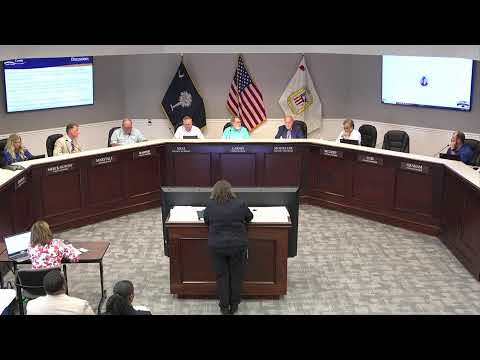
At a council meeting, Lisonbee Harden, introduced as the county's development services director, reviewed the Carolina Heel Splitter overlay and the credit requirement tied to projects in the 6 Mile Creek watershed. Harden said the county coordinated an agreement with the U.S. Fish and Wildlife Service and a mitigation bank operator (Resource Environmental Solutions, later referenced in conversation) that requires developers in the watershed to purchase environmental-bank credits to offset impacts to heelsplitter habitat.
Why it matters: The Carolina heelsplitter (a small freshwater mussel) is federally listed as endangered in 1993. Harden said the overlay and credit program were designed to reduce sedimentation and other impacts in the Catawba River and its tributaries, including 6 Mile Creek, by requiring mitigation credits when developments disturb riparian buffers or impervious surfaces in the watershed.
Credit pricing and project history: Harden described the credit-price history staff has tracked: $6,900 per credit in 2020; $8,900 for a sale in May 2023; and staff are holding a budget assumption of $9,500 per credit for planning purposes. Harden said three projects were part of the original agreement: project 1 (estimated 388.1 credits; credits delivered by 2017), and project 2 (estimated 573.4 credits; credits sold out in 2023). Harden said there is not yet a confirmed project 3 and that Fish and Wildlife must approve any future project that would provide additional credits.
Operational approach while credits are exhausted: Harden said staff previously required developers to purchase credits before a permit was issued, but with credits sold out they have required proof of credit purchase before certificate of occupancy for some projects and have included a line item in last year's budget to hold funds earmarked for purchases of Carolina Heel Splitter credits when projects reach CO. Harden said staff are evaluating whether to convert some of the credit funds into an internal county project to stabilize the 6 Mile Creek watershed, reduce turbidity and improve water quality; that approach would include sending funds to Fish and Wildlife for credits and using some monies for local remediation.
Questions and next steps: Council members asked for documentation of the original contract and records. Harden said some Fish and Wildlife records are proprietary or redacted, and staff have been working since 2023 to compile records and will provide notebooks and digital copies on request. Council members also discussed whether the requirement for three bank projects remains in force; Harden said staff are in contact with Fish and Wildlife and the regional coordinators but did not provide a final determination at the meeting. Any change to the county's approach would require coordination with Fish and Wildlife and possibly changes to the UDO.
Ending: No formal statutory or regulatory change was adopted at the meeting. Staff asked for direction to continue researching options, provide the original agreement and supporting documents to council, and pursue coordination with Fish and Wildlife on project 3 or alternative mitigation approaches.