Get Full Government Meeting Transcripts, Videos, & Alerts Forever!
Get email alerts on the Stormwater Management topic
No spam. Unsubscribe anytime.
Lancaster County stormwater staff outline needs for updated plan, ordinance and enforcement
Summary
County stormwater staff told council they have increased plan reviews and inspections, saved money by moving lab work and reporting in-house, and need an updated stormwater management plan, an enforcement response plan, and an ordinance to support enforcement. Council asked about fees, department placement and developer warranties.
Lancaster County stormwater staff provided council with a progress report and asked for authority to tighten rules and enforcement, saying they have increased inspections and plan reviews while bringing some technical work in-house to save county funds.
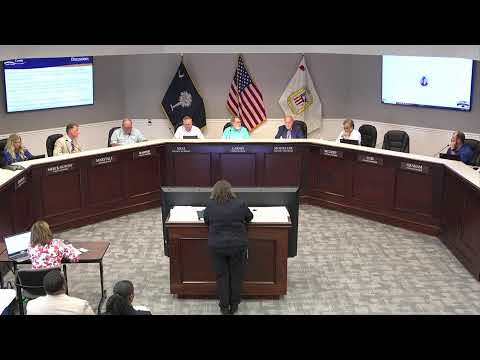
In a presentation to Lancaster County Council, Terrence Barr, introduced as director of the county's stormwater program, said the department reviewed 228 development plans to date for fiscal 2025 and performed 812 inspections so far this year, up from about 700 last year. Barr said the county has inspected 187 of 208 post-construction stormwater control measures, which he described as "over 90%." He also said the county has moved lab water-quality analyses and inspection reporting in-house, saving the county roughly $14,000 on lab work and about $8,000 previously spent on a cloud reporting vendor.
Why it matters: Barr told council the county is operating under a small MS4 regulatory framework for a portion of the county (the panhandle above Highway 5) and must meet permit requirements that include a stormwater management program plan, pollution-control practices, monitoring and reporting, public participation, and yearly evaluation. Barr said the county has not updated its stormwater management program plan since 2018 and needs a new enforcement response plan and an ordinance to back stronger enforcement.
Details of the presentation: Barr described day-to-day challenges the department faces, including large-scale grading left open rather than done in phased increments, inconsistent plan quality from submitters, and new staff needing training. He said the county previously relied on a single regional inspector at the state agency and that the local program now allows the county to manage inspections directly. Angela Crockett, introduced as the department's deputy, summarized permit elements and said public involvement and annual updates are required under the MPDS permit the county follows.
Council questions and staff responses: Council members pressed for specifics. Council member Billy Mosteller asked whether the plan reviews included residential lots; Barr confirmed they do. Council member Charlene McGriff and others asked whether stormwater belongs under Public Works; County staff (Mister Marsdahl) said the program was moved to Development Services around 2017–2020 because of development workload but agreed to explore whether returning it to Public Works would increase synergy. Barr said staff can and will explore options.
Fees and financials: Barr said the county's stormwater fee for single-family homes is $60, which he compared to a neighboring jurisdiction's $78 fee. Council asked how that fee is set; staff said the fee is set in the budget and is calculated using an ERU (equivalent runoff unit) based on impervious surface area. Staff also said commercial fees have a different calculation and caps (discussed as a $60 base for single-family and separate commercial calculation, described in the presentation as "ERU for impervious surfaces").
Policy next steps: Barr and other staff asked council to approve work on an enforcement response plan, updated maps, staff training, and an updated stormwater management program plan. Barr said the department has drafted a stormwater ordinance that will be brought to council for consideration; once adopted, it would allow the county to impose stronger standards than the minimum DES requirements.
Votes at a glance: The only formal vote recorded in the provided transcript was council approval of the meeting agenda at the start of the session. The motion to approve the agenda was made by Charlene McGriff, seconded by Stuart Graham, and the record shows all named council members present voted to approve.
Ending: Staff did not request a final policy vote on stormwater at this meeting but asked council to direct follow-up work on an ordinance, enforcement plan and training; council members signaled interest in exploring developer warranties or extended guarantees during the UDO update. A formal ordinance or fee change will require subsequent council action.