Get Full Government Meeting Transcripts, Videos, & Alerts Forever!
Get email alerts on the Ems And Community Paramedicine topic
No spam. Unsubscribe anytime.
SFFD EMS reports improved ambulance turnover but plans to fold street overdose response into expanded neighborhood crisis teams
Summary
Deputy Chief Simon Pang told the Fire Commission that ambulance offload times are improving but remain above the statewide benchmark, and that the department will reassign street overdose resources into larger neighborhood street crisis teams starting July 1.
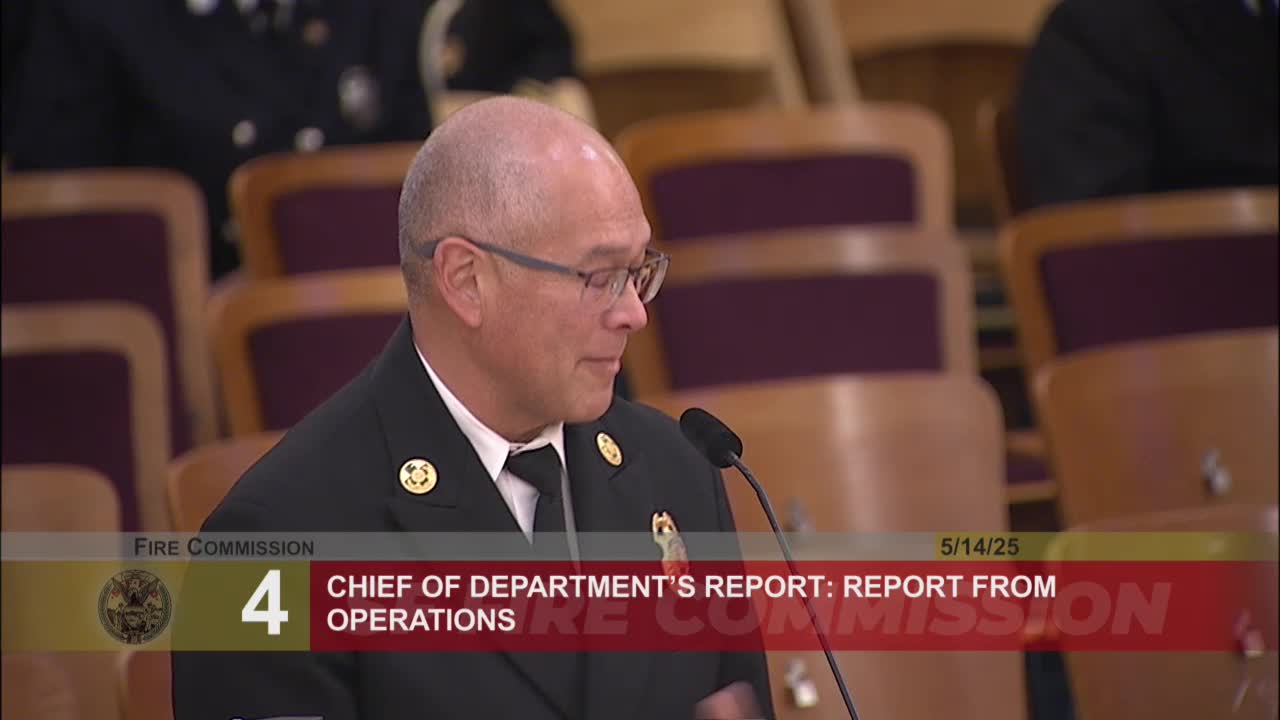
Deputy Chief Simon Pang told the San Francisco Fire Commission on May 14 that ambulance-patient-offload-time (APOT) delays have improved but remained above the statewide benchmark, and that the department will reorganize its street-overdose response units into a broader neighborhood street crisis structure this summer.
Pang reported that total ambulance dispatches in April were 11,364 citywide (including private ambulance companies) and that San Francisco Fire Department ambulances were dispatched to 7,912 calls. He said the department'9s average APOT delay at hospitals in April was 39.6 minutes, compared with a statewide benchmark of 30 minutes; he estimated that delay represented roughly 180 ambulance hours and 360 crew-member hours lost to hospital holds.
Pang said the department has worked with hospitals and the local emergency medical services agency to streamline the process that triggers an APOT alert, a step that allows ambulances to selectively divert to alternate hospitals when backed up. He credited Assistant Deputy Chief Tony Malloy with suggesting changes to policy 4000.1 that simplified the APOT-alert process.
On overdose and street response, Pang said the department will demobilize the dedicated Street Overdose Response Team on July 1 and fold those staff into larger neighborhood street crisis teams and EMS-6 operations. "We simply have to do more with less," he said, describing budget constraints and rising call volumes for street crisis work. The department plans to align six neighborhood street teams (organized by police districts) and a citywide team; SFFD will contribute community-paramedicine captains and staff to those teams.
Pang also reviewed clinical activity: in April there were 24 resuscitations attempted with 10 patients achieving return of spontaneous circulation upon arrival at hospital. He described growth in advanced interventions: paramedics used intraosseous (IO) access 41 times in April and highlighted a recent case in which prompt IO use and coordinated care contributed to rapid transport to a trauma center.
Pang presented aggregate Narcan data showing people who received naloxone in April numbered about the same as March; he said approximately 30 percent of people who received Narcan were unhoused, with 29 percent listed as "unknown" housing status. He also highlighted the department'9s outreach and training programs, including mobile training teams that provide short, in-person training modules to crews at hospitals and elsewhere.
Commissioners asked about the change to the street overdose team and whether core overdose services would continue; Pang said EMS-6 captains and neighborhood teams will maintain overdose outreach and post-overdose follow-up in the reorganized model.