Get Full Government Meeting Transcripts, Videos, & Alerts Forever!
Get email alerts on the Federal Funding Cuts topic
No spam. Unsubscribe anytime.
Federal grant cuts leave California arts institutions scrambling; lawmakers hear appeals for state backup
Summary
SACRAMENTO — Lawmakers and arts leaders warned at a joint informational hearing that abrupt federal actions and a proposed White House budget that zeros out the NEA, NEH and IMLS have already halted grants and disrupted arts programming across California.
SACRAMENTO — Lawmakers and arts leaders warned at a joint informational hearing that abrupt federal actions and a proposed White House budget that zeros out the National Endowment for the Arts (NEA), National Endowment for the Humanities (NEH) and the Institute of Museum and Library Services (IMLS) have already halted grants and disrupted arts programming across California.
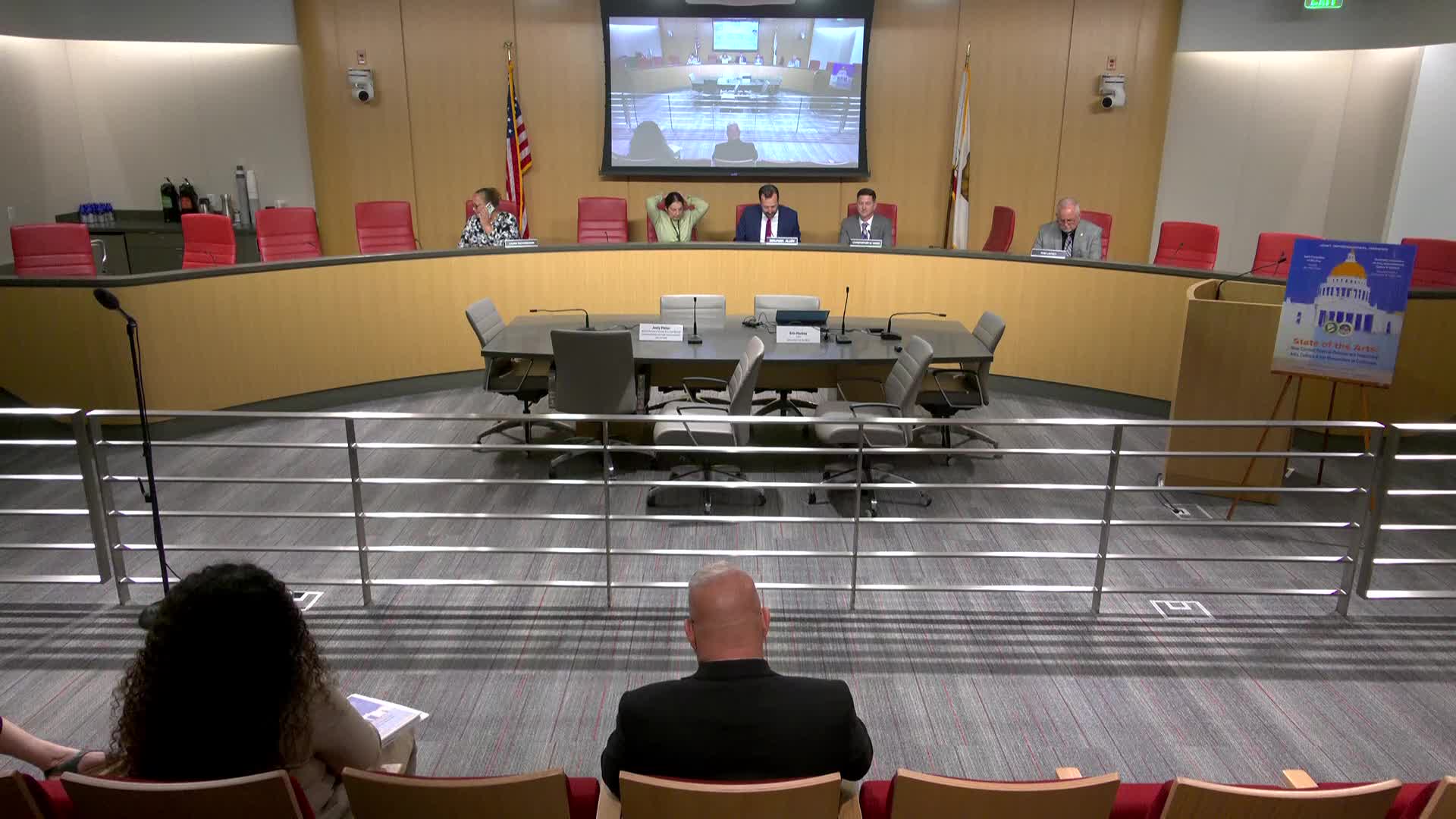
The hearing, convened by State Senator Ben Allen and Assemblymember Chris Ward in Room 2100, brought national advocates, state agency leaders and local cultural organizations to the Capitol to describe immediate harms and to press the Legislature for state-level relief.
The concern is both practical and symbolic: Erin Harkey, chief executive of Americans for the Arts, told the committee federal rescissions have “created immediate financial scribe” for organizations and put “pass-through dollars” at risk — funds that local and state agencies use to leverage additional public and private support. Harkey said that since 2020 NEA awards in California exceed $70 million, including more than $8 million benefiting the California Arts Council, and that thousands of small community groups are now vulnerable.
Why it matters: State and local arts funding often multiplies federal investment. At the hearing, multiple speakers said federal dollars are a lever that helps California agencies and nonprofit partners match and regrant funds into underserved communities. Without those federal allocations, some programs — from K–3 arts curricula to community documentary projects and museum education — face cancellation.
What speakers told legislators
- Rick Noguchi, president and CEO of California Humanities, said the organization received an April 2 notice from NEH that its federally derived funds would be repurposed. California Humanities’ annual budget is about $4.5 million, Noguchi said, and the cuts immediately affected FY 2025 awards (about $970,000 in grants not awarded) with roughly $2 million at risk for FY 2026. “After 50 years of serving California, our funding was cut immediately and without warning,” he told the committee.
- Danielle Purcell, director of the California Arts Council (CAC), said the NEA informed some grantees that offers or awards had been rescinded and that CAC is conducting a damage assessment to identify which California grants were affected. She also said the NEA had approved certain state partnership agreements the week of the hearing, but the White House FY 2026 proposal still calls for elimination of the NEA, NEH and IMLS. CAC staff are awaiting federal award letters and contract language before committing to next steps.
- Greg Lucas, California State Librarian, described a near-term restoration: he said a portion of IMLS funds that had been canceled was restored within hours after paperwork was filed, which filled an immediate hole but left next year’s allocation uncertain (Lucas said about 50% of next year’s expected federal allocation has been set aside). He urged state support because the May revision to the governor’s budget did not reflect these sudden federal developments.
- Local organizations described concrete layoffs and program stoppages. Leslie Ito of the Armory Center for the Arts in Pasadena said four federal grants (three IMLS and one NEA award) totaling about $440,000 were terminated, putting staff, teaching artists and K–12 programs at risk. Jacob Kornbluth, a documentary filmmaker whose work had been slated for California Humanities funding, said an $800,000 slate of documentary projects was now unfunded and that editors and technicians he relied on were seeking other work.
Legal and advocacy responses
Speakers described simultaneous advocacy and legal strategies. Noguchi said the Federation of State Humanities is exploring litigation and that multi‑state legal actions are being investigated, though he noted some limits — many state humanities councils are independent nonprofits rather than state agencies, complicating certain legal claims. Several witnesses reported appeals already filed with federal agencies and outreach to members of Congress, including Republican officeholders in districts whose constituents lost grants.
Requested state-level responses
Witnesses urged the Legislature to consider emergency support for affected programs and longer-term dedicated funding. Proposals mentioned at the hearing included restoring $5 million to the California Arts Council; restoring a $27.9 million museum grants program previously defunded in the state budget process; and establishing or expanding funds for performing arts payroll support and cultural districts. Representatives from the California Association of Museums and other groups asked lawmakers to use May revision negotiations to reinstate state grant lines that had been cut in 2024.
Numbers cited at the hearing
- Americans for the Arts: NEA awards to California since 2020 totaled more than $70 million, including over $8 million to the California Arts Council (Erin Harkey).
- California creative economy: roughly $289 billion and about 800,000 jobs, contributing about 7.5% of state GDP (testimony summarized from Americans for the Arts and Adam Fowler, economist).
- California Humanities: annual budget about $4.5 million; FY 2025 awards disrupted (about $970,000 not awarded) and $2 million at risk for FY 2026 (Rick Noguchi).
What legislators said
Senators and assemblymembers on the joint committee repeatedly pledged to explore emergency state options and to press Congress and federal agencies for answers. Several members emphasized the economic multiplier effect of cultural funding and urged constituents and arts advocates to contact their representatives.
Next steps
Panelists asked the Legislature to: (1) consider emergency appropriations to cover immediate grant shortfalls; (2) restore previously cut state museum and arts grant lines in the May revision; (3) explore ballot or dedicated funding mechanisms to stabilize state cultural funding; and (4) continue coordination with attorneys general and congressional delegations on legal and advocacy remedies. No formal vote or binding action occurred at the hearing.
Ending
Speakers framed the moment as both urgent and recoverable if state leaders act. “This is not a moment for retreat. It is a moment for resolve,” Erin Harkey told the committee. Legislators closed the hearing by promising follow‑up briefings and asking agency staff for detailed impact assessments they can use during budget negotiations.