Get Full Government Meeting Transcripts, Videos, & Alerts Forever!
Get email alerts on the Public Works topic
No spam. Unsubscribe anytime.
Douglas County staff preview public works budget, CIP and major projects including Waukarusa Drive
Summary
County public works staff reviewed operations, staffing and spending, and previewed the five‑year capital improvement plan that projects about $130 million in road, bridge and facility work through 2029; no formal actions were taken during the work session.
Douglas County public works staff presented an informational update Wednesday that reviewed departmental staffing, 2024 expenditures, major maintenance commodities and a preview of the county’s draft five‑year capital improvement plan.
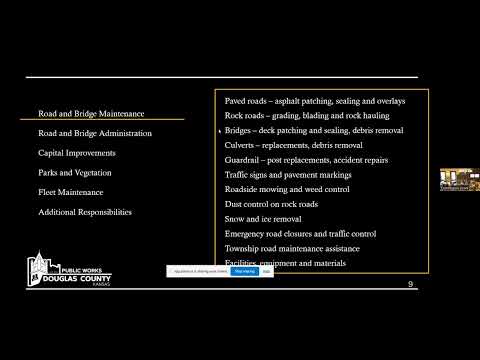
The briefing, given by Chad Voigt, public works staff, and Brooke (last name not specified), public works staff, outlined operations across road and bridge maintenance, fleet, parks and vegetation, and engineering; it emphasized that the work session was for information only and that no decisions were made. “We do a lot of fun stuff, and we’re all pretty proud of our work,” Voigt said during the presentation.
The nut graf: Staff summarized 2024 spending, current fund balances and planned projects, noting a capital improvement fund balance of roughly $15 million — about $10 million of which is allocated to the long‑planned Waukarusa Drive project — and previewed a five‑year CIP that staff estimates will program about $130 million in total capital spending through 2029, split mainly between facilities and road/bridge work.
Voigt said the public works department has 58 full‑time employees and budget authority for about seven seasonal temporary workers. He described major budget drivers for 2024: fuel purchases (about $110,000 in gasoline countywide and roughly 59,000 gallons of diesel used primarily by public works), 3,800 tons of salt for winter operations, and about 9,400 tons of asphalt for road maintenance.
Contracted pavement maintenance accounted for roughly $1.1 million in 2024, and Voigt noted that the county uses a mix of in‑house crews and contractors — for example, the county’s crews handle many patching and maintenance tasks while larger mill‑and‑overlay or long‑run projects are typically bid to contractors. He said capital projects and maintenance are funded across multiple county funds and that reimbursements and grants (including awards from KDOT) offset some costs.
On funding and balances, staff said public works touched seven county funds. Voigt and other staff identified the road and bridge fund as the most significant (it receives state gas tax and other revenue) and described several smaller funds that carry year‑to‑year balances. Voigt reported a roughly $15.1 million balance in the county’s capital improvement fund and said $10 million of that is earmarked for the Waukarusa Drive extension across the Waukarusa River, a project the county has planned for about nine years.
Staff provided an inventory and condition overview: about 220 miles of paved county roads (plus township roads), roughly 61 bridges in the county system and about 1,100 culverts (428 of those on township roads). Voigt said the county’s system is roughly 85% paved and noted that bridge and culvert work is prioritized using inspection reports tied to the National Bridge Inspection Program.
On capital planning, Brooke explained the county’s five‑year CIP process and funding mix. Staff said the board will adopt a five‑year plan each year that aligns the first year with the following fiscal year’s budget. For the current draft (covering 2025–2029), staff projected about $99.3 million in facilities projects and about $36.7 million in road and bridge projects. Staff also said roughly $82 million is currently estimated for the justice center and public safety building program; about 55% of the facility side funding is anticipated from bond proceeds, with the remainder from reserves, grants and investment/rental income.
Staff described several near‑term project updates and constraints. The Farmers Turnpike Bridge replacement was put out to bid earlier in the year and received no bids, prompting staff to defer the project to next year and re‑bid when contractor capacity is more available. Voigt said contractor availability tied to other regionally funded projects is limiting capacity this year.
Staff emphasized safety‑driven pavement and roadside work, including shoulder and drainage improvements and annual culvert replacements. Voigt cited Federal Highway Administration data noting higher fatality shares on rural roads and said county priorities include sight‑distance improvements, shoulders and intersection upgrades to reduce crashes on high‑speed rural roads.
Other program and operations notes: public works maintains county parks (Lone Star Park and Wells Overlook Park were cited), operates the county fleet shop (which also services sheriff vehicles and some outside agency equipment under reimbursement), maintains recycling drop‑off sites, and provides township assistance for bridge and culvert work. Voigt and staff described mixed in‑house and contracted approaches and said equipment reserves are at intended levels.
Commissioners asked questions about fuel budgeting, lease versus buy analysis for equipment, the lifespan of new bridges, the 2024 $300,000 winter event cost (mostly personnel and salt), and the timing of specific CIP items. Staff said fuel budgets are based on prior years with a conservative buffer, lease payments are generally disfavored because state replacement funds cannot be used for leases, and modern bridge designs should last substantially longer than structures built in the 1970s.
The session closed as a work session preview; staff will bring a formal CIP allocation and detailed cost schedule to the board’s budget process this summer for adoption. No votes or formal actions were taken during the work session; staff invited commissioners to raise additional questions during the formal budget/CIP review period.
Ending note: staff asked that commissioners expect a more detailed CIP packet in mid‑June and said that some projects and funding assumptions (including bond sale proceeds and grant awards) could shift as the board and staff refine project priorities and schedules.