Get Full Government Meeting Transcripts, Videos, & Alerts Forever!
Get email alerts on the Legislative Approvals topic
No spam. Unsubscribe anytime.
Appropriations Committee advances hundreds of bills; moves to protect medication abortion, clarify towing rules and propose housing funding amendment
Summary
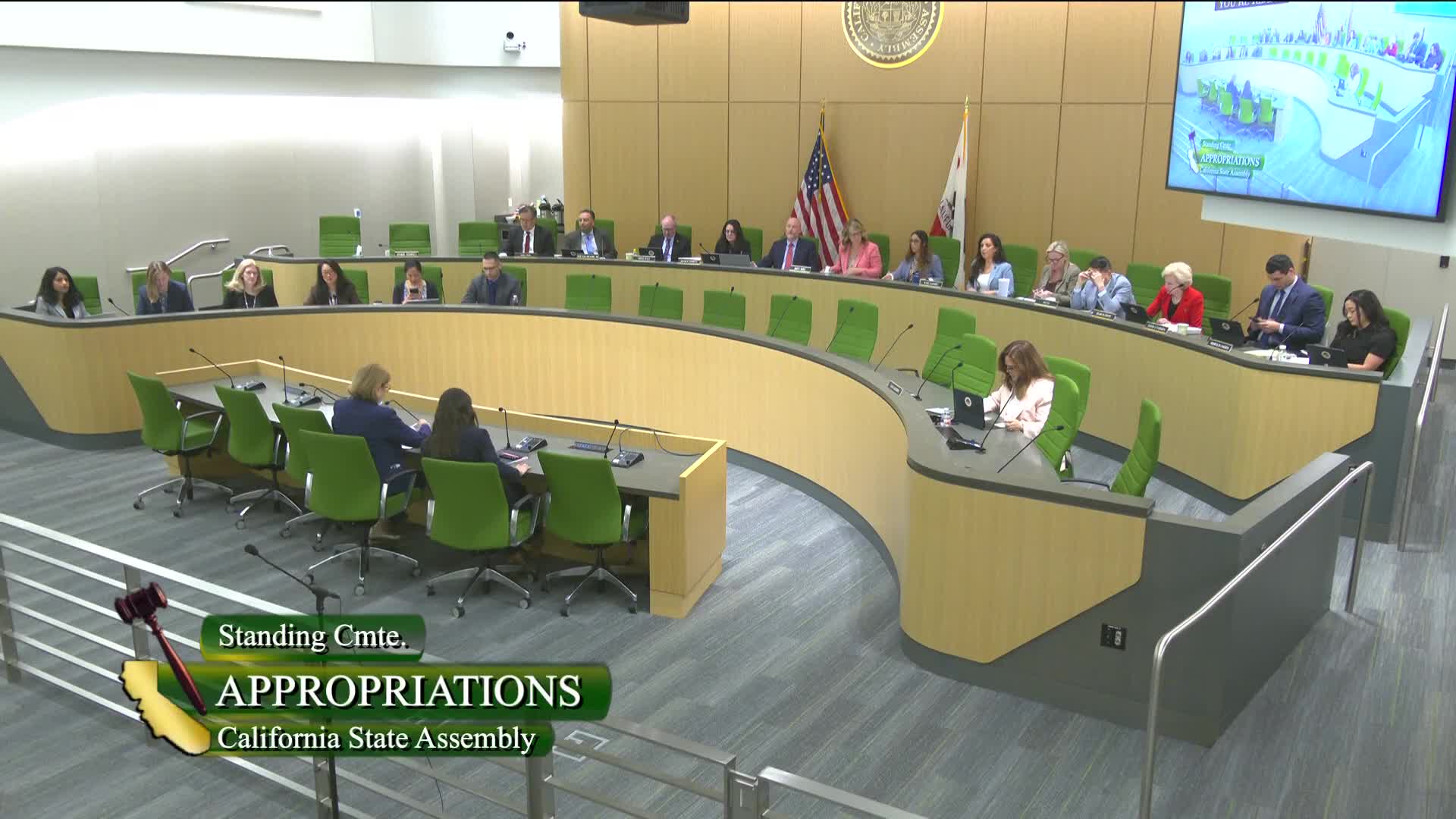
May 14, 2025 — The California State Assembly Appropriations Committee met in a regularly scheduled hearing that covered 327 bills and approved a wide slate of measures for further action, front‑loading proposals on reproductive health, housing finance and homeless assistance, groundwater law, vehicle towing rules and protections for students at schools.
May 14, 2025 — The California State Assembly Appropriations Committee met in a regularly scheduled hearing that covered 327 bills and approved a wide slate of measures for further action, front‑loading proposals on reproductive health, housing finance and homeless assistance, groundwater law, vehicle towing rules and protections for students at schools.
AB 260, a bill to shield medication abortion (mifepristone) access and to provide legal protections for providers, drew one of the more detailed presentations and cosponsor testimonies. Assembly Majority Leader Aya Curry, the bill’s author, said the measure is “an important proposal to protect and safeguard safe and legal, reproductive health care here in California” in response to federal and out‑of‑state restrictions after Dobbs. Angela Pontes of Planned Parenthood Affiliates of California testified in support, saying AB 260 “safeguards access to medication abortion in California by protecting against federal interference with the current practice of medicine in this state.” The committee advanced AB 260 out of Appropriations on a roll call.
The committee also advanced AB 1022, which would remove statewide authority to immobilize or tow vehicles solely to collect unpaid parking fines. The bill’s sponsors and supporters argued campus and local towing programs are costly and ineffective at collecting underlying debts; Rebecca Miller of the Western Center on Law and Poverty described the practice as imposing “devastating financial and emotional toll[s]” on low‑income Californians. Sponsors noted that existing towing authorities for safety or permit enforcement would remain in place and that several UC campuses say they already do not tow solely for unpaid tickets. The committee moved AB 1022 forward on a roll call.
On housing and homelessness, the committee heard a presentation-only item, ACA 4 (the “Housing Opportunities Made Equal Act”), that would add a constitutional dedication of 5% of the state General Fund for 10 years to fund affordable housing and homelessness programs. Witnesses framed the amendment as intended to scale funding to meet a documented housing shortage; proponents pointed to studies they said show major long‑term fiscal benefits from upfront housing investments. The committee advanced many housing bills as part of its packet; ACA 4 was presented for committee consideration and proponents said they will continue to refine the proposal.
AB 49, a bill to bar immigration enforcement actions inside California public schools (so‑called “sensitive locations” protection), was presented with multiple community and legal advocates testifying. A staff attorney from the Coalition for Humane Immigrant Rights described the bill as necessary to preserve the long‑standing principle that students should be able to attend school without fear. The committee advanced the measure on a roll call.
Several groundwater and SGMA‑related bills were presented and moved out. AB 1413 would limit court proceedings that would adopt a sustainable yield higher than the validated amount in a local Groundwater Sustainability Plan, preserving the locally determined “size of the pie” subject to existing validation and review. AB 929 would temporarily exempt small community water systems and managed wetlands from SGMA pumping reductions for limited historical uses and requires groundwater sustainability plans to account for impacts on wetlands and small systems; sponsors said the bill would sunset after three years. Both bills advanced out of committee.
Other notable measures the committee moved out include: - AB 904: Clarifies child‑care subsidy eligibility so parents on family leave, pregnancy leave or searching for employment do not automatically lose subsidized care; advanced out of committee (one member noted a specific voting change on the record: Miss Dixon voted aye and one member did not vote). - AB 956: Clarifies state law to allow homeowners to build up to two detached accessory dwelling units provided local size/height/setback rules are met; advanced out of committee. - AB 507, AB 1470 and AB 893: Several bills aimed at increasing student and downtown housing options and permitting conversions or student‑oriented housing were presented and advanced; sponsors said the measures are designed to leverage existing loan funds or ministerial approval to accelerate housing near campuses and downtowns. - AB 930: Updates elections code so vote‑by‑mail ballots postmarked by Election Day and received within seven days would be counted; advanced on a roll call.
The committee also dispensed with the suspense calendar (the clerk read a long list of bill numbers), deeming it approved and advancing a large number of additional measures with limited on‑the‑record discussion. Members and witnesses typically described fiscal impacts as “minor and absorbable” where the analysis indicated minimal General Fund cost, and many bills were described as technical or implementation clarifications by their authors.
Votes at a glance (selected bills from today’s hearing): - AB 260 (Curry) — Protect medication abortion access (mifepristone); advanced out of Appropriations on a roll call. Motion: pass to next location. (Vote tally not specified in transcript.) - AB 1022 (Calera/authoring staff) — Prohibit towing vehicles solely to collect unpaid parking citations; advanced on a roll call. (Vote tally not specified.) - ACA 4 (Jackson) — Constitutional dedicatory amendment proposing 5% of General Fund for housing for 10 years; presented (advance/next steps noted), presentation only; proponents will continue work on language and finance details. - AB 49 (Martucci) — Restrict immigration enforcement at schools (sensitive‑location protection); advanced on a roll call. (Vote tally not specified.) - AB 1413 (Pappen) — Limits on adjudicated sustainable yield against validated GSPs; advanced on a roll call. (Vote tally not specified.) - AB 929 (Connolly) — Temporary exemptions for small community water systems and managed wetlands under SGMA; bill to sunset in three years; advanced on a roll call. - AB 904 (Cloz/author) — Clarify child‑care subsidy eligibility during family leave and job search; advanced out on a roll call (transcript records Miss Dixon voted aye; one member did not vote). - AB 956 (Quirk Silva) — Allow two detached ADUs on a parcel when local standards are met; advanced on a roll call (transcript notes members’ votes: Mister Tangapah not voting, Mister Ta voting aye). - AB 930 (Ward) — Count ballots postmarked by Election Day and received within seven days; advanced on a roll call.
What the committee did not decide today: a handful of bills were placed on call or held for members to return; AB 46 (Winn) on mental health diversion was put on call to await additional members before a final vote.
Why this matters: bills advanced by Appropriations face additional committee or floor consideration and, for fiscal measures, are routed for budgetary review. Several measures taken up today would change statewide practice in ways proponents say will expand access to health care, stabilize household child‑care needs, protect vulnerable water and wetland uses, and accelerate housing production. Opponents frequently flagged downstream costs, legal concerns or implementation details that authors said would be refined with amendments.
Next steps: bills that left Appropriations will proceed according to Assembly rules — many will go to the floor for further debate or to the Senate if already passed; constitutional amendments and measures with fiscal implications will follow statutory budget and legislative paths. The committee’s suspense calendar was approved, meaning the large packet of bills read by the clerk is now out of Appropriations for subsequent action.
(Quotations in this report are taken verbatim from the committee hearing transcript.)