Get Full Government Meeting Transcripts, Videos, & Alerts Forever!
Get email alerts on the Municipal Finance topic
No spam. Unsubscribe anytime.
Norwood has $29.8M in certified free cash; FinCom warns of structural gap and recommends $7.45M for FY26
Summary
Finance Commission told Town Meeting that an unusual $29.8 million ‘free cash’ windfall offers a chance to shore up reserves and fund one-time needs, but rising pension and health costs create a structural deficit that outpaces recurring revenue growth.
The Finance Commission told the Town of Norwood at its annual and special town meetings that $29.8 million in certified free cash gives the town an unusual opportunity to shore up reserves and fund one-time projects, but that recurring costs — chiefly pensions and health insurance — create a structural deficit that will outpace forecast revenue increases.
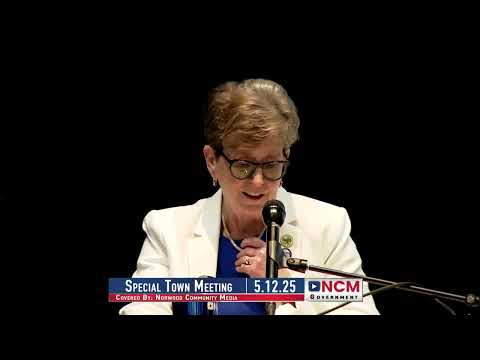
Finance Commission member Miss Bodenhofer presented the group’s financial dashboard and said the commission recommends using $7,450,000 of free cash to support the FY26 operating budget. “We would like to work with the other boards to develop a long term solution for our budget shortfalls,” Bodenhofer said.
The $29.8 million certified free cash is composed of underspending from the prior year, strong investment income and unexpectedly high building-permit receipts. Bodenhofer told the meeting that investment income exceeded estimates by about $7.6 million and building permits ran about $11.7 million higher than projected, primarily because of large commercial projects including the FM Global permit and a Norwood Hospital permit.
FinCom laid out the arithmetic that drives its recommendation: projected FY26 revenue rises about $6.8 million in total, but nearly $5.2 million of last year’s FY25 budget had been supported by one-time sources (free cash and override stabilization), so the “effective” recurring revenue increase is roughly $1.6 million. Shared, non-discretionary costs — pension and health insurance among them — are projected to rise roughly $2.5 million, with pension contribution up about $1,000,000 and health insurance up roughly $2,000,000, FinCom said. That gap, FinCom argued, means the town would otherwise have to cut operating budgets across departments to balance recurring costs.
FinCom emphasized that free cash is best used for one-time needs rather than to permanently fund recurring services. “This is like using savings for your expenses,” Bodenhofer said. “If you have to dip into your savings account every month to make your mortgage payment, that is a real problem.” The commission recommended a mix of one-time appropriations and putting money into reserves and stabilization accounts to smooth future budget cycles.
FinCom also reviewed long-term liabilities: the Norwood contributory pension system was reported at about 76.3% funded; the FY26 pension contribution to the system will exceed $7,000,000, the commission said. FinCom proposed establishing and funding targeted reserve accounts to reduce year-to-year pressure on the operating budget and to address capital needs in future years.
The presentation concluded with a recommendation to the meeting to approve a set of free-cash appropriations, to move a portion of the windfall into reserves and stabilization accounts, and to spend a portion on capital and one-time priorities detailed in the budget book and pink sheets.