Get Full Government Meeting Transcripts, Videos, & Alerts Forever!
Get email alerts on the Immigration Enforcement Sb8 topic
No spam. Unsubscribe anytime.
Board debates Dallas role if Texas mandates 287(g) participation; refers matter to policy committee
Summary
Following presentations on Texas Senate Bill 8 and 287(g) agreements, the Community Police Oversight Board voted to have its policy subcommittee review the chief’s forthcoming memo and prepare recommended board action; the full board will reconvene by special meeting to consider a letter or other steps.
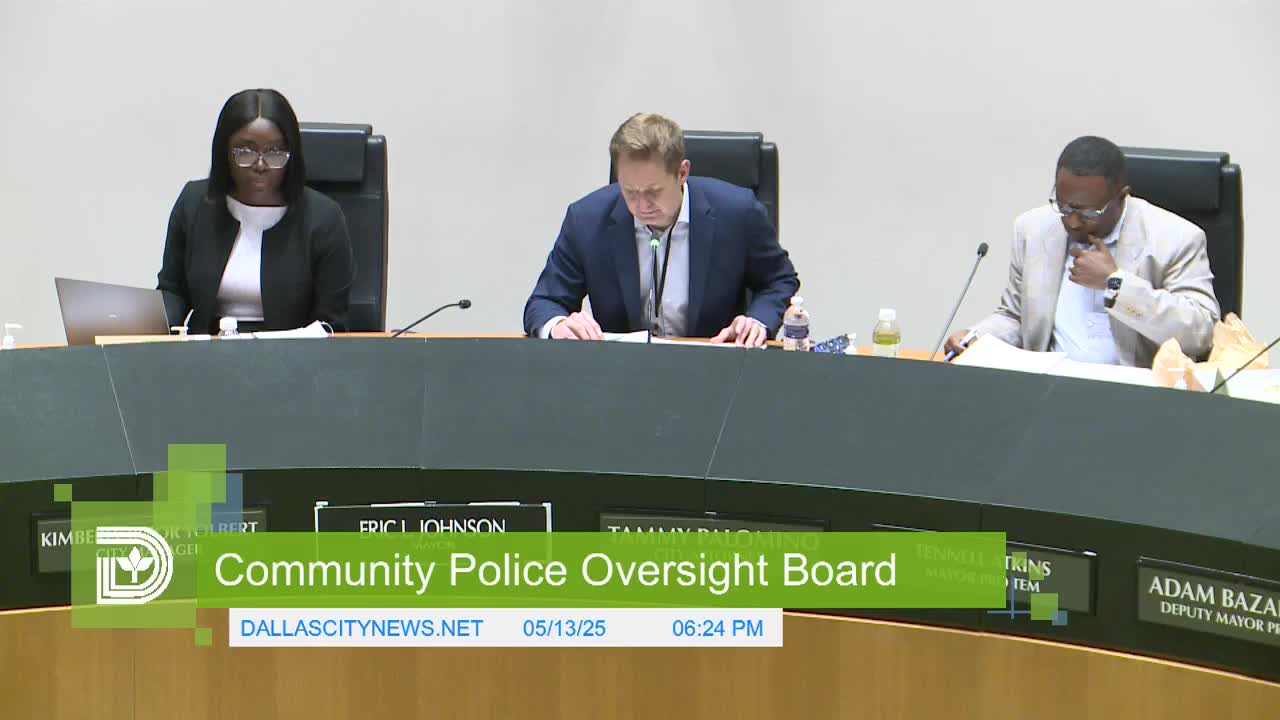
The Community Police Oversight Board on May 13 heard a briefing on Texas Senate Bill 8 and federal 287(g) immigration agreements and then debated what role the Dallas Police Department should play if state law compels county participation.
Sierra Obasuji, policy analyst for the Office of Community Police Oversight, briefed the board on SB 8’s requirements. She summarized that SB 8 would require sheriffs and counties with populations over 100,000 to request and, if offered, enter into a 287(g) agreement with U.S. Immigration and Customs Enforcement. Under those agreements, local officers may be trained by ICE, query federal immigration databases and be authorized to perform limited immigration enforcement functions. Obasuji noted that the bill allows smaller counties to opt in and provides limited grant funding only to counties under 1,000,000 people; larger counties such as Dallas County would likely face an “unfunded mandate.”
David Donati, an attorney with the ACLU of Texas, gave a legal and policy overview and warned of potential effects documented in other jurisdictions: reduction in crime reporting, strained community relations, civil‑rights litigation and significant local costs. “These agreements have exploded in the past few months,” Donati said, and added that many agreements shift operational and liability costs to local entities.
Board member Brandon Friedman said he was troubled by public reports that Dallas Police leadership indicated the department would “work shoulder to shoulder” with federal partners if asked; Friedman said he wanted the board to formally express concern and that the chief’s statement to a news outlet had been “troubling.” Board members expressed a range of views about timing and process — some urged waiting to review a written memo the police chief plans to provide on Friday, while others said the board should act promptly to show its position to the community.
After discussion, the board voted to refer the matter to its policy subcommittee for review once the chief’s memo arrives, with a plan for the committee to prepare a recommended letter or other actions and for the chair to convene a special called meeting so the full board can vote. The motion passed on a roll call: Ozzie Smith (yes), Jonathan Maples (yes), Tonka Higgins (yes), Lauren Gilbert Smith (yes), Brian Ball (yes), Derek Pegram (yes), Tim Jackson (no), C. Victor Lander (yes), Allison Grinter Allen (yes), Jenny King (yes), Arlene Steinfeld (yes), Dee Wadsworth (yes), Brandon Friedman (yes), John Mark Davidson (yes). (Record of votes taken from roll call read at the meeting.)
Obasuji and Donati emphasized that SB 8 — as drafted — focuses on counties and the sheriff’s office; the Dallas Police Department would not be directly mandated by SB 8, but implementation in Dallas County could affect public perceptions of all local law enforcement and the willingness of immigrant communities to report crimes. Donati recommended options for mitigation including limiting any agreement to jail enforcement, insisting on local control over MOU terms, collecting data on costs and racial impact, and seeking state indemnity or appropriations if forced into costly implementation.
The board asked staff to coordinate with the chair and the policy subcommittee and to schedule any necessary special meeting once the chief’s written memo is received.