Get Full Government Meeting Transcripts, Videos, & Alerts Forever!
Get email alerts on the Social Services topic
No spam. Unsubscribe anytime.
Austin Public Health: CSBG funds support neighborhood centers, avoid evictions and food distributions; reauthorization bill introduced in Congress
Summary
Austin Public Health’s Neighborhood Services Unit reported on CSBG-funded neighborhood center services, saying staff helped 254 households avoid eviction through March and served nearly 23,385 unduplicated people through food distributions.
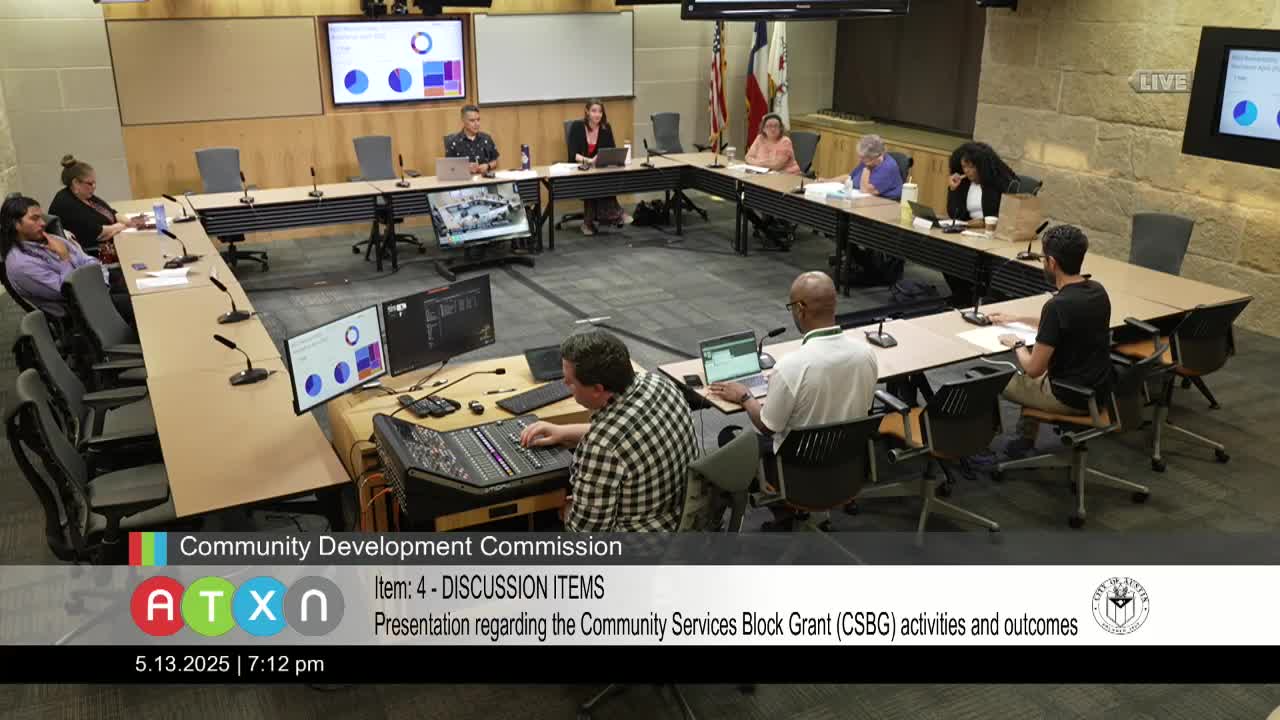
A Neighborhood Services Unit presentation to the Community Development Commission on May 13 summarized Community Services Block Grant (CSBG) activities, outcomes and operational updates.
Angel Zambrano, Neighborhood Services Unit (Austin Public Health), said the CSBG funds support basic needs, case management, preventive health and employment support services delivered through neighborhood centers across Austin and Travis County. Zambrano said the unit’s transition goal from the state for the grant year is 43 documented transitions out of poverty (clients who obtain and maintain living-wage employment for three months); the presentation reported five transitions so far this year and additional cases in progress.
Operational highlights and outcomes cited: - Evictions avoided: Through March, staff said they helped 254 households avoid eviction through rent-assistance programs. - Food distributions: The presentation listed nearly 23,385 unduplicated people served via food distribution programs. - Neighborhood centers: Three centers (South Austin, Blackland and Rosewood) were closed temporarily for major HVAC renovations; reopening dates were cited as June 2 (Rosewood/Sarangosa), June 9 (Blackland) and July 2 (South Austin). - Rental assistance and utility support: Staff summarized rental-assistance work; a small Austin Energy Plus One program can provide up to $500 per household for energy bills in crisis situations. - Public-health nursing: Nurses provide free screenings and health education at neighborhood centers and community events.
Zambrano also said the CSBG reauthorization was introduced in the U.S. House by Rep. Glenn Thompson (R-PA) and Rep. Suzanne Bonamici (D-OR), proposing a seven-year reauthorization for the program.
Commissioners asked questions about funding amounts, deliverables, client stories, duplication of services and public-health preparedness (including measles response and vaccine planning). Zambrano acknowledged requests for more qualitative client stories and said staff can include anecdotal program successes in future reports. On infectious-disease response, staff noted the public-health nursing team typically staffs flu clinics and would be mobilized for emergency responses as needed; epidemiology and response planning are handled by Austin Public Health epidemiology staff.
Why it matters: CSBG funds support neighborhood-level services that help residents avoid eviction, access food and receive case-management and preventive-health supports. Local delivery of these services depends on continued federal and state funding and on operational capacity at neighborhood centers.
Next steps: Staff said they will send commissioners additional materials, including event flyers, dashboards showing anti-displacement spending and lists of previous CIS awardees. Zambrano also agreed to include more qualitative client stories and program anecdotes in future reports.