Get Full Government Meeting Transcripts, Videos, & Alerts Forever!
Get email alerts on the Police Protest Operations topic
No spam. Unsubscribe anytime.
Dallas Police outlines updated protest tactics emphasizing de‑escalation, egress planning and duty to intervene
Summary
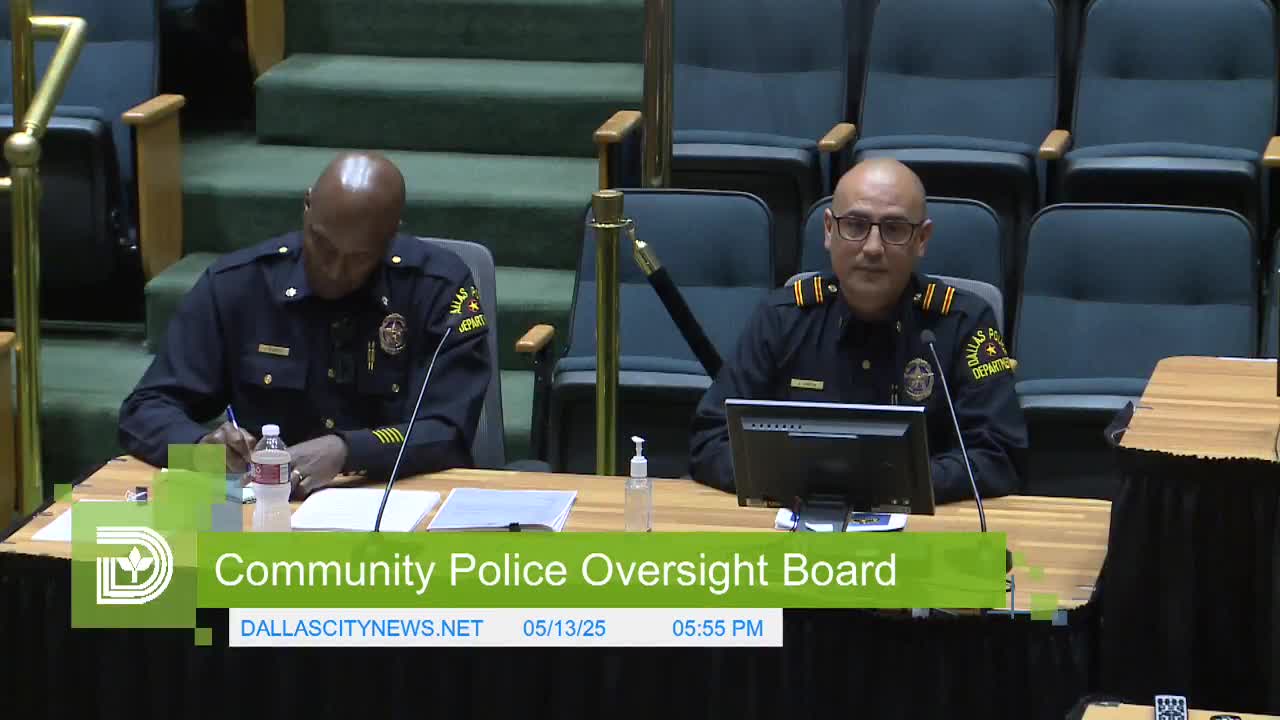
Major Jose Garcia of the Dallas Police Department briefed the Community Police Oversight Board on the department’s tactical planning and special events units, describing policy changes since 2020 that center on de‑escalation, officer intervention, crowd egress and limits on “less‑lethal” weapons.
Major Jose Garcia, commander of the Dallas Police Department’s tactical and special operations units, told the Community Police Oversight Board on May 13 that the department has updated its public‑order policies and training since the 2020 protest period, placing greater emphasis on de‑escalation and officer accountability.
Garcia said changes over the past four years include expanded “duty to intervene” training, clarified limits on less‑lethal platforms in crowd environments, new long range acoustic devices for communicating with large crowds, and requirements to identify egress routes before dispersal. “The preferred outcome for any interaction with the public is to deescalate hostilities and restore peace,” Garcia said.
The briefing framed those changes as a response to past incidents. Board member Brandon Friedman asked how much the 2020 bridge incident shaped current policy; Garcia said the event prompted revisions including a prohibition on firing 40‑millimeter rounds into crowds and reinforced one‑to‑one deployment requirements for certain munitions. He said the department now emphasizes identifying safe egress routes and giving dispersed crowds time to leave.
Garcia described the department’s verbal warning protocol and body‑worn camera use. He said officers typically make a clear dispersal order — repeated up to three times — and record warnings on BWCs. “We will only use city issue body worn cameras to be able to record the verbal warning,” Garcia said, adding that cover officers should be present during warnings.
On the subject of officer intervention, Garcia said the duty‑to‑intervene standard is part of academy and in‑service training and that discipline — including possible charges — can follow failure to act, depending on the facts. “It depends on what it is. And, absolutely, … discipline to include possible charges if it merits,” he said.
Board members pressed about surveillance and identification at demonstrations. Allison Grinter Allen asked whether facial recognition is used; Garcia said the command post can view city cameras and deploy drones to gain a situational picture, but to his knowledge facial recognition is not used and the footage is not routinely saved. “As far as face recognition, nothing that I know about or I have seen, ma’am,” he said, and added, “It is not saved. To my knowledge, it is not saved.”
Board members also asked about coordination with federal agents. Garcia said incident command sets the operation plan and, when federal partners are in a support role, they are expected to follow directions issued by Dallas’ command post. “If they are in a support role, the expectation is that they would follow the commands that are being directed from the CP,” he said.
Several board members praised the reforms and asked for continued public transparency around training and tactics. Garcia said the department conducts monthly special response training, has updated mobile field force training, and runs semiannual joint exercises with North Texas agencies.
The presentation closed with Garcia saying the department will continue to evolve tactics and training “as need changes” and reiterated that ensuring safety for residents, visitors and officers is the department’s primary concern.
Minor details discussed at the meeting that may be relevant to future oversight requests included Garcia’s statement that operation plans do not list specific tactics publicly, and his repeated emphasis that any less‑lethal deployment into a crowd requires authorization by the chief or a designee and must meet strict criteria.