Get Full Government Meeting Transcripts, Videos, & Alerts Forever!
Get email alerts on the State Legislation topic
No spam. Unsubscribe anytime.
Lake County supervisors receive state legislative update, direct staff to prepare formal positions on several bills
Summary
County officials heard a Sacramento update from Nielsen Merxemer and gave staff consensus direction to return with formal letters or consent items on AB 339 and AB 470 and expressed support for SB 346; no formal votes were taken.
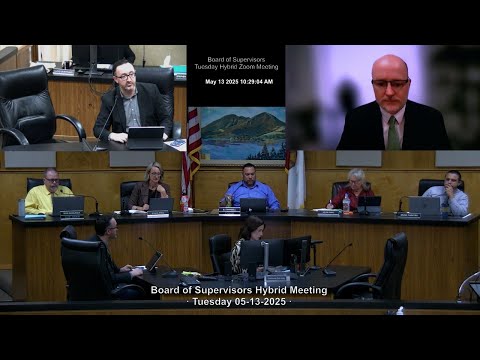
Jeff Neal of Nielsen Merxemer briefed the Lake County Board of Supervisors on active California legislation and state budget developments, and the board provided consensus direction to staff to prepare formal positions and potential consent items for future board action on several bills.
Neal, the county's state advocacy representative, told the board the governor's May budget revision—due the day after the briefing—was likely to be a pivotal document for the session. “This will be an important moment for policy for the year,” Neal said, describing revenue variances, rising Medi-Cal costs and projected multi-year deficits that will affect state funding decisions.
The update highlighted several bills of direct interest to Lake County. Neal described AB 339 as a measure that would require counties to give 120 days’ notice before contracting for most types of services and said the provision would remove flexibility for counties; the county has opposed similar measures previously. Neal also outlined AB 993, a Rural County Fire Protection reimbursement extension and expansion that the county supports and that has an estimated state cost of roughly $1 million to $1.5 million per year.
On public-safety and pension matters, Neal reviewed AB 1383, a CalPERS-related bill that would change retirement and cost-sharing rules for some public-safety members; the presenter said the statewide cost estimate for that provision could be in the hundreds of millions of dollars annually. Neal also summarized two Brown Act proposals—SB 239, which would ease some remote-meeting rules for advisory bodies, and SB 707, which would add remote comment and translation requirements and other obligations for local bodies.
Wildfire and insurance-related measures included AB 1 (home-hardening and insurer regulation), AB 4401 (technology and home-hardening programs), SB 547 (extending policy noncancellation to commercial properties after a declared local fire emergency) and SB 616 (home-hardening expansion). Neal identified these as priorities for many legislators after recent Southern California fires.
The board discussed AB 470, a measure on "carrier of last resort" provisions that would allow local telephone providers latitude to retire plain-old-telephone service; Neal and staff reported county and statewide associations (RCRC, CSAC) strongly oppose the bill because of emergency-notification and rural-communications concerns.
During public comment, Patrick (identified on the record as a resident) urged the board to support SB 346, a short-term rental transparency bill that would require platforms to notify local agencies about listings so local jurisdictions can collect occupancy taxes and enforce rules. “Lake County is heavily impacted,” Patrick said. A supervisor responded, “I think we should,” and the chair and other supervisors agreed that there was consensus to pursue support for SB 346.
Board members also asked about Proposition 4 funding allocations and how the governor’s May revision might propose to distribute bond pots for wildfire, drinking water and flood-control projects. Neal cautioned that bond proceeds are typically parceled out over years and directed by multiple state agencies and grant programs; he said detailed allocations would become clearer after the May revision and subsequent departmental grant guidance.
No formal motions or roll-call votes were recorded during the item. Instead, the board provided consensus direction to staff. County staff said they had already signed onto a coalition letter opposing AB 339 but that supervisors could make the opposition official; staff offered to return with proposed letters or consent-calendar items so the full board could take formal action.
The board asked staff to return with draft letters or consent items on the identified bills so the board can consider formal positions at a future meeting.