Get Full Government Meeting Transcripts, Videos, & Alerts Forever!
Get email alerts on the Elections Administration topic
No spam. Unsubscribe anytime.
Lake County registrar seeks staffing, equipment and space to speed post‑election processing
Summary
Registrar Maria Valadez asked the Board of Supervisors for direction to pursue investments in staff, a signature‑verification machine, a replacement ballot scanner and temporary space or vehicle support to accelerate post‑election processing and meet certification deadlines.
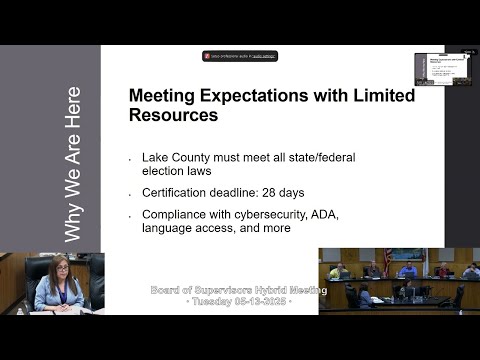
Maria Valadez, Lake County registrar of voters, asked the Board of Supervisors on an agenda item to authorize work toward a targeted investment in staffing, infrastructure and technology intended to speed post‑election processing and meet state certification deadlines.
Valadez told the board the county’s election workload has grown sharply since 2020, driven by new laws and rising voter interest, and that current staffing, floor space and equipment have not kept pace. “This isn’t about inefficiency. It's about capacity,” she said, describing the request as a way to “accelerate results” while remaining compliant with certification and accessibility requirements.
Why it matters: Lake County must complete statutory certification steps after each election and now provides weekly public results in some election cycles, which has increased post‑election processing demands. Valadez said the county’s vote‑by‑mail program accounted for the majority of returns in the last election and that on the day after the election her office processed only a few hundred ballots before the workday ended.
Key details and numbers - Mail ballots: Valadez said mail ballots were the largest share of returned ballots (56%), representing 13,331 ballots in the last election. - Drop boxes and polls: The county has six ballot drop boxes; roughly 3,500 ballots were returned via drop boxes in the last election. Between the mail drop period and election day the office logged about 3,000 additional returns; on election day roughly 1,700–1,800 ballots came through the polls. - Calls and staffing pressure: On election day the office handled more than 4,700 phone calls; Valadez said five permanent staff were answering phones that day and that staffing shortages make it difficult to both field public inquiries and process ballots. - Workspace and equipment: The registrar said the office moved from about 900 to roughly 2,000 usable square feet but has outgrown that space for expanded vote‑by‑mail processing. Valadez said a candidate signature‑verification machine under consideration would require roughly 150–200 square feet. She said vendor funding available for voting‑system purchases included about $130,000 that must be used before June 2026. - Cost notes: Valadez reported receiving vendor quotes for a signature‑verification system (she cited a range read in the meeting); she noted those equipment quotes do not include annual software or hardware maintenance. Separately, board members discussed annual software costs of about $12,000–$13,000 and maintenance estimates in the mid‑five figures to low‑six figures range depending on vendor and configuration. Valadez also estimated replacing roughly 30 of the office printers would cost about $24,000.
Proposal elements presented by the registrar - Staffing: reclassify one specialist to an analyst; add an elections technician; add one elections manager at a future date; create a part‑time election specialist and expand extra‑help hires for peak periods. Valadez said the package equates to roughly "two and a half" full‑time equivalents when accounting for the part‑time role and reclassification, and that extra help would be engaged about 60–90 days before an election and for 30 days after. - Technology and equipment: purchase or lease a signature‑verification system to automate and accelerate vote‑by‑mail (VBM) processing, and replace at least one aging ballot scanner to increase throughput. - Space and logistics: explore options for additional temporary workspace during high‑intensity periods (for example, the 29 days before an election through certification) and evaluate vehicle options—renting or dedicating a county vehicle during peak ballot pickup periods—since Central Garage pool vehicles are often too small for secure transport of multiple ballot bags. - Fiscal approach: phase implementation to prioritize early efficiency gains and present detailed cost models to the board if given direction to proceed.
Board reaction and requested next steps Board members expressed support for the goal of faster, timely results but declined to approve funding at the meeting. Supervisors requested further information before committing to new ongoing positions. The board directed the registrar to return with the following items: - Detailed cost estimates and implementation models for positions, equipment and recurring maintenance costs. - Vendor demonstrations or presentations (to be coordinated through the county’s purchasing/RFP process) so the board can see system capabilities and compare options. - A meeting with county IT to assess whether existing IT capacity can be redirected, and with the space committee to evaluate temporary or longer‑term facility solutions for peak processing; the registrar was asked to coordinate those meetings and report back. - Budget adjustments or midyear requests to reflect any extra‑help or one‑time equipment spending; members noted some equipment funds are one‑time and therefore easier to accommodate than ongoing FTE costs.
What the board did not do: the board did not approve permanent funding or create positions at the meeting. No formal motion or vote on funding was taken; the item concluded as direction to return with the additional information.
Quotes “This isn’t about inefficiency. It’s about capacity,” Maria Valadez, registrar of voters, said during her presentation. “We are not solving a problem that doesn’t exist. We are looking at being more expeditious in the process,” Supervisor Salati said in support of exploring options to speed results while emphasizing election integrity.
Context and background Valadez said the office has responded to a growing number of public records requests and is tracking dozens of bills that could change election procedures. She noted past statewide shifts in allowable return windows (for example, temporary extensions during COVID) and that new reporting requirements (weekly reports in some years) increased the office’s workload. The county replaced its voting system after a statewide decertification in 2019; Valadez said replacement and maintenance of voting‑system hardware is expensive and recommended setting aside funds for future system updates.
Next steps and outlook The registrar will work with administrative staff, IT and the space committee to supply detailed cost estimates, schedule vendor demonstrations and identify short‑term logistics (vehicle rentals or pool vehicle prioritization) and return to the board for further direction during upcoming budget deliberations. The board’s prevailing view at the meeting was to pursue more information rather than commit to ongoing staffing increases at this time.