Get Full Government Meeting Transcripts, Videos, & Alerts Forever!
Get email alerts on the Energy Infrastructure topic
No spam. Unsubscribe anytime.
Glendale officials say Grayson repowering construction is underway but tariffs threaten battery costs
Summary
Glendale Water and Power officials told the City Council the Grayson Repowering Project is well into construction, but new federal trade actions and shipping pauses could add tens of millions to the battery energy storage cost and strain project contingencies.
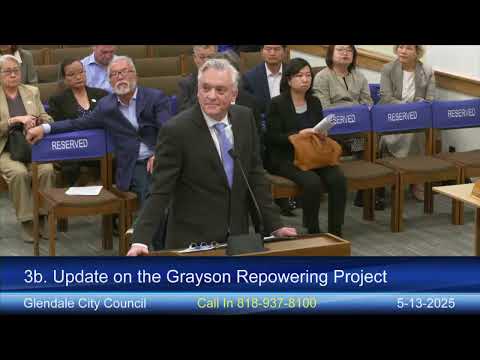
Glendale Water and Power reported to the City Council on May 13 that demolition and construction work at the Grayson Repowering Project is in progress, but recent federal trade actions and a 90-day pause on some imports threaten to raise equipment costs substantially — especially for the battery energy storage system.
Scott Mellon, acting general manager of Glendale Water and Power, said contractors are at varying stages of completion: roughly 45% complete on the Wärtsilä power island work, about 29% complete on the battery energy storage system (BESS) power island, and 19% complete on the balance-of-site work. He said nearly all civil, structural and mechanical engineering for the Wärtsilä units is complete and most major equipment has been delivered to site, though transformer and switchgear deliveries remain pending. He added that engine blocks were in Long Beach and a permitted pathway to deliver them to the site was recently identified.
Mellon said overall construction man-hours total roughly 171,000 to date and exceed 250,000 if soil improvements and demolition are included. He said the Grayson site layout includes separate zones for engines, transformers, battery racks and power conversion equipment, and that the engine house is sized for three reciprocating internal combustion engines and associated step-up transformers.
The project team told council members that international tariffs and an administration pause on certain imports are the biggest unknown for project cost. Mellon and staff estimated parts routed through Mexico and China could add about $7 million to the “balance of site” costs. The cost impact on the BESS — batteries and power conversion systems — is significantly larger: project staff estimated an increase on the order of $75 million under the newly announced pause and tariff scenarios. Mellon said earlier contracted and pre‑paid components and contingency funds cover some increases but that $75 million plus a $7 million materials pressure “does exceed our current contingencies.”
Council members pressed staff on timing, alternatives and contingency planning. Council member Brotman asked whether batteries could still be delivered within 90 days; Mellon said delivery remained possible but depended on manufacturing and shipping queues. Brotman and Council member Farbetchyan asked whether the city was considering delaying battery deliveries or negotiating delivery schedule slips to avoid tariff exposure; Mellon said staff and contractors were actively negotiating options, including potential rescheduling and other procurement routes, and that more detail would be brought to council at the next report.
Council member Farbetchyan repeatedly raised the policy question of long-term local generation versus storage. He said batteries “do not generate power” and urged staff to prioritize engines or other generation if that offered greater operational resiliency. Mellon and other staff responded that engines and the BESS perform different roles — engines provide generation, batteries provide capacity and fast response — and that the project as designed combines both technologies to meet operational and environmental goals. Mellon said other local projects, such as Shoal Canyon (discussed in the hearing), are expected to add roughly 11 megawatts and remain on a schedule staff is trying to keep on track in 2025–26, though he acknowledged schedule slippage and supply-chain risk.
On financing risk, Mellon told the council he had reviewed the city’s municipal-bond exposure and that, according to recent updates, proposed federal tax changes did not currently jeopardize the city’s ability to issue municipal bonds; staff said the bills under consideration did not, as currently drafted, strip the municipal bond exemption.
Mayor Ara Najarian and other members invited council members to schedule hard‑hat tours of the Grayson site; Mellon said site tours could be arranged in groups and that drone footage would be provided with upcoming staff reports. Mellon and staff said the project team planned to return with a more detailed procurement update at a forthcoming special meeting and that staff expect to present options if tariff implications become acute.
Why it matters: Grayson is a major Glendale Water and Power capital project combining engines and large-scale battery storage to support local reliability and peak demand management. A sharp rise in battery costs or long delays would increase contingencies or require council decisions on scope or financing. Council members who pressed staff said they want more robust contingency analyses and alternatives brought back before bindings are finalized.
Mellon’s presentation and council discussion covered construction punch‑list items, equipment delivery status, contingency exposure to tariffs, and options to negotiate delivery timing. No formal council action was taken during the update; staff said a detailed procurement and finance briefing would return to a future meeting.
Ending: Staff will return with a procurement and contingency update and is arranging site tours for council members. Mellon asked council members to expect a deeper briefing on battery procurement and tariff impacts at the next special meeting of Glendale Water and Power and the council.