Get Full Government Meeting Transcripts, Videos, & Alerts Forever!
Get email alerts on the Homekey Rio Linda topic
No spam. Unsubscribe anytime.
Council unanimously approves application for Homekey Plus funding for 100‑unit Rio Linda senior supportive housing; residents voice split views
Summary
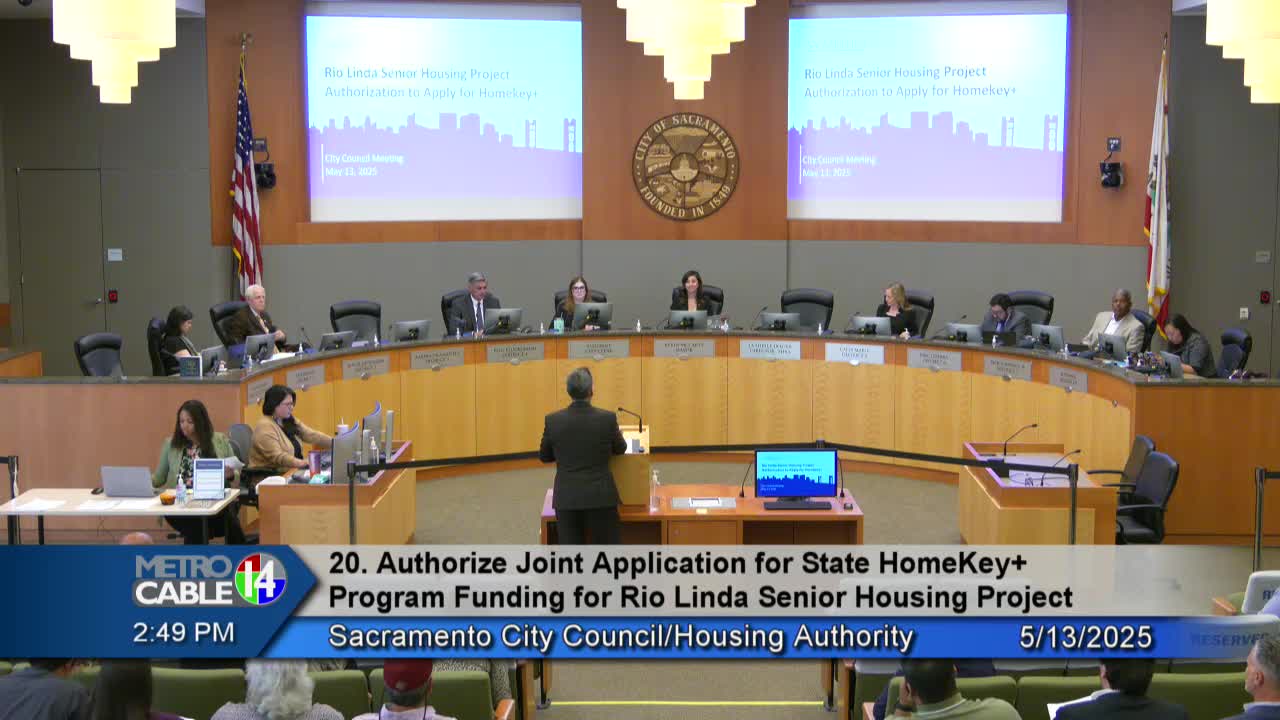
The Sacramento City Council voted unanimously to authorize an application for Homekey Plus funding to build a 100‑unit permanent supportive senior housing project at 2809–2821 Rio Linda Boulevard in District 2.
The Sacramento City Council voted unanimously May 20 to authorize submission of an application for Homekey Plus funding for a proposed 100‑unit permanent supportive senior housing project at 2809–2821 Rio Linda Boulevard in District 2.
Under the proposal, the site would be developed at about 42 dwelling units per acre on 2.41 acres and consist primarily of 240‑square‑foot studio units with kitchenettes and private bathrooms. The developer, Urban Capital, and the city described the product as code‑compliant, factory‑built housing (referred to in the presentation as BOSS Homes) that meets state building code and accessibility standards. The site plan shown to council included 38 parking stalls, a community garden, shared laundry, gated controlled entry, gathering space, a small dog area and on‑site storage.
SHRA staff told the council the project requests up to $20 million in Homekey capital funding for construction costs but said they have worked to hold per‑unit capital costs at or below $200,000. Staff also described a separate services and operations request that includes matching funds; staff characterized the full services package as part of the Homekey application process and said the applicant expects the approach to fund on‑site case management, behavioral health services from Sacramento County Behavioral Health, five full‑time case managers (staff later corrected that number to five case managers and two on‑site managers), and security after hours.
City staff said they expect the Homekey allocation process to be competitive and regional; the Sacramento region received roughly $101 million under the Homekey Plus allocation, split into pools for general and veterans populations. Staff explained the region’s timeline and first‑come, first‑review application process and said the city would submit applications to draw down available regional funds before they are allocated elsewhere.
The city sought to clarify residency and referral processes. SHRA staff said outreach and coordinated entry data (HMIS) would be used to identify candidates in the community and they would prioritize seniors in District 2 to the extent allowed under coordinated entry and Homekey rules. Councilmember Dickenson asked the council to drop a section of the resolution that would have authorized a $1.5 million city commitment of HAP funds; staff agreed to remove that section before the council voted.
During a long public comment period 20 people spoke. Supporters included residents, neighborhood advocates and homelessness service providers who urged the council to use Homekey funds to house seniors and veterans and highlighted the project’s proximity to the Sacramento Northern Bike Trail and transit. Opponents and residents living near the proposed site expressed concerns about concentration of homeless services in District 2, impacts on the bike trail, security, ongoing maintenance and whether the city had adequately engaged the neighborhood or evaluated alternatives such as smaller micro‑communities spread across districts.
Developer Urban Capital’s representative, John Vinocki, said “this is a housing project, it’s not a shelter,” described the units as dignified and durable and said the company will memorialize a “good neighbor” policy for operations and security; he said the project would provide live video feeds to Sacramento Police as part of a security protocol. He also said the developer’s fee for the project is roughly $11.2 million and estimated combined site and unit manufacturing costs that staff provided in briefing materials of roughly $7 million for units and about $6 million in site work across 100 units.
Councilmembers who supported the application acknowledged deep neighborhood concerns about prior siting and follow‑through on neighborhood commitments but said the region’s Homekey funding window created urgency. Councilmember Dickenson emphasized the need to prioritize District 2 residents who qualify and to make the city’s good‑neighbor expectations enforceable through the planning and approval process. After discussion, Councilmember Dickenson moved to apply for the funding and that motion was seconded by Councilmember Maple. The council voted unanimously in favor; the clerk recorded ayes from Kaplan, Dickenson, Talamontez, Pluckybaum, Maple, Guerra, Jennings, Vang and Mayor McCarty.
The council’s vote authorized staff to submit the Homekey Plus application for the Rio Linda Senior Housing project; staff removed the section that would have committed $1.5 million of city HAP funds pending later council approval. The project will proceed to the usual planning and entitlement and contracting process if funding is awarded.