Get Full Government Meeting Transcripts, Videos, & Alerts Forever!
Get email alerts on the Municipal Budget topic
No spam. Unsubscribe anytime.
Wasco presents conservative-but-optimistic 2025-26 preliminary budget, highlights reserves, water projects and CIP priorities
Summary
City finance staff told the Wasco City Council at a budget workshop that the preliminary 2025-26 budget is balanced, preserves high reserves, and prioritizes water capacity projects and a large capital improvement program while flagging risks from grants, interest rates and supply chains.
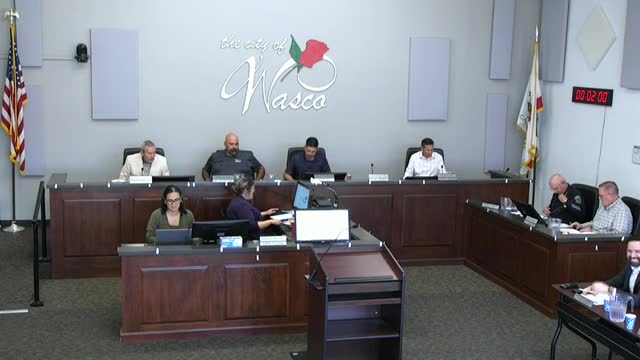
Wasco City presented a preliminary 2025-26 budget Wednesday that city finance staff described as “conservative but optimistic,” saying projected revenues of about $17.2 million would cover $17.1 million in operating costs and preserve a sizable reserve balance. Finance Director Perez Hernandez told the council the plan keeps essential services funded while maintaining capacity to pursue capital projects and grant opportunities.
Perez Hernandez summarized the document as a balanced budget that preserves service levels and maintains a strong unassigned general fund balance. He said staff projects an unassigned general fund balance of about $27 million (roughly 161 percent of operating costs) at June 30, 2026, well above the city’s 35 percent policy target. “We are conservative. We don’t want to be optimistic and then have to come back to the council,” Perez Hernandez said.
The presentation emphasized five council priorities carried from earlier goal-setting: support for a sports complex, water-management expansion, community engagement, public safety enhancements and economic development. Staff also outlined 55 CIP projects (13 new), with 8 completed, 15 more than 50 percent complete and many awaiting grant opportunities or later construction steps.
City Manager Israel joined staff in answering council questions about implementation and timing. Councilmembers pressed for midyear reporting and quarterly CIP KPIs to track revenue collections, project schedules and supply‑chain risks. Scott urged staff to return with quarterly financial projections and with any adjustments at midyear if revenues lag.
Enterprise funds were reviewed in detail. The water fund is presented as healthy: staff projected an unassigned water reserve that would cover operating needs (Perez Hernandez reported an estimated $5 million reserve and said the fund would be at or above the city’s policy target). Staff described one near‑term use of reserves: construction of a 1.5‑million‑gallon water storage tank to add operational capacity while aging wells are replaced. Council members and staff noted well replacements are expensive (staff cited an example estimate of about $6 million per well) and that maintaining large reserves helps absorb such contingencies.
Sanitation, transit and refuse funds were described as stable or recovering; the sanitation fund is projected to hold a reserve above policy (about 47 percent). The city flagged the compressed natural gas (CNG) fund as operating at close to break‑even and said staff continues to evaluate whether to seek an external operator or different financing for major repairs.
Public safety budgets rose largely because the city’s police department is in its first full year of operations. Perez Hernandez noted that some software and community outreach costs were grant‑funded in the first year and will shift to the city budget in future years. The Kern County Fire contract is shown with a modest reduction after a multi‑city review adjusted cost‑recovery methods.
Personnel and benefits: staff described a roughly 4–4.5 percent cost‑of‑living adjustment reflected in multiple MOUs, and emphasized the city’s proactive practice of prepaying portions of CalPERS liabilities. Perez Hernandez said the city has been actively reducing its unfunded pension liabilities and estimated roughly $7 million remaining in the classic pension plan’s unfunded liability that staff expects to address as CalPERS projections are finalized in June. Workers’ compensation and liability premiums were noted to increase from about $1.1 million to $1.7 million in the city’s budget proposal, a change staff attributed primarily to new public‑safety payroll exposure as police staffing increases.
The council discussed several specific programs and funding clarifications. Councilmembers asked about a senior water discount subsidy (the presentation shows roughly $60,000 set aside to offset discounts for qualifying customers; Perez Hernandez reported about 587 participants), the city’s ongoing meter replacement program (staff said meters being purchased include connectors compatible with future automated reading systems) and an animal‑services spay/neuter grant that offsets vet services. Perez Hernandez and the city manager noted some budget items depend on state and federal grant availability, and they recommended a midyear recalibration if revenues or grants change.
Staff framed a series of “action plan” approaches for fiscal prudence: defer nonessential spending for the first half of 2025‑26 if revenue softening occurs; protect general fund reserves and creditworthiness; pursue targeted grants for infrastructure; and provide quarterly reporting to the council including CIP progress and revenue forecasts.
Council members commended staff for the conservative approach and for maintaining the city’s financial position while preparing shovel‑worthy projects for grant opportunities. Council direction included asking staff to: - Continue monthly revenue monitoring and provide quarterly financial projections. - Return in June with a refined operating and CIP budget for adoption. - Prepare midyear recalibration if revenues materially miss projections.
No formal votes were recorded at the workshop. Perez Hernandez closed by noting his personal connection to the work after 10 years with the city and turned the presentation back to council for questions and public comments.