Get Full Government Meeting Transcripts, Videos, & Alerts Forever!
Get email alerts on the Public Monuments topic
No spam. Unsubscribe anytime.
Rockwall commissioners approve privately funded 10 Commandments monument for historic courthouse
Summary
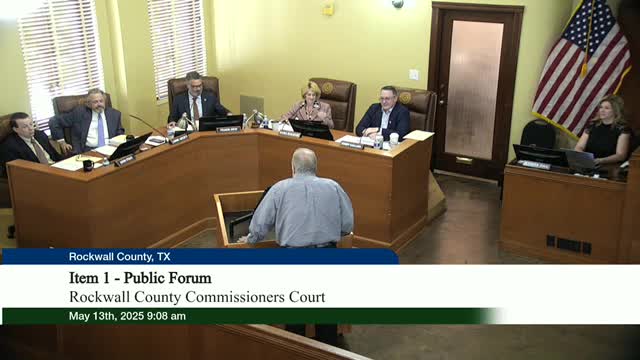
After more than an hour of public comment almost entirely in favor, the Rockwall County Commissioners Court voted 5-0 to accept donated funding and a donated monument commemorating the 10 Commandments for placement on the Rockwall County Historic Courthouse grounds and to designate two commissioners to coordinate design and placement.
The Rockwall County Commissioner's Court voted 5-0 on May 13 to accept a privately funded monument commemorating the 10 Commandments and to authorize the acceptance of donations and labor for its construction and installation on the grounds of the Rockwall County Historic Courthouse.
The motion, introduced by Commissioner Lichtke and seconded on the floor, directs that the monument be placed at no expense to the county, that donors may give directly or through a 501(c)(3) partner, and that Commissioners Lauren Lichtke and Bobby Galana (designated in the court motion as delegates) work with the Rockwall County Historical Commission on design and site selection. The resolution specifies the inscription to match the version the U.S. Supreme Court referenced in Van Orden v. Perry (545 U.S. 677, 2005).
Why it matters: Supporters told the court the monument would commemorate the historical roots of Western law and the county’s moral traditions; opponents who spoke during public comment urged sensitivity to the separation of church and state. The court’s resolution attempts to limit county expense and requires consultation with the local historical commission, while also stating placement “shall not be construed to mean that Rockwall County… favors, endorses, or establishes any religion.” The First Liberty Institute — cited by county commissioners in the meeting — offered pro bono representation to the county if the monument is legally challenged, according to material distributed to the court.
Public comment: The meeting’s public-comment period featured a large turnout. More than two dozen residents spoke in favor of the monument, framing it as historical and civic rather than exclusively religious. Examples from the record:
- Gary Moody (public commenter) said, “I want to talk about the 10 commandments… It’s a moral matter.” - John White (public commenter) invoked founding-era practices of prayer and said the monument would be “an example for other cities.” - Beth Maynard (public commenter) said she had recently moved to Rockwall and asked the court to also consider residents who oppose the monument.
Court discussion and legal context: Commissioner Lichtke read a prepared resolution and supporting materials into the record, including a memo and a proffered commitment from an outside legal group. The court directed that the historical commission be consulted on placement and that the monument acceptance proceed only as a donated item or via donated funds and labor so the county would not incur construction costs.
Implementation details: The resolution allows donors to give directly to the county or to donate through a nonprofit partner (a 501(c)(3)) used in other Texas jurisdictions. It designates two commissioners to lead site and design work and requests the historical commission’s input before final approval. The court specified the monument text (the language the Supreme Court referenced in Van Orden v. Perry) in the motion record.
What remains: The court approved the resolution authorizing acceptance of a donated monument and related donations and designated commissioners to proceed. The county will coordinate design and site selection with the Rockwall County Historical Commission and determine whether donations will be accepted directly by the county or routed through a nonprofit. Commissioners acknowledged the possibility of legal challenge and cited outside legal counsel’s offer to represent the county pro bono should litigation arise.
Ending: The motion passed unanimously, 5-0. The court recorded that future details — the final site, complete design and the mechanism for accepting donations — would be worked out by the two designated commissioners and returned to the court as needed.