Get Full Government Meeting Transcripts, Videos, & Alerts Forever!
Get email alerts on the Utilities Water Termination topic
No spam. Unsubscribe anytime.
League City council approves ordinance authorizing water-service terminations for public-health threats after extending notice period
Summary
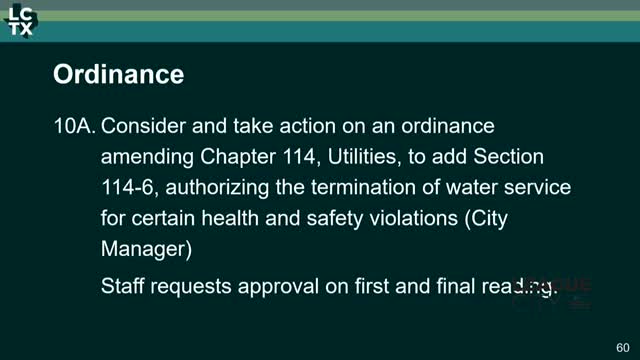
League City council approved an ordinance adding a provision to Chapter 114 that allows the city to terminate water service in specified health- and safety-related circumstances. Council amended the notice requirement from 10 to 30 days except in emergencies; debate centered on due process and overlapping health-district authority.
League City council voted on May 13, 2025, to adopt an ordinance amending Chapter 114 (Utilities) to add a provision authorizing termination of water service in defined health- and safety-related situations. Council members voted to amend the draft to require written notice of 30 days (rather than 10) before termination except where an emergency exists, and then approved the ordinance as amended.
City staff said the amendment gives the city an additional enforcement tool to protect the integrity of the water system in “extreme circumstances” while preserving notice and appeal rights. A staff speaker summarized: “This clarifies that the city has the right in certain extreme circumstances … to be able to terminate service. We don't intend to use this lightly … [the resident] would be notified of their right to appeal.”
Several council members expressed concern about the city shutting off water to a household. Councilmember Tom Cruise said, “I am just fundamentally opposed to shutting off any citizen's water,” and asked whether the action could deny someone a full day in court. Other council members said the measure is meant as a last resort where ongoing sewage or other conditions present a continuing public-health risk and where prior notices and opportunities to cure have not resolved the problem.
Council discussion also addressed the limits of city authority. When asked whether the county health district has jurisdiction over on-site sanitary sewers, a staff speaker said the health district regulates septic systems but does not regulate incoming water service; the ordinance therefore targets the city’s ability to stop water inflow that worsens an existing sewage problem.
The council first voted to amend the proposed ordinance to replace the 10-day written-notice requirement with 30 days except in emergency situations; the amendment passed. The ordinance as amended was approved and was considered for first-and-final reading at the same meeting and carried as recorded by the council.
Council members who spoke said the provision should be applied carefully and only after attempts to work with the property owner; at least one councilor said the case prompting the new authority had persisted for about six months and involved raw sewage affecting neighboring property. City staff said the process includes notification and an opportunity to appeal before termination except in emergency circumstances.
The ordinance text adds a new Section 114-6 to Chapter 114 of the city code. The council’s vote record in the meeting audio/transcript presents inconsistent numeric tallies in places; the transcript indicates the amendment and final approval carried. The ordinance will be incorporated into the city code as adopted.