Get Full Government Meeting Transcripts, Videos, & Alerts Forever!
Get email alerts on the Economic Development Tirs topic
No spam. Unsubscribe anytime.
Ellis County approves participation agreement with Grand Prairie for TIRS No. 3 after negotiations on board representation
Summary
The commissioners approved a participation agreement allowing Grand Prairie TIRS (tax increment reinvestment zone) No. 3 to include parts of Ellis County, after negotiating language on defined areas, exclusions for single‑family infrastructure and equity in board membership.
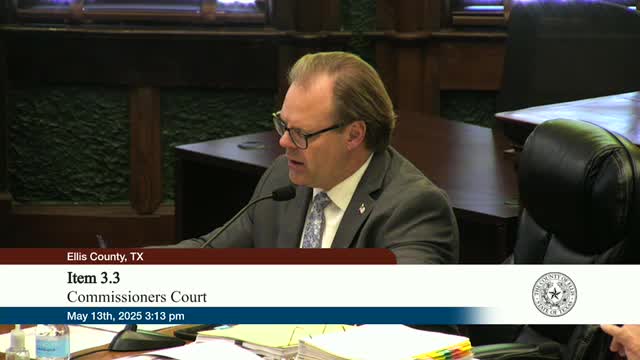
Ellis County Commissioners Court voted May 13 to approve a participation agreement with the City of Grand Prairie for Grand Prairie TIRS (Tax Increment Reinvestment Zone) No. 3, with county legal to finalize board‑membership language before the county judge signs the document.
The court’s action authorizes the county to participate in up to three separately designated “defined areas” inside the TIRS; each defined area carries a maximum 10‑year county participation period beginning on the tax year the developer designates that defined area. The agreement excludes county tax increment participation for single‑family residential infrastructure: “County's participation rate for single family residential development shall be 0%,” the text states.
The provision that drew the most discussion was how many seats Ellis County would hold on the TIRS board. County counsel Greg Wilhelm said Ellis County should be entitled to match the representation of any other participating county and not be limited by an arbitrary percentage. “It is my position that Ellis County should have the same number of board members as any of the other… counties,” Wilhelm said, arguing for parity as other counties join.
Megan Mahon, deputy city manager for Grand Prairie, said the city’s negotiators were willing to make the county’s representation equivalent to the most‑numerous county member count so Ellis County would not be disadvantaged as other jurisdictions join. She emphasized that Grand Prairie sees the project as a partnership and offered to provide periodic progress briefings to the county. “If there’s a particular once a year, once every 6 months…we’d be happy to do that,” Mahon said.
Developer Daniel “Twig” (Provident Realty) described why the agreement does not include an exhibit listing projected public‑improvement costs: the project covers roughly 2,500 acres and exact, long‑range infrastructure needs are difficult to predict now. “For such a large development... it’s impossible to forecast the exact improvements that we’ll need over such a long time horizon,” he told the court.
The participation agreement also includes several guardrails for the county: county increment may not fund municipal operations, economic development grants, or administrative costs without prior court approval; abatements on real property within a defined area require prior commission approval; and any expansion of the TIRS or of the areas that would use county increment must be presented to the commissioners for approval.
Commissioners emphasized the mechanic for starting the 10‑year participation clock: a developer must designate a defined area and submit meet‑and‑bounds to the county. Counsel noted that if the designations and start dates are delayed, later participation could be shorter than 10 years for a particular defined area, and any extension beyond the statutory end year would require future court approval.
Commissioner Butler moved to approve the agreement and allow the county judge to sign after county legal and the City of Grand Prairie finalize the board‑membership language; Commissioner Ponder seconded. The court voted in favor; the judge’s office was to receive the final documents for signature the following day.
The court’s vote followed an executive review of the draft language in a prior workshop, and commissioners said they expect future briefings as development and defined‑area designations proceed. No specific projected cost exhibits were attached to the agreement at the time of signature; the county will review and approve specific defined areas and any cost items before using local tax increment funds.
The agreement will not take effect for any tax year until a developer designates a defined area and submits required legal descriptions to Ellis County. The agreement contains a provision capping county payments so that no payment obligations from the agreement will extend beyond the 2055 tax year absent a future amendment approved by the parties.
The court’s action authorizes staff and the judge to finalize and execute the agreement once the contested board‑membership language is clarified to give Ellis County equivalent representation to other participating counties.