Get Full Government Meeting Transcripts, Videos, & Alerts Forever!
Get email alerts on the Fy26 Budget Public Hearing topic
No spam. Unsubscribe anytime.
Public urges City Council to boost schools, transit, mental‑health response, cooperatives and energy programs in FY26 budget
Summary
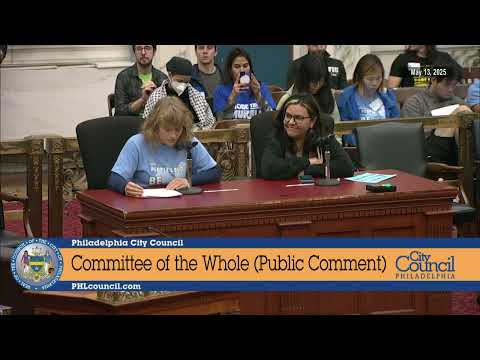
At a May public hearing on the proposed FY26 budget, dozens of residents and advocates urged City Council to increase local funding for schools, SEPTA, mobile crisis teams, tenant inspections, cooperative business supports and the Philadelphia Energy Authority’s Built to Last program. Council recessed the hearing to continue deliberations.
Dozens of residents, nonprofit leaders and small‑business owners testified before the Philadelphia City Council Committee of the Whole during a public hearing on the proposed FY26 budget, urging the council to restore or increase funding for schools, transit, mental‑health response and community programs while opposing proposed tax changes they said would harm small businesses.
Speakers described concrete funding requests and local effects. Simbelai, of Children First, urged council to increase the millage transfer to the School District of Philadelphia by 1 percentage point — an increase she said would generate $25,000,000 in recurring local funds — and warned the district is “$1,200,000,000 underfunded” and that the city’s share comprises about 44% of the district’s budget. ‘‘As it stands, the fund balance is enough to get the district through 4 and a half weeks of operations,’’ she said.
The hearing featured repeated calls for new and expanded public services. Jules Rogers of Amistad Law Project and other advocates asked council to allocate $20,000,000 to fund 24/7 mobile mental‑health crisis teams, arguing that clinicians and peer responders — not armed police — should respond to many crises. Rogers cited the March fatal police shooting of Aaron Rainey during a mental‑health episode and said mobile teams could prevent similar outcomes.
Transit riders and advocates described the effect of proposed SEPTA service reductions and fare increases. Katie (first name only) and Katie, a Community College of Philadelphia student who commutes from Abington, said cuts would make getting to school impossible for students and working families who cannot drive. Speakers urged council to dedicate additional city funds to SEPTA and to back expanded fare‑free pilots.
Public‑safety and street‑safety advocates pressed for Vision Zero investments. Nicole Bernay of the Bicycle Coalition of Greater Philadelphia and Jacob Russell said the mayor’s proposed capital budget includes steps toward Vision Zero, including budget lines that would allow concrete protected bike lanes on Spruce and Pine streets; Russell noted about 7,000 petition signatures supporting protection there and said the $5,000,000 line item is a modest share of the city budget.
Housing and energy issues drew multiple requests. Several speakers, including Reverend Alan Drew and Emily Davis, asked City Council to fund the Philadelphia Energy Authority’s Built to Last program at $10,000,000 to expand weatherization, heat pumps and rooftop solar for low‑income homeowners. Tenant advocates and renters asked for $10,000,000 for the Department of Licenses and Inspections to expand proactive inspections and enforcement; speakers said the city currently has too few inspectors for the rental stock and that proactive enforcement would prevent health and habitability harms.
Small‑business owners and arts workers warned against removing what they called the BIRT exemption for many small proprietors. Yvonne Long and other artists said losing the exemption would add financial pressure on sole proprietors and creative workers; opponents said proposed changes could affect as many as 80,000 small businesses and that a $30,000,000 transition fund would be insufficient.
Several speakers also urged a $1,300,000 city grant and technical‑assistance fund to support Philadelphia cooperatives. Cori Reedy of the Philadelphia Area Cooperative Alliance (PACA), Brad Forbes of PACA and other cooperative leaders described the request as $1,000,000 for direct cooperative support and $300,000 for pro bono technical assistance modeled on similar programs elsewhere.
Speakers repeatedly tied budget choices to city priorities. Alexia Clark, CEO of Covenant House Pennsylvania, described unmet needs for youth housing and services and asked council to fully fund existing beds and supportive services so shelters can stop turning young people away. Community College of Philadelphia faculty and union leaders asked for $15,000,000 in additional general operating funds and $2,000,000 for SEPTA passes for students.
The hearing also included critiques of police funding and technology spending. Katie Perez and others accused the administration of over‑relying on police and surveillance technology, and People's Tech Project organizers asked council to increase oversight of police technology purchases and data‑sharing with federal agencies.
At the end of the hearing, Majority Leader Kendra Brooks Richardson (motion recognized by the chair) moved that the public hearing and meeting stand in recess until Wednesday in May 2025 at 10 a.m.; the motion was seconded, no roll call was recorded, and the chair announced the motion carried.
The council’s Committee of the Whole will consider these public requests as it reviews the mayor’s FY26 proposal; members did not vote on substantive budget items during the hearing.