Get Full Government Meeting Transcripts, Videos, & Alerts Forever!
Get email alerts on the Sewer Infrastructure topic
No spam. Unsubscribe anytime.
Cheektowaga officials briefed on DEC consent order, funding gaps for sewer overflow fixes
Summary
Pat Bowen told the Town of Cheektowaga Board on May 13 that the town remains under a DEC consent order to reduce sanitary sewer overflows and that completed pipe lining has lowered flows in many areas, but funding shortfalls and private‑side inspections remain unresolved.
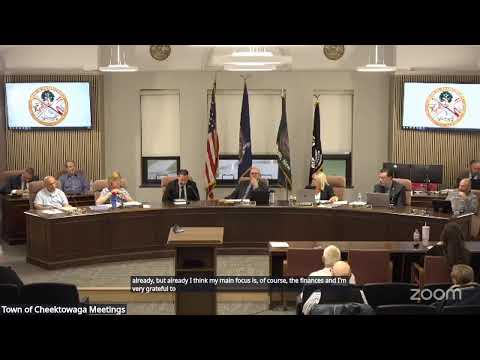
Pat Bowen, the town official assigned to manage the sewer consent-order work, told the Town of Cheektowaga Board at its May 13 meeting that the town remains under a New York State Department of Environmental Conservation (DEC) consent order requiring steps to eliminate or sharply reduce sanitary sewer overflows during heavy rain and snowmelt.
Bowen said the town has completed pipeline rehabilitation in sewer sheds 1–8 and that work on sheds 9 and 10 is in progress. He told the board the system is largely old clay tile pipe, installed from the 1920s through the 1950s, and that defects at pipe joints and manholes allow groundwater and storm inflow (I&I) into the sanitary system during wet weather.
"All of our overflows occurred during wet weather events. We don't have any dry weather overflows into our creeks or ditches," Bowen said, summarizing the DEC finding and the town's monitoring results.
What the town did and still owes
He described projects completed and planned under a revised Schedule A in the consent order (the transcript notes the revised schedule "became effective in February" but does not specify the year). Key points Bowen gave to the board:
- The town divided the sanitary system into 10 sewer sheds. Sewersheds 1and 8 tributary to the town's main north pump station; sheds 9 and 10 flow to Plant 3 in the south. - The pipeline rehabilitation for sheds 1 through 8 is complete; lining work for sheds 9 and 10 was bid and is underway. - Manhole rehabilitation is complete in sheds 1 3 and 5through 8. Manhole rehab for Shed 4 has been bid but not awarded for lack of funding; Bowen said the total needed for that work is $1,341,000 and that manhole rehab bids for Sheds 9 and 10 would require $1,462,000 to fund. - A pilot Sewer System Evaluation Survey (SSES) and corrective-action pilot was done in Sewer Shed 3 to assess private-side sources of I&I. Pre-rehabilitation flow monitoring for the pilot is complete and has been submitted to the DEC; interior I&I property inspections had not yet begun at the time of the meeting. - A contract (resolution 2024-738) was awarded for rehabilitation work covering two of five mini‑system bid sections (b and d) in the pilot area: $1,836,000 funded with previously allocated ARPA money. Bowen said the town is seeking an additional $2,860,000 to complete the remaining three mini sections (a, c and e).
Funding history and grant layers
Bowen and board members reviewed earlier funding layers: the town received a $5,000,000 WQIP (Water Quality Improvement Program) grant for part of the work and a package through the Environmental Facilities Corporation (EFC) that combined a $5,000,000 grant and a $15,000,000 zero-interest loan as part of earlier bonded and grant-funded projects. Bowen said the $20 million package was used across multiple sewer projects (lining and manhole rehab) and that reimbursements for those earlier projects have been processed and closed on.
Board members repeatedly asked for an itemized breakdown showing which projects were paid with which funding sources (grants, bond proceeds, EFC loan, ARPA). Bowen said he has two spreadsheetsone that lists completed projects and a second that breaks funding out by sourceand he agreed to send them to the board.
Private-side work and DEC expectations
Bowen and engineers told the board they expect the DEC to press the town to address private-side I&I after the pilot. The pilot includes interior inspections of private laterals where the DEC has directed the town to investigate suspected illegal connections and defective private laterals. Bowen said the DEC has been unsparing about enforcement expectations: the town must demonstrate enforcement or remediation to bring properties into compliance with sewer-use laws.
Council members voiced concerns about logistics, enforcement, equity and cost to homeowners. Bowen and others on the dais noted approaches used elsewhere (interior inspections tied to time-of-sale, use of CDBG funds to assist low- and moderate-income homeowners, public education campaigns) and discussed operational issues such as staffing, grant administration and contractor availability. Bowen said prior ‘‘walk-by’’ exterior inspections had been used to flag properties and the pilot would expand to interior inspections where warranted.
What the town has shown so far
Bowen cited analysis by Nussbaum & Clark showing lining and manhole rehab work has reduced wet-weather flows by roughly 40–50 percent in some sheds when compared to similar rainfall years. He said sheds 1through 8 cover about 80 percent of district flow and that the remaining work on sheds 9 and 10 is concentrated in the Plant 3 tributary area.
Board requests and next steps
Council members pressed Bowen for a clear accounting of where earlier loans/grants were spent and for the bid tabs and breakdowns for already‑bid manhole rehabilitation. Bowen agreed to provide the spreadsheets and the bid tab summaries to the board. Council members and Bowen said they would pursue additional grants; Bowen said he would ask the DEC for examples of successful public-education campaigns used by other municipalities and that the town planned additional technical staff meetings with DEC.
Discussion vs. decisions
The May 13 presentation was informational and elicited questions; the board did not adopt new policy or a new contract during the meeting. Several resolutions that relate to consent‑order work (advertising bids, public hearings) were pulled from the consent calendar for later discussion; no formal new commitments beyond earlier-bidallocations were adopted at the meeting.
Ending
Bowen told the board he would send the requested funding and bid spreadsheets and work with engineering and the town supervisor on next steps; he said the pilot study results will shape whether the DEC requires townwide private‑side inspections and lateral rehabilitation. Council members emphasized the need for clearer public education materials, funding transparency and follow-up with the DEC.