Get Full Government Meeting Transcripts, Videos, & Alerts Forever!
Get email alerts on the Telecommunications topic
No spam. Unsubscribe anytime.
Bonner County schedules workshop after resident warns HB 180 could fast-track small wireless facilities
Summary
A Bonner County resident warned commissioners that Idaho House Bill 180 will shorten local permitting timelines and treat some wireless facilities as utilities, and asked the county to adopt targeted ordinance language. County staff said a public workshop will be scheduled to consider stop-gap and longer-term ordinance changes.
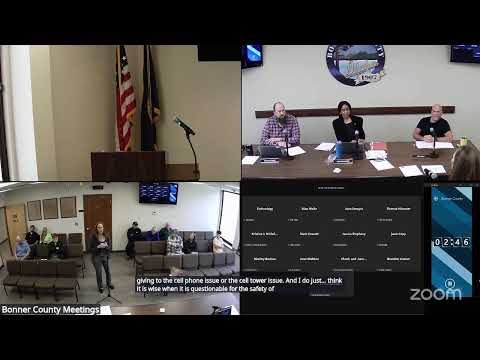
Anne Wilder Chamberlain, a Bonner County resident, warned the Bonner County commissioners that Idaho House Bill 180 would reduce local review time for small wireless facilities and allow the wireless industry to treat those facilities as utilities, potentially sidestepping local hearings.
"The bill which goes into effect on July 1," Chamberlain said, "states that other than the reduction in approval time in subsection 1, nothing in this section limits the authority of a municipality over decisions regarding the placement, construction, and modification of a wireless telecommunication facility." She said local code vagueness leaves the county vulnerable to industry interpretation and urged specific, measurable ordinance language.
Chamberlain told the board Bonner County’s telecommunications ordinance is missing clear definitions and evidentiary requirements, and recommended adopting or adapting provisions used in other Idaho ordinances such as Dalton Gardens’ model. She urged a short-term stop-gap amendment to prevent placement of small-cell facilities "in or near residential neighborhoods and zones in our county prior to the 07/01 deadline," and offered sample language, drive-test requirements and distance offsets to use in evaluating applications.
County staff said they will prepare an updated informational video about the law and schedule a public workshop for deliberations on short- and long-term ordinance changes. Staff emphasized the workshop will be public and will be used to develop options for the board to consider; the county also offered that members of the public may submit materials by email or comment during the designated public-comment period.
Speakers at the meeting and several public commenters later in the session repeatedly pressed the board about health, ecological and property impacts of additional wireless infrastructure; commissioners and staff acknowledged those concerns but said legal limits on what can be considered under federal case law and the 1996 Telecommunications Act restricts local authority on certain health-related grounds. County officials told the room they intend to pursue ordinance language focused on objective, quantitative permitting requirements—such as evidentiary drive tests, specified setbacks, and clear application completeness checklists—to preserve locally enforceable review criteria within the constraints of state and federal law.
The board did not take a formal vote on an ordinance at the meeting. Staff said a public workshop will be scheduled soon to begin drafting specific language and a longer-term ordinance update, and that county staff would circulate resources (including Dalton Gardens’ ordinance examples and a revised "Wired Idaho" information video) in advance of the workshop.
Why it matters: HB 180 shortens timeframes for local review of wireless facilities and reframes some small wireless structures in ways residents and some officials say could reduce public hearings; the board’s planned ordinance update aims to set local, measurable criteria that can be applied quickly when applications arrive.
Next steps: County staff will schedule and publicize a workshop open to participation by residents; written materials submitted to the board and the county’s informational video will be used as background for that session.