Get Full Government Meeting Transcripts, Videos, & Alerts Forever!
Get email alerts on the Women Health And Safety topic
No spam. Unsubscribe anytime.
Miami-Dade Commission for Women urges two new domestic‑violence centers, maternal‑health outreach after CEDAW report
Summary
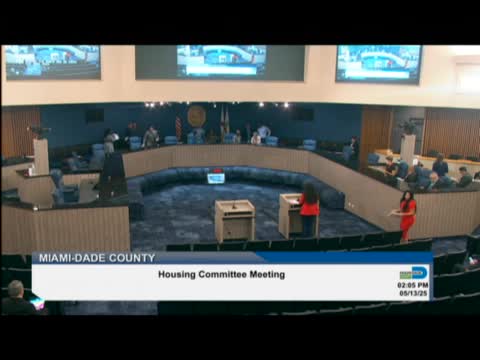
At a May 2025 Miami‑Dade County Housing Committee meeting, the Miami‑Dade County Commission for Women presented a CEDAW-based status report and recommended two new domestic‑violence (CVAC) centers, a maternal‑health fair and a county workforce pay analysis to address wage disparities and rising maternal mortality among Black women.
At a Miami‑Dade County Housing Committee meeting in May 2025, the Miami‑Dade County Commission for Women presented its annual status report under the Convention on the Elimination of All Forms of Discrimination Against Women (CEDAW) and recommended the county authorize two new domestic‑violence centers, fund a maternal‑health fair and conduct a county workforce pay analysis.
The report, introduced by Josephine Novo, legislative chair and District 13 appointee to the Miami‑Dade County Commission for Women, said the county has seen an “84.7% increase” in domestic‑violence incidents, “over 300 more domestic violence cases” and “286 forcible” offenses in the last year, and recommended two new CVAC centers be established in underserved North and West parts of the county and promoted through a multimedia marketing campaign.
The recommendation matters, Commission for Women officials said, because the county’s data show gaps in prenatal and maternal care and persistent pay disparities that contribute to broader health and safety outcomes. “These services cannot do anybody any good if nobody knows they exist,” Josephine Novo said. “As of right now, we are lacking locations in the north and west parts of the county, underserving these populations and these women at need.”
Rose Martin, executive director of the Commission for Women, told the committee the commission follows the Cities for CEDAW blueprint and is working with partners such as Florida International University, the Human Rights Law Clinic and the Women’s Fund to build capacity and disaggregate data by ZIP code for each commissioner. “We just need, like, your partnership,” Martin said, adding that the commission is preparing outreach events including a disability resource fair for mothers and panels on violence against women.
On maternal health, the report cited partnership data with Florida International University that show only 57% of Black women receive adequate prenatal care and said Black maternal mortality has increased substantially in recent years; presenters said updated FIU figures showed the disparity rising from roughly three times to five times the mortality rate for Black women in childbirth, compared with other groups. The commission recommended the board authorize and fund a maternal health fair to bring local partners and services to residents.
On economic opportunity, the report said the county’s overall wage gap for full‑time female workers is about 18%, an increase since 2011, and that the county employee wage gap is about 16.7%. The report gave median earnings examples: $41,454 for full‑time women versus $50,577 for men, and county median pay of $64,522 for women versus $77,446 for men. The commission recommended the county conduct an analysis of the county workforce to determine why pay disparities exist and to develop a roadmap for internal solutions.
Committee members responded with support and follow‑up questions. Vice Chair Gonzales and several commissioners offered to host outreach events in their districts and invited the commission to present disaggregated ZIP‑code data so each commissioner could see conditions in their area. A county attorney explained procedural options for formalizing the commission’s recommendations, including bringing proposals to the full board or sponsoring items through committee channels.
The Commission for Women noted the county adopted an ordinance in September 2015 that incorporated CEDAW principles locally; the board frequently publishes an annual Status of Women report in partnership with Florida International University and the commissioner auditor’s office. The presenters said the commission would continue outreach and return with additional materials and proposed resolutions following a proposed conference and stakeholder meetings.
The presentation concluded without a committee vote; the commission framed its proposals as recommendations and requests for county partners and commissioners to sponsor or request follow‑up actions.