Lifetime Citizen Portal Access — AI Briefings, Alerts & Unlimited Follows
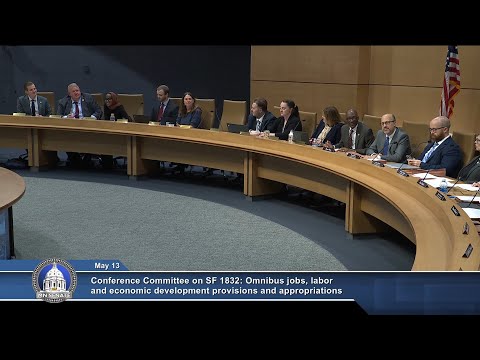
Conference committee on SF 1832 opens, fiscal gaps and policy differences outlined
Loading...
Summary
The joint House-Senate conference committee on Senate File 1832 convened to introduce members, review side-by-side fiscal spreadsheets and a policy comparison, and schedule further meetings as negotiators await targets.
The Minnesota joint conference committee on Senate File 1832 convened on May 13, 2025, to introduce members, walk through side-by-side fiscal spreadsheets and policy provisions from the House and Senate positions, and set a tentative follow-up meeting time.
The committee meeting drew chairs and members from both the House and Senate jobs and labor committees, committee administrators, counsel and fiscal analysts. Committee chair Champion called the session to order and opened by identifying the item: “Senate file number 1832 … conference committee, I'm calling it to order. We are excited that you all are here.” Representative Dave Pinto, co-chair for the House jobs side, said the two chambers face “obviously, significant fiscal difference between these bills … driven a lot by the extremely different targets that we received.” Senator Jen McEwen, chair of the Senate labor committee, said she was “very pleased to be joining all of you today,” and noted work this session to “preserve a lot of important protections for working Minnesotans.”
Why it matters: SF 1832 is a combined jobs, economic development and labor package that contains both spending proposals (including many one-time appropriations to workforce and community organizations) and policy changes affecting workforce development, apprenticeship programs, construction and licensing fees, paid family and medical leave administration, and unemployment insurance provisions. Differences between the House and Senate fiscal targets and some policy formulations will guide negotiations and timing of final agreement.
What the meeting covered: Fiscal staff walked through three spreadsheets (a cover sheet combining jobs and labor positions, a jobs/workforce spreadsheet, and a labor spreadsheet). The Senate and House positions diverge on overall targets and many line items. Fiscal staff described a number of one-time appropriations and adjustments in the Senate position, including a $14,000,000 cancellation from the Minnesota Forward Fund transferred to the general fund and a footnote increasing unemployment insurance benefit costs in the Senate fiscal note. The Senate presentation listed numerous one-time awards from the Workforce Development Fund to community organizations (amounts ranging from $50,000 to $5.5 million for individual organizations), and one-time appropriations for events including $1,500,000 for the 2026 Special Olympics U.S. Games and $5,000,000 for the World Junior Hockey Championships.
Policy walk-through: Committee counsel led a line-by-line comparison of policy sections. Counsel summarized similar and differing provisions across dozens of sections, including: changes to the business development public infrastructure program; expansions to small business assistance and youth employment programs; technical edits to the Minnesota Expanding Opportunity account; treatment of workforce development fund timing; apprenticeship and workforce training provisions; adjustments to construction code fees and plan-review revenues; and differences in unemployment insurance-related language (including a Senate proposal to allow certain remote work searches without disqualifying claimants and a Senate-only provision adding 26 weeks of UI for certain iron ore mine layoffs). Counsel also summarized divergent approaches on misclassification fraud reporting — the House would require a biennial report while the Senate’s language is permissive.
No formal votes or final actions were taken. The meeting served as an organizational and informational session: introductions, lengthy spreadsheet and policy side-by-side walkthroughs, and scheduling. Representative Pinto and Chair Champion said the committee planned to reconvene; after some discussion about members’ floor schedules, senators suggested a later start. The committee agreed to aim for a 3 p.m. follow-up meeting the next day but noted the time remained subject to change based on floor activity.
Discussion vs. decisions: The transcript shows extensive staff presentations and member questions; it does not record any adopted motions or formal votes. Committee members repeatedly emphasized doing policy work that does not require a dollar figure while awaiting a joint target from leadership.
What remains: Negotiators will use the joint fiscal target from leadership to reconcile the substantial spending differences between the House and Senate positions. The next meeting was set tentatively for 3 p.m. the following day, subject to floor schedules and rule-based permissions for members to participate remotely.