Get Full Government Meeting Transcripts, Videos, & Alerts Forever!
Get email alerts on the Municipal Budgeting topic
No spam. Unsubscribe anytime.
Springfield budget committee opens FY26 review as city plans $3.11 million in reductions
Summary
The Springfield Budget Committee convened to begin a three‑evening review of the city's proposed FY26 budget. Staff outlined a $3.11 million reduction package, the use of one-time reserves and federal ARPA dollars, and the city's structural general‑fund challenges; committee officers were elected by voice vote.
The Springfield Budget Committee opened its FY26 budget review with training and a presentation from city staff that outlined $3,110,000 in proposed reductions and a mix of one-time reserves to balance the city's budget.
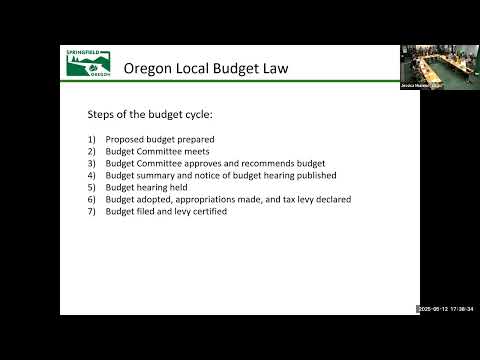
Finance Director Nathan Bell led an orientation on committee procedures and Oregon budget law, emphasizing the committee's advisory role. "I want to stress that it's a recommending body. It is not a decision making body," Bell told the committee as he reviewed quorum rules, public‑comment procedures and the three‑evening schedule for deliberations.
City Manager Nancy Newton delivered the budget message, saying the proposed plan includes $1,360,000 in departmental reductions and $1,750,000 drawn from reserves. "This year is a little different than last year. We're really in a time of reductions in the budget," Newton said, adding the reductions "buy us some time" but do not resolve a longstanding structural gap in the general fund.
Why it matters: City staff told the committee that a combination of inflation, contract settlements and the expiration of one‑time federal pandemic funding has left limited flexibility in FY26. Staff presented the general fund's cash target (about 25–26% of operating expenditures) and warned that projected reserves dip below the preferred level in later years under current forecasts.
Key numbers and drivers: Staff said the proposed FY26 package relies on departmental changes plus one‑time resources. They reported the city received roughly $14 million in ARPA funds during prior years, used those dollars for one‑time investments (including about $3 million for LED streetlight replacement) and that $2 million in ARPA‑funded personnel costs returned to the general fund in FY25, adding to FY26 budget pressure. The operating budget presented to the committee was roughly $145 million; the full FY26 budget displayed on staff slides totaled nearly $500 million because it includes capital and the Metropolitan Wastewater Management Commission budget that passes through the city.
Public safety and revenue context: Staff said public safety (police, fire and municipal court) is the single largest general‑fund cost and that total, full‑cost public‑safety spending was presented at about $37.1 million. Property taxes were shown at about $28 million, which staff said does not cover full public‑safety costs. Staff described franchise fees and other transfers that subsidize public safety and noted long‑term constraints from Oregon measures (Measure 5 and Measure 50) and assessed‑value growth limits.
Funds and programs: Staff reviewed other enterprise and restricted funds: the building code fund (reserves reported above $7 million and restricted to building code uses), street and transit lodging tax funds, ambulance and sewer/drainage funds, and the Booth‑Kelly commercial property, which formerly subsidized the general fund but has declined after losing a major tenant.
One‑time balancing steps: To balance FY26 staff described using one‑time or restricted sources: a Comcast settlement in a special‑revenue fund, opioid settlement dollars (limited to drug‑related uses and subject to multi‑year spend rules), and transfers from the employer/employee health plan reserve that was built through prior "benefit holidays." Staff emphasized these are not sustainable long‑term solutions.
Longer‑term work: Newton and staff noted the mayor convened a fiscal sustainability task force that met earlier in the year and will present recommendations to the City Council on May 19. The task force considered expenditure reductions, revenue diversification, economic development, and state‑level policy changes as possible paths to address the structural imbalance.
Committee business and next steps: The committee set its schedule for three evenings of budget review (staff identified May 13 and May 14 as subsequent meetings) and a city budget hearing date of June 16. Department directors were scheduled to present across the evenings, and staff set aside time for public comment and Q&A.
Votes at a glance: During the meeting the committee held voice‑vote elections for officers.
- Nomination and approval of Devin Marche Duncan as chair (single nomination; second provided; approved by voice/consent). Motion mover: not specified; second: Bob Brew; outcome: approved by voice/consent. - Nomination and approval of Michael Roman as vice chair (nominator not specified; seconded; approved by voice/consent). Motion mover: not specified; second: not specified; outcome: approved by voice/consent. - Nomination and approval of Art (Arthur) Ayer as secretary (nominator and second not specified in record; approved by voice/consent). Motion mover: not specified; second: not specified; outcome: approved by voice/consent.
Attributions and process notes: Committee members asked clarifying questions about fund restrictions, the composition of reserves, ambulance transport reimbursement (staff said a typical transport costs about $2,200 while Medicare/Medicaid reimburse roughly $400, and Medicare/Medicaid transports make up about 82% of total transports), and building‑fund reserves. Staff repeatedly cautioned that several of the balancing items are one‑time or restricted and that longer‑term structural options are under study. The presentation materials and legal references cited Oregon budget law and named the Department of Revenue as a source for guidance.
What’s next: The committee will hear department presentations and deliberations over the scheduled evenings, consider adjustments through motions requiring a quorum and recorded votes, and forward a recommended balanced budget to the City Council, which will hold the public hearing and adopt a final budget and tax levy.
Ending: Staff asked members to notify the budget and procurement manager or finance director if they cannot attend upcoming meetings; department directors will be present for Q&A during the remaining sessions.