Get Full Government Meeting Transcripts, Videos, & Alerts Forever!
Get email alerts on the Free Speech Protests topic
No spam. Unsubscribe anytime.
Lafayette council hears staff analysis on sidewalk protests at Lafayette Elementary; keeps options limited by free-speech protections
Summary
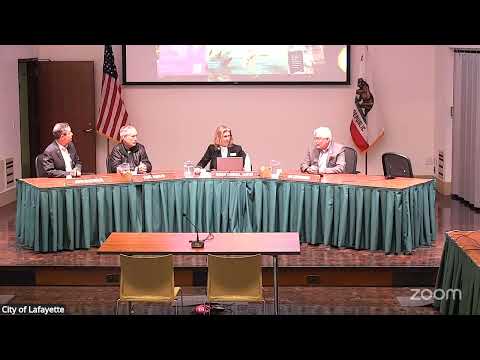
The Lafayette City Council on Monday received a staff report on protests near Lafayette Elementary School and took no ordinance action, voting instead to receive and file the report.
The Lafayette City Council on Monday received a staff report on protests near Lafayette Elementary School and took no ordinance action, voting instead to receive and file the report.
The briefing, presented by City Attorney Jamie Williams and by the Police Chief, summarized recent staff research into municipal ordinances in San Diego, Lancaster, Napa and Sacramento that create small “buffer” zones around certain facilities. Williams told the council those ordinances typically measure a 100-foot radius from the facility entrance and bar approaching within roughly eight feet of an individual to intimidate, harass or hand a leaflet to a person trying to enter or exit.
“San Diego and Lancaster have ordinances that apply to health care facilities, places of worship and school grounds,” Williams said, explaining that the rules prohibit approaching within eight feet of a person to intimidate or harass and prohibit giving materials to someone entering the facility without consent. Napa and Sacramento adopt narrower protections limited to reproductive health facilities or health-care clinic entrances; Napa’s code creates a 30‑foot zone marked with signage.
The Police Chief told the council that Lafayette police reviewed calls for service at Lafayette Elementary and found three protest-related calls with no crimes documented; officers left without making arrests or writing reports. The chief also reported a traffic-volume check on Moraga Road showing roughly 1,400–1,500 vehicles during morning drop-off and similar afternoon counts, and average travel speeds in the 17–21 mph range during those windows. “There were zero traffic accidents in the last month in the vicinity of the school,” the chief said, and staff concluded they could not attribute traffic conditions to the protests.
Public commenters were divided. Several speakers, including Lisa Disbrow and Marlene Huffaker, defended the protesters’ right to stand with signs on the public sidewalk and criticized the council if it attempted to limit those demonstrations. Other speakers urged the city to ensure safety during drop-off and pick-up times. Multiple residents described heated encounters and said they had filed police reports about aggressive behavior; one commenter said she had three incident reports.
Council discussion emphasized the city’s legal obligation to remain content-neutral. Councilmember Cervantes noted that standing on a sidewalk with a sign would generally not violate the ordinances Williams described. Several council members said they were reluctant to adopt new local restrictions because Lafayette’s observed activity did not match the prohibitions used in places like San Diego or Lancaster, and because any restriction would implicate the First Amendment.
By consensus the council accepted staff’s analysis and “received and filed” the report, with members thanking the city attorney and police staff for the review. Council members said they will continue to monitor compliance with existing laws and asked staff to respond to any incidents of harassment or obstruction that might require enforcement.
The city did not introduce or adopt any new ordinance at the meeting; council members noted that, under the rules staff summarized, stationary demonstrators holding signs on a public sidewalk typically remain protected speech so long as they do not approach, harass, obstruct entry or physically impede individuals attempting to enter a school.
Looking ahead, staff recommended continuing to coordinate police presence at school drop-off and pick-up and to respond to complaints as they arise. The council made no further policy change at Monday’s session.