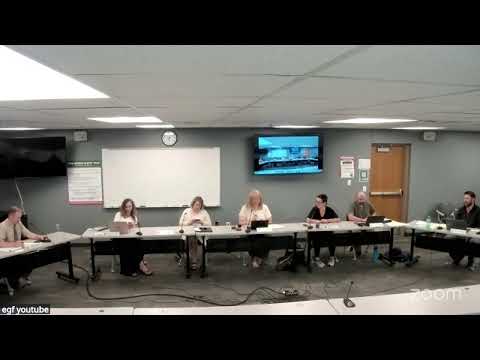
East Grand Forks board approves K‑12 science curriculum, signs off on large payments; debate continues over tech subscriptions
Loading...
Summary
The East Grand Forks School Board voted to buy new K‑12 science curriculum materials and approved routine payments, while members pressed staff for more time to review digital subscription contracts and asked for better presentation of future curriculum recommendations.
The East Grand Forks School Board voted Monday to purchase a K‑12 science curriculum for fiscal year 2026 and approved payment of routine district bills, while also discussing technology subscriptions and the board’s role in curriculum review.
The board approved the science curriculum purchase — a one‑time cost of $100,724.87 with ongoing costs over five years that the district estimates at $293,003.39 — on a 5‑1 vote after several board members asked for more time to review the materials. The board also approved payment of K‑12 claims and electronic fund transfers totaling $1,194,814.66.
Board members who spoke during the curriculum discussion said they respect the work of the teacher committees that vetted materials but wanted time to review hundreds of pages and to hear a short presentation from curriculum committees in future cycles. One board member urged a “trust but verify” approach, saying it is the board’s duty to be able to explain what it votes on.
The board approved the consent agenda, which included several routine items and technology subscriptions, without pulling individual items. During the consent‑agenda discussion a board member asked whether the district could consolidate assessment and behavior‑tracking subscriptions by replacing Panorama with FastBridge. Staff said FastBridge offers many assessments but does not operate as a full data warehouse like Panorama and that Panorama also includes family and staff survey modules the district values. Staff confirmed the Panorama subscription being discussed is a one‑year contract and that the district is exploring alternatives such as Synergy and EduCLIMBER. No vote was taken specifically to change subscription vendors; the subscriptions remained in the approved consent agenda.
Why it matters: curriculum and student‑data systems drive instruction, assessment and how teachers and support teams track student progress. Board members emphasized they want enough time to review materials before votes and asked that future curriculum recommendations include presentations from committee representatives so trustees can better understand rationale and scope.
Details of formal actions
Votes at a glance - Science curriculum purchase (Fiscal Year 2026): Motion to approve passed 5–1. Motion language in board book: purchase for $100,724.87 with ongoing costs over five years totaling $293,003.39. (Tally: yes 5; no 1; abstain 0.) - Approval of consent agenda: Motion carried (vote recorded as "motion carries"). Consent agenda included technology subscriptions and other routine items; no item was pulled for separate vote. - Payment of claims and accounts: Motion to approve payment of K‑12 bills numbered 129393 through 129463 and electronic fund transfers in the amount of $1,194,814.66. Motion carried. - Approval of meeting agenda: Motion carried at start of meeting.
Discussion vs. decision - Discussion: Board members debated whether the board should have formal representation on curriculum selection committees going forward and said they want curriculum committees to present their choices and rationale to the full board before final votes. Staff and trustees agreed to schedule committee presentations earlier in the approval timeline in future cycles so trustees have time to review materials. - Decision: Despite those concerns, trustees voted to approve the current science curriculum purchase at this meeting.
What staff said - District administrators said curriculum committees (elementary through high school) vetted the materials and made recommendations. Administrators reported some print/hard copies were removed to reduce costs and several items were reduced to bring total price down; some high‑school classes will still require hard copies where digital pricing made that the less economical option. - On assessment/data platforms, staff said Panorama functions as a comprehensive data warehouse that stores attendance, behavior, interventions and survey results; Panorama’s survey tools (student, family and staff) were described as valuable. FastBridge was described as educationally focused and offering behavioral assessments but lacking the warehouse capabilities Panorama provides. EduCLIMBER and Synergy were noted as other products being explored.
Speaker list (relevant to this article) - Board member (unnamed): board member, East Grand Forks School Board (government) - Kevin (last name not specified): district administrator reporting on curriculum and facilities (government) - Sareya Driscoll (spelled in transcript): district staff involved in data/MTSS use (government)
Clarifying details - Science curriculum purchase: one‑time FY26 cost $100,724.87; five‑year ongoing costs totaling $293,003.39 (source: board book text read into the record). The board discussion noted that hard‑copy classroom sets would add about $30,000 if purchased. - Panorama subscription: presented as a one‑year contract; cost discussed in session around $22,000–$26,000 for one year (figures cited by staff during discussion). Board did not approve a multi‑year contract at this meeting. - Payment of claims: $1,194,814.66 for K‑12 bills numbered 129393–129463 and associated electronic fund transfers.
Proper names (extracted) - East Grand Forks Public School Dist (district), type: organization - Panorama (student-data/assessment vendor), type: organization - FastBridge (assessment vendor), type: organization - EduCLIMBER (student-data/warehouse product), type: organization - Synergy (student information system), type: organization
Authorities referenced - Minnesota Department of Education guidelines (referenced by presenters during facility and adequacy discussion) — referenced_by: ["facility presentations"] - Title VI / federal Title programs (mentioned when staff described federal funding sources alongside state American Indian Education Aid) — referenced_by: ["American Indian Education Aid discussion"] - LTFM (Long‑Term Facilities Maintenance) funding (finance/facility discussion) — referenced_by: ["facility presentations"]
Provenance - topicintro: {"block_id":"block_526.825","local_start":0,"local_end":122,"evidence_excerpt":"3 is roll call of all school board members, and we're all present today. We all blew in. 4 is to approve the agenda. I'll do a motion to approve. Need a second?","reason_code":"topicintro"} - topfinish: {"block_id":"block_2460.8901","local_start":0,"local_end":139,"evidence_excerpt":"To make the motion to approve the payment of k 12 bills 1 2 9 3 9 3 through 1 2 9 4 6 3. And a lot of electronic fund transfers in the amount of $1,194,814.66.","reason_code":"topicfinish"}
Searchable_tags":["curriculum","science","payments","technology subscriptions","Panorama","FastBridge","consent agenda","board votes"],"salience":{"overall":0.60,"overall_justification":"Board approved a multi‑year curriculum purchase and large payments; discussion about data systems affects instruction and budgets.","impact_scope":"local","impact_scope_justification":"Decisions affect district students, staff and local taxpayers.","attention_level":"medium","attention_level_justification":"Routine business with policy impact; likely interest from parents and staff."},"topics":[{"name":"curriculum","justification":"Primary topic: board voted on K‑12 science curriculum purchase and debated board review process.","scoring":{"topic_relevance":0.98,"depth_score":0.75,"opinionatedness":0.05,"controversy":0.40,"civic_salience":0.70,"impactfulness":0.65,"geo_relevance":1.00}},{"name":"school_finance","justification":"Board authorized payment of claims and discussed budgetary effects of subscriptions and curriculum costs.","scoring":{"topic_relevance":0.86,"depth_score":0.60,"opinionatedness":0.03,"controversy":0.20,"civic_salience":0.72,"impactfulness":0.68,"geo_relevance":1.00}}],"speakers":[{"name":"Kevin","role_title":"District administrator","affiliation_type":"government","affiliation_name":"East Grand Forks Public School Dist","first_reference":{"timecode":"00:12:02","transcript_line_range":[63,66]}},{"name":"Sareya Driscoll","role_title":"District staff - MTSS/data","affiliation_type":"government","affiliation_name":"East Grand Forks Public School Dist","first_reference":{"timecode":"00:28:01","transcript_line_range":[167,169]}}],"actions":[{"kind":"other","identifiers":{},"motion":"Approve K-12 science curriculum purchase for FY 2026 for $100,724.87 with ongoing costs over five years totaling $293,003.39 as presented in the board book.","mover":"Board member (mover not specified)","second":"Board member (second not specified)","vote_record":[],"tally":{"yes":5,"no":1,"abstain":0},"legal_threshold":{"met":true,"notes":"Majority vote carried; no additional statutory threshold cited in transcript."},"outcome":"approved","notes":"Board members asked for future committee presentations and additional review time before subsequent curriculum votes."},{"kind":"other","identifiers":{},"motion":"Approve consent agenda as attached (includes technology subscription renewals).","mover":"Board member (mover not specified)","second":"Board member (second not specified)","tally":{"yes":-1,"no":0,"abstain":0},"legal_threshold":{"met":true,"notes":"Recorded as 'motion carries' in transcript; individual consent items not split."},"outcome":"approved","notes":"Discussion included whether to consolidate assessment/data subscriptions; staff indicated Panorama functions as a warehouse and FastBridge lacks full warehouse capabilities."},{"kind":"other","identifiers":{},"motion":"Approve payment of K‑12 bills 129393 through 129463 and associated EFTs totaling $1,194,814.66.","mover":"Board member (mover not specified)","second":"Board member (second not specified)","tally":{"yes":-1,"no":0,"abstain":0},"legal_threshold":{"met":true,"notes":"Motion carried; no roll call tally provided in transcript."},"outcome":"approved","notes":"Payment includes a large set of routine claims and electronic transfers."}],"discussion_decision":{"discussion_points":["Board members expressed desire for committee presentations before curriculum votes; some trustees said they need more time to review lengthy curriculum materials.","Staff explained differences between Panorama and FastBridge and noted Panorama functions as a data warehouse with survey and MTSS integration.","Administrators said curriculum committees made recommendations and that some hard‑copy materials were removed to lower costs."],"directions":["For future cycles, curriculum committees will present recommended materials and rationale to the full board earlier to allow trustee review time."],"decisions":["Approve science curriculum purchase FY26 as presented (5–1).","Approve consent agenda including technology subscriptions.","Approve payment of claims totaling $1,194,814.66."]},"clarifying_details":[{"category":"curriculum_cost","detail":"One‑time FY26 cost","value":"100724.87","units":"USD","approximate":false,"source_speaker":"meeting record"},{"category":"curriculum_cost","detail":"Five‑year ongoing costs","value":"293003.39","units":"USD","approximate":false,"source_speaker":"meeting record"},{"category":"payment_of_claims","detail":"Total amount approved for payments","value":"1194814.66","units":"USD","approximate":false,"source_speaker":"meeting record"},{"category":"panorama_contract_length","detail":"Contract term discussed as one year","value":"not specified","source_speaker":"staff"}],"proper_names":[{"name":"East Grand Forks Public School Dist","type":"organization"},{"name":"Panorama","type":"organization"},{"name":"FastBridge","type":"organization"},{"name":"EduCLIMBER","type":"organization"},{"name":"Synergy","type":"organization"}],"community_relevance":{"geographies":["East Grand Forks (city)"],"funding_sources":["local general fund","state aid","federal Title VI"],"impact_groups":["K‑12 students","teachers","special education students"]},"meeting_context":{"engagement_level":{"speakers_count":10,"duration_minutes":170,"items_count":15},"implementation_risk":"low","history":[]}},{"id":"american-indian-aid-and-facility-planning-presentations","headline":"District reviews American Indian education aid plan and hears two facility‑planning firms; trustees ask for more community engagement","shortSummary":"Administrators presented the district's American Indian Education Aid application goals and two firms, ICS and Nexus, outlined facility assessment and long‑range planning services. Trustees asked that any future plans include robust community input and staged timelines before pursuing referendums.","body":"Administrators and program staff described the district's American Indian Education Aid plan and two outside firms presented facility‑assessment and long‑range planning approaches to the school board.
At the start of the business portion, a district staff member summarized the American Indian Education Aid application that the district parent committee had approved and said the plan will be signed by the superintendent and sent to the state. The application sets measurable goals and lists activities to support American Indian students, including graduate portfolio monitoring, college visits, mentorships with the University of North Dakota, FAFSA and scholarship assistance, cultural activities such as beading and star quilting, monthly cultural events, school‑wide powwows, and Ojibwe and Dakota language learning exercises for families. The presenter emphasized the program is state aid designated for American Indian programming and is intended to enhance, not replace, existing state and federal funding.
Facility planning presentations
Two firms gave extended presentations about conducting facility condition assessments, demographic and educational adequacy analyses, solutioning and potential funding pathways. The firms were ICS (represented by Jason Splett, business development director, and Blair Stoltman) and Nexus (represented by Rob Brown).
ICS outlined a five‑phase process (assessment, solutioning, decision, election/referral if needed, and implementation). Jason Splett described ICS's Northern Minnesota team, stakeholder listening sessions, demographic studies, an 18‑category educational adequacy review tied to Minnesota Department of Education guidelines, and detailed facility condition surveys (roof, HVAC, building shell, remaining life estimates). ICS proposed fees of $16,002.50 for phases 1–3 (assessment through decision); ICS said that if the district awards a later project, that fee would be credited back. ICS quoted $10,000 for referendum communications if the district chose that path.
Nexus presented a planning approach that emphasizes single‑source accountability and long‑term (10‑year) living plans that merge facilities and academic programming. Rob Brown highlighted the district’s demographic profile (noting growth in district‑residing children over a 10‑year period), a comparatively high special‑education enrollment (about 30 percent of district students, per his analysis), and the fact that three major district buildings were dedicated around the same time in 1998 and are now aging simultaneously. Nexus said it provides architecture, engineering, construction management and commissioning services; Rob Brown described a program‑manager‑at‑risk model in which Nexus invests time and some costs up front and will redesign at its own expense if a bid comes in over budget.
Trustee questions and next steps
Board members asked for references and reiterated that any planning should include broad community engagement: listening sessions, third‑party surveys (every mailbox), staff and student outreach, and ThoughtExchange or similar tools to gauge priorities. Trustees stressed communications must be clear and timely if the district eventually considers a referendum and noted referendum success rates vary by month; presenters recommended avoiding summer dates and noted November and February often have higher historical success rates.
Why it matters: Facility and long‑range plans determine how the district will allocate maintenance dollars, address capacity and special‑education space needs, and whether it will place a referendum before voters. Presenters said an upfront assessment and community engagement increase the odds of a successful public vote and better align facilities with educational goals.
Speakers (relevant to this article) - Jason Splett, business development director, ICS (business) - Blair Stoltman, ICS team member (business) - Rob Brown, Nexus (business) - Mr. Grover, district administrator (government) - Ron (last name not specified), district facilities lead (government) - Diane (first name), district preschool lead (government)
Authorities referenced - American Indian Education Aid (state program) — referenced_by: ["American Indian Education Aid presentation"] - Minnesota Department of Education (educational adequacy guidelines) — referenced_by: ["ICS and Nexus presentations"] - LTFM (Long‑Term Facilities Maintenance) finance codes (Minnesota) — referenced_by: ["ICS presentation","Nexus presentation"]
Clarifying details - ICS fee proposal: $16,002.50 to complete phases 1–3 (assessment through decision). ICS said that fee would be credited back if ICS is later contracted for implementation. ICS quoted $10,000 for referendum communications if needed. - Nexus offered a program‑manager‑at‑risk approach; Nexus representatives said they will redesign at their own cost if bids exceed budget (claim presented by the firm). - District demographics: presenters noted the number of school‑residing children grew about 17% over a 10‑year period (applied‑insights demographic slide); Nexus noted a district special education population of roughly 30% (584 of 1,934 students cited in presentation).
Proper names - East Grand Forks Public School Dist (organization) - ICS (company) (organization) - Nexus Solutions / NexSys (company name as spoken: "Nexus"/"NexSys") (organization) - ThoughtExchange (engagement platform) (organization) - Ehlers/Eller's (financial partner referenced as 'Eller's' in presentation) (organization) - University of North Dakota (UND) (organization)
Provenance - topicintro: {"block_id":"block_1016.32","local_start":0,"local_end":192,"evidence_excerpt":"Okay. Every time. Alright. So good evening. It is time for our American Indian Education Aid application to be turned into the state and it was approved by our parent committee.","reason_code":"topicintro"} - topfinish: {"block_id":"block_5380.64","local_start":0,"local_end":55,"evidence_excerpt":"Perfect. Thank you, folks. Thank you. Thank you. Appreciate it.","reason_code":"topicfinish"}
Searchable_tags":["American Indian Education Aid","facility assessment","ICS","Nexus","referendum planning","demographics","special education"],"salience":{"overall":0.67,"overall_justification":"District aid application and choices about facility planning and potential referendum have medium‑high local impact; presenters provided cost and timeline estimates.","impact_scope":"local","impact_scope_justification":"Decisions affect district capital planning and taxpayer funding at the city level."},"topics":[{"name":"american_indian_education","justification":"Presentation of the district's American Indian Education Aid plan, goals and use of funds.","scoring":{"topic_relevance":0.98,"depth_score":0.90,"opinionatedness":0.00,"controversy":0.10,"civic_salience":0.65,"impactfulness":0.40,"geo_relevance":1.00}},{"name":"facility_planning","justification":"Two firms presented facility condition assessment, demographic analysis and referendum/finance options to the board.","scoring":{"topic_relevance":0.99,"depth_score":0.85,"opinionatedness":0.02,"controversy":0.35,"civic_salience":0.85,"impactfulness":0.88,"geo_relevance":1.00}}],"speakers":[{"name":"Jason Splett","role_title":"Business Development Director","affiliation_type":"business","affiliation_name":"ICS","first_reference":{"timecode":"00:48:00","transcript_line_range":[291,295]}},{"name":"Blair Stoltman","role_title":"ICS team member","affiliation_type":"business","affiliation_name":"ICS","first_reference":{"timecode":"00:50:15","transcript_line_range":[299,301]}},{"name":"Rob Brown","role_title":"Principal/President (Nexus)","affiliation_type":"business","affiliation_name":"Nexus","first_reference":{"timecode":"02:03:10","transcript_line_range":[614,619]}},{"name":"Mr. Grover","role_title":"District administrator","affiliation_type":"government","affiliation_name":"East Grand Forks Public School Dist","first_reference":{"timecode":"00:12:30","transcript_line_range":[74,78]}},{"name":"Ron","role_title":"Facilities lead","affiliation_type":"government","affiliation_name":"East Grand Forks Public School Dist","first_reference":{"timecode":"01:00:00","transcript_line_range":[392,395]}}],"discussion_decision":{"discussion_points":["American Indian Education Aid application goals include post‑secondary readiness, staff training in Native American practices, increased family participation and cultural instruction for students and families.","ICS proposed a five‑phase assessment/solutioning cycle and quoted $16,002.50 for phases 1–3 with credits if ICS wins later work; ICS also quoted $10,000 for referendum communications.","Nexus emphasized single‑source accountability, a program‑manager‑at‑risk model, and a 10‑year living plan aligned with academic goals."],"directions":["Board requested references from both firms and asked staff to distribute presenters’ materials to trustees for review.","Trustees emphasized broad community engagement (listening sessions, third‑party surveys, ThoughtExchange) before pursuing any referendum."],"decisions":[]}]}]}}}}]}{