Get Full Government Meeting Transcripts, Videos, & Alerts Forever!
Get email alerts on the School Consolidation Pbl Cca topic
No spam. Unsubscribe anytime.
Camas leaders outline PBL campus co‑location, enrollment and plans to reengage families after staff reductions
Summary
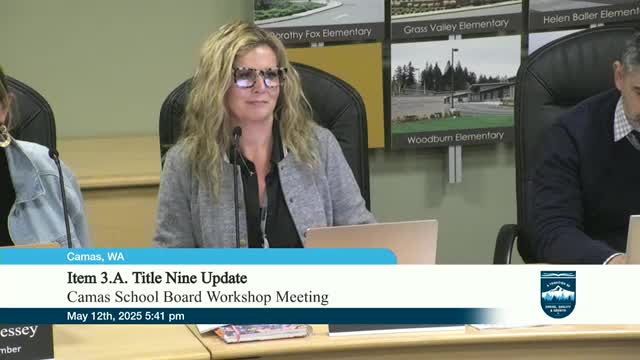
District leaders presented a building‑use plan for the PBL campus consolidation of Odyssey (middle school) and Discovery (high school), described advisory and mentorship programs, and discussed refinements to the CCA online program and relationship with Hayes alternative pathways.
District leaders Dr. Dan (PBL campus lead) and Amy Stewart, PBL/Discovery administrator, told the Camas board at a May 12 workshop that staff have finalized a co‑location plan for the PBL campus and are preparing outreach and advisory groups now that staffing reductions are concluding.
Dr. Dan described a two‑sided building plan: middle school grades (sixth and seventh) will occupy east‑side classroom space and use the East Commons for exhibitions, while high‑school programs will use west‑side spaces and the West Commons. He said eighth grade and high‑school courses will be positioned so eighth graders can access algebra, Spanish and makerspace options normally unavailable elsewhere. The handout and map that Dr. Dan previewed used orange and blue to visually signal the integration of Discovery and Odyssey programs.
Dr. Dan reported strong demand for the newly configured program: he said four grades (sixth, seventh, ninth and tenth) are at or over capacity for next year and that enrollment outreach and tours produced significant interest. “Our enrollment looks to grow by quite a bit on the PBL campus,” he said, and described plans for a month‑by‑month parent and student advisory group and a high‑school mentorship program to promote cross‑age supports.
CCA, Hayes and student voice
Amy Stewart addressed integration of CCA (Canvas/online course academy) and Hayes (the district’s alternative program). Stewart said CCA will move to a quarter system (three classes at a time instead of six) to increase focus and called for stronger expectations of face‑to‑face engagement for students who are struggling. “We had 91 students failed 226 classes in the first semester at CCA this year,” she told the board, and said the district must be intentional about admissions and supports so students in CCA are likely to succeed.
Stewart said instructors will be required to meet directly with students who are falling behind rather than rely on advisor‑only communications; that change is intended to ensure earlier intervention. She also said current CCA teachers will need to be locally accessible (the MOU was changed so teachers must be in‑state) and that the program will be promoted as a flexible “seasonal” option for students who may enroll for a period rather than the entire high‑school term.
Stewart and Dr. Dan said they will relaunch community engagement now that staffing reductions will be finalized, including launching parent and student advisory groups and a mentorship pilot. They said they will maintain transparent communications on a newly updated website and plan summer outreach to fifth‑grade families who may be considering PBL for sixth grade.
Staff and board reaction
Board members praised the planning and emphasized student‑centered decision making. One board member noted the staff’s “intentionality and reflection” over the transition and thanked Dr. Dan and Stewart for keeping students central to decisions. Stewart said she protects student privacy when deciding which student work and presentations to put before the board, and asked that board members consider workshop formats that allow student groups to present their work more personally.
No formal board action was taken; district leaders said they will finalize staffing reductions, launch advisory groups, post a building‑use plan to the PBL site and return with updates.