Get Full Government Meeting Transcripts, Videos, & Alerts Forever!
Get email alerts on the Affordable Housing topic
No spam. Unsubscribe anytime.
Committee approves 15-year PILOT for 94-unit Grand Meridian affordable housing project
Summary
The committee approved a 15-year payment-in-lieu-of-taxes (PILOT) agreement for Grand Meridian LP, a 94-unit affordable housing redevelopment, with a 40-year affordability commitment and supportive services funded in part by the PILOT.
The Metropolitan and Economic Development Committee on Monday approved a 15-year payment-in-lieu-of-taxes (PILOT) agreement for Grand Meridian LP, a TWG Development project that will convert a long-vacant 1951 building at 3470 North Meridian Street into 94 affordable housing units.
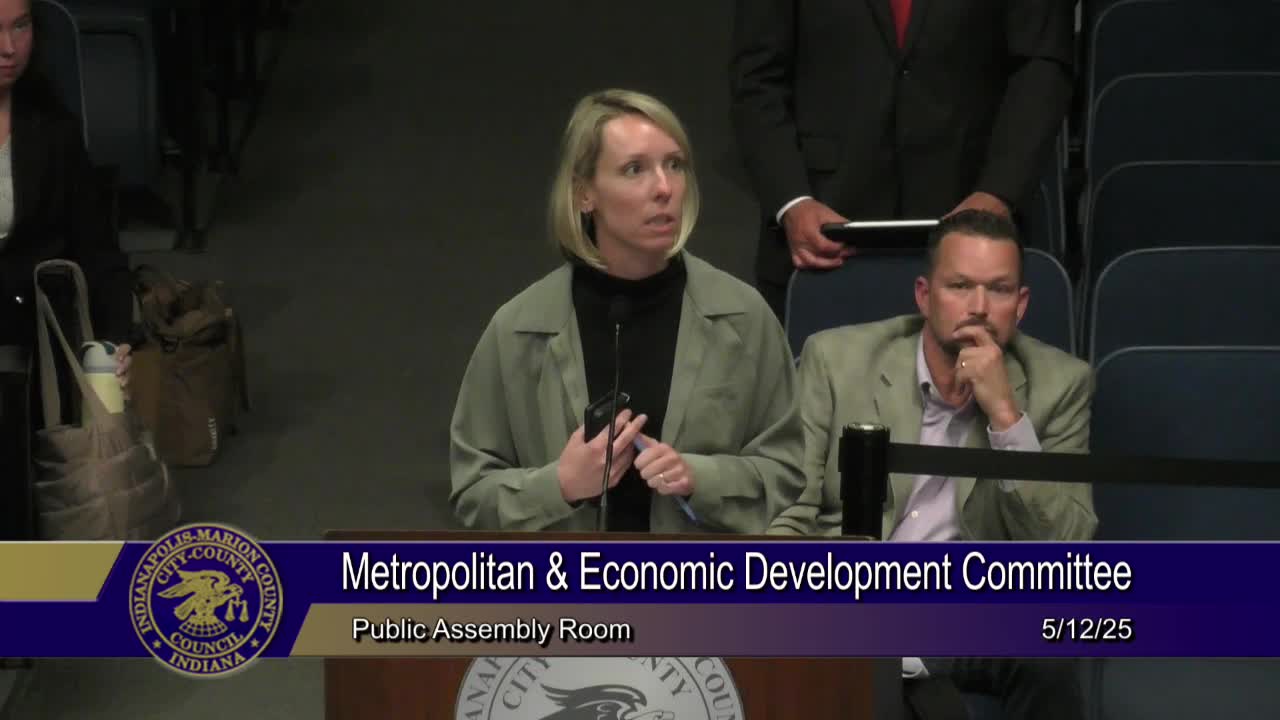
Marissa Knaister, senior development director at TWG Development, presented the Proposal 146 application. She said Grand Meridian will offer units at 30, 50 and 60 percent of area median income, preserve most original unit layouts (with six units repurposed for resident amenities), and include on-site supportive services such as an on-site learning center, fitness space and year-round hydroponic planters.
Knaister said the capital stack includes ARPA funds from the Department of Metropolitan Development used for acquisition, low-income housing tax credits from the Indiana Housing and Community Development Authority, historic tax credits from the National Park Service, financing from the Federal Home Loan Bank of Indianapolis and permanent financing partners.
The developer requested a PILOT to begin in 2027; the PILOT term is 15 years, with an initial annual payment of $10,050 that increases 3 percent annually, the presenter said. TWG committed to maintain affordability for 40 years and to provide a menu of supportive services overseen by a certified provider (Rainbow Housing). TWG also described a community benefits agreement under which services are reviewed periodically (every three to five years) and adjusted based on resident participation.
Scott Frizzell, attorney for the applicant, explained the PILOT structure: the agreement authorizes the property owner to seek a property tax exemption under Indiana Code 6-1.1-10-16.7 and make PILOT payments directly to the city. Frizzell said city estimates indicate full property tax liability for the first year without a PILOT would be approximately $56,000; TWG said the PILOT payment schedule would produce roughly an 80–85 percent tax reduction over the 15-year term compared with full taxes.
Councilors asked whether affordability terms and supportive services depended on the PILOT. Knaister said affordability commitments are tied to low-income housing tax credit requirements and would remain even if the PILOT were not approved; the developer said the PILOT specifically supports the provision of onsite supportive services. Committee members also asked about who would oversee services; the developer said Rainbow Housing would provide oversight and local nonprofits would deliver services.
Proposal 146 passed by voice vote. Committee materials cite Indiana Code 36-3-2-12 in connection with this PILOT request.